Finding Them, Mining Them: Exploration and Mining from Kimberley to the Arctic
Change log: Wave 2 first pass. This module deliberately fuses GIA Assignments 5 and 6 because in Gems & Gemology the exploration story is inseparable from the mine story — most A6 articles are written by the explorers who found the pipes they describe.
The geologist’s question at the counter
“What makes a deposit a deposit?” Nobody asks it in those words, but it is what people mean when they ask “are Canadian diamonds a thing?” or “why are Lesotho stones so expensive per carat?” This module gives you the trade’s own record — four G&G landmark studies — for the answers.

How diamonds are found: a five-step method, with its Canadian proof
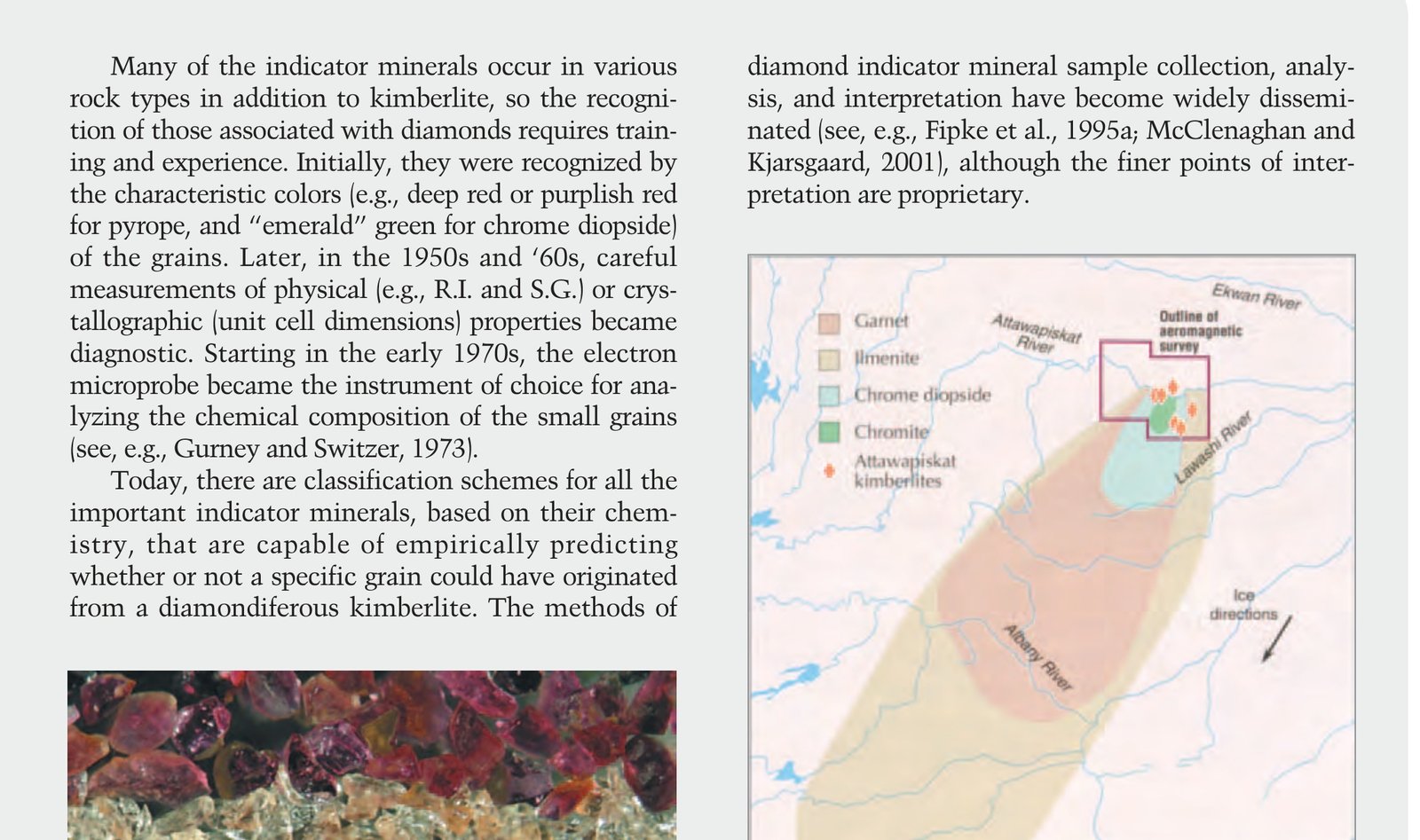
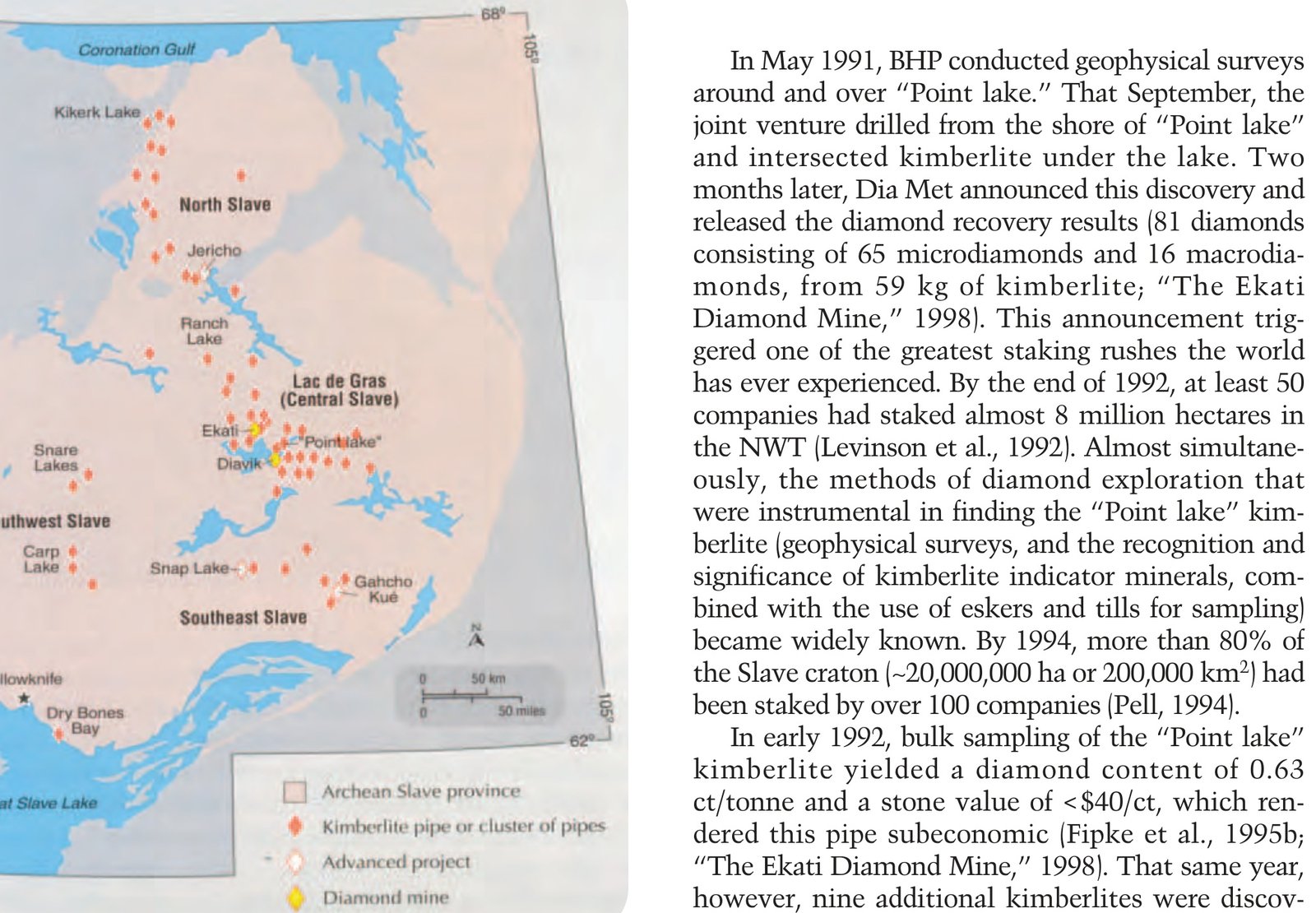
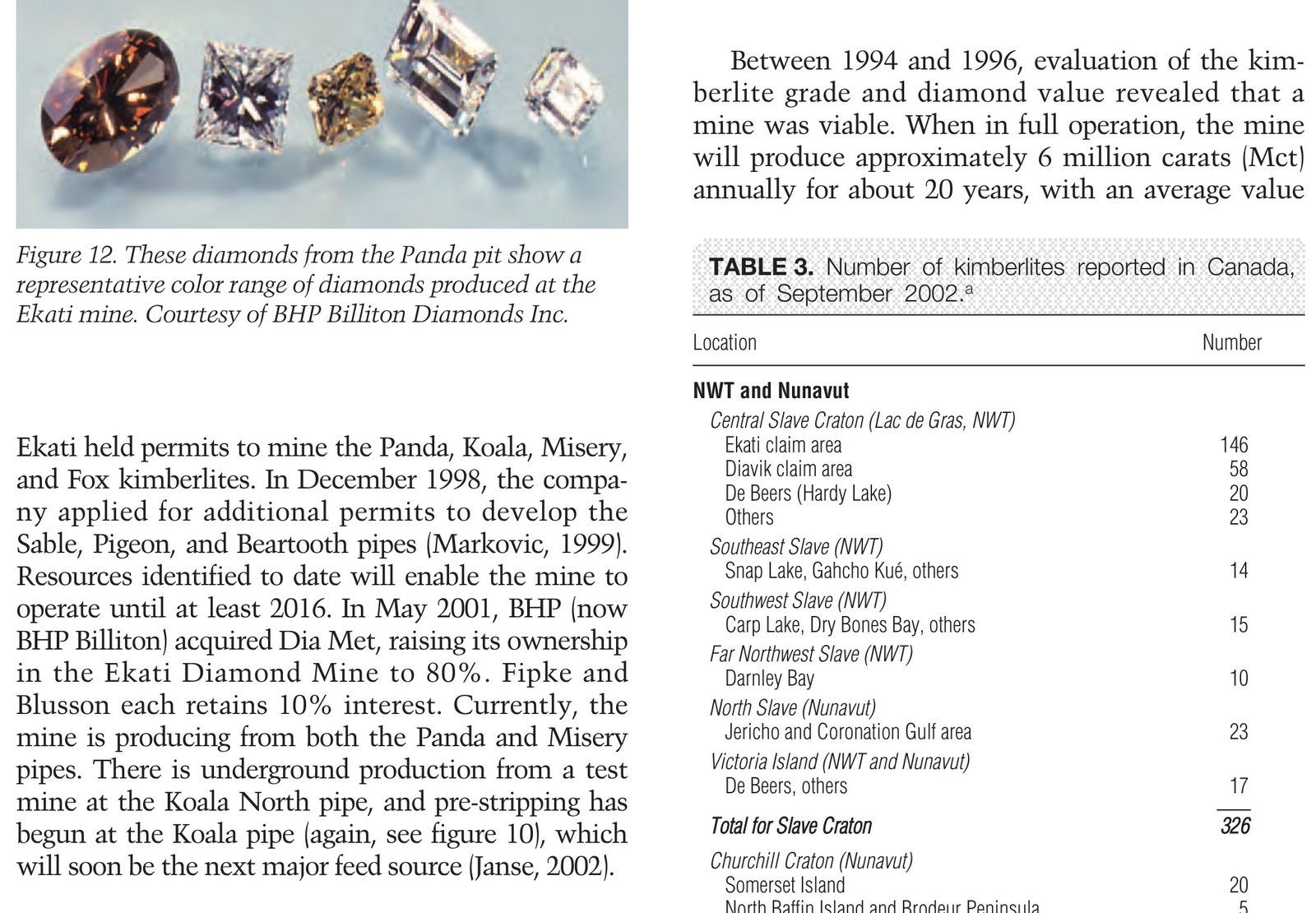
Exploration is one of the most failure-dense businesses on Earth. The method, as Kjarsgaard & Levinson tell it for Canada (G&G Fall 2002, 538 kimberlites reported nationally, “typically small but with high diamond grades”):
- Follow the gravels. Historically: placer diamonds in river beds (South Africa 1867; Brazil 1720s) point upstream toward a source. Garnet-rich “trap” gravels flagged the Kimberley pipes a century before the word “kimberlite” meant anything (Shigley’s historical list).
- Sample for indicator minerals. Modern kimberlite exploration is largely a heavy-mineral hunt through glacial drift: chrome-bearing garnet (G10), chromium diopside, ilmenite, chromite — the fingerprint minerals of diamond-bearing mantle. You rarely sample the pipe directly at first; you find the pipe by finding what it blew out of the keel.
- Fly the magneto/tellurics. Kimberlites are magnetic and conductive against their surroundings; airborne geophysics converts indicator anomalies into drill targets across terrain no prospector could grid.
- Drill, date, decide. A kimberlite is only interesting if it is (a) old enough and (b) erupted fast enough — geophysics says nothing about diamonds; only test panning does.
- Mine economics vs. mine geology. Grade counts as carats per hundred tonnes (cph), and value per carat counts more. A 25 cph pipe of industrial bort and a 5 cph gem pipe are different businesses; a 2 cph pipe of Letšeng-class large gem stones can out-earn both. That value-per-carat discipline is why Janse’s production table (below) ranks countries twice, by weight and by dollars.
Canada’s Slave craton discovery sequence — the 1991 Lake lakathia/Flockton-Breakthrough indicator trail through till, Ekati (1998) and Diavik — is the textbook case of steps 1–4, and it is why, per Kjarsgaard & Levinson, a newcomer since 1998 was already the world’s “seventh most important diamond producer by weight and fifth by value” within four years. The same article documents the deliberate policy response: fledgling cutting/polishing and branding initiatives (CanadaMark — Module 4) in the source country, a move the mid-2000s GNI pieces in the A5 list anticipated as Ekati/Diavik production came online and Alberta’s barren exploration (GNI Summer 1998) demonstrated that “kimberlites found” ≠ “mine” (steps 4–5 failing in real time).
For the classroom, the cautionary pair in the A5 list matters as much as the wins: Vierthaler 1961’s “Wisconsin Diamonds” (quartz — see the G&G 10:7 note in the bibliography) and the Trinity County, California “large diamond” finds (Kopf 1990, G&G 26:3 — real stones, no deposit) teach why a gemologist’s default toward verification — scratch test, spectroscopy, source documentation — is the entire professional discipline in one line. Janse’s methodological confession in A2 (“stories that could not be substantiated were omitted”) is the same instinct at journal scale.
How diamonds are mined: four working styles
| Style | Mechanism | Canonical examples (G&G) | Character of output |
|---|---|---|---|
| Open-pit pipe | Drill-blast-haul on weathered/“blue ground” kimberlite | Premier/Cullinan (open years); Kimberley Big Hole; Orapa, Jwaneng (Botswana’s 1970 start, Janse 2007) | The volume engine of the 20th-century market; everything moves to sorting |
| Underground pipe | Block-cave/shafts beneath exhausted pit or sill barriers | Premier post-sill (550→763→planned 1100 m; Scarratt & Shor 2006); Kimberley deep mines | Rare large stones survive best when the pipe is worked patiently; De Beers stayed under a 70 m sill “because it paid” |
| Alluvial / coastal | Trench, wash plant, marine grab and recovery plant | Brazil Minas Gerais (Lucas 2013 field report), Ghana (Shor 2013: washing tables at Akwatia/Tano-Ofin), Namdeb beach+marine (Kampf 2007; Gurney & Levinson 1991 marine mining) | Ranges from individual artisanal finds (high $/ct, low predictability) to De Beers Marine’s “highest value per carat” sea-floor plants |
| Arctic/lacustrine | Frozen lake beds diked and drained; winter ice roads; summer barge | Diavik (Shigley, Kjarsgaard & McCandless 2016, G&G 52:2); Ekati | Highest engineering-cost per carat; national brand equity in exchange |
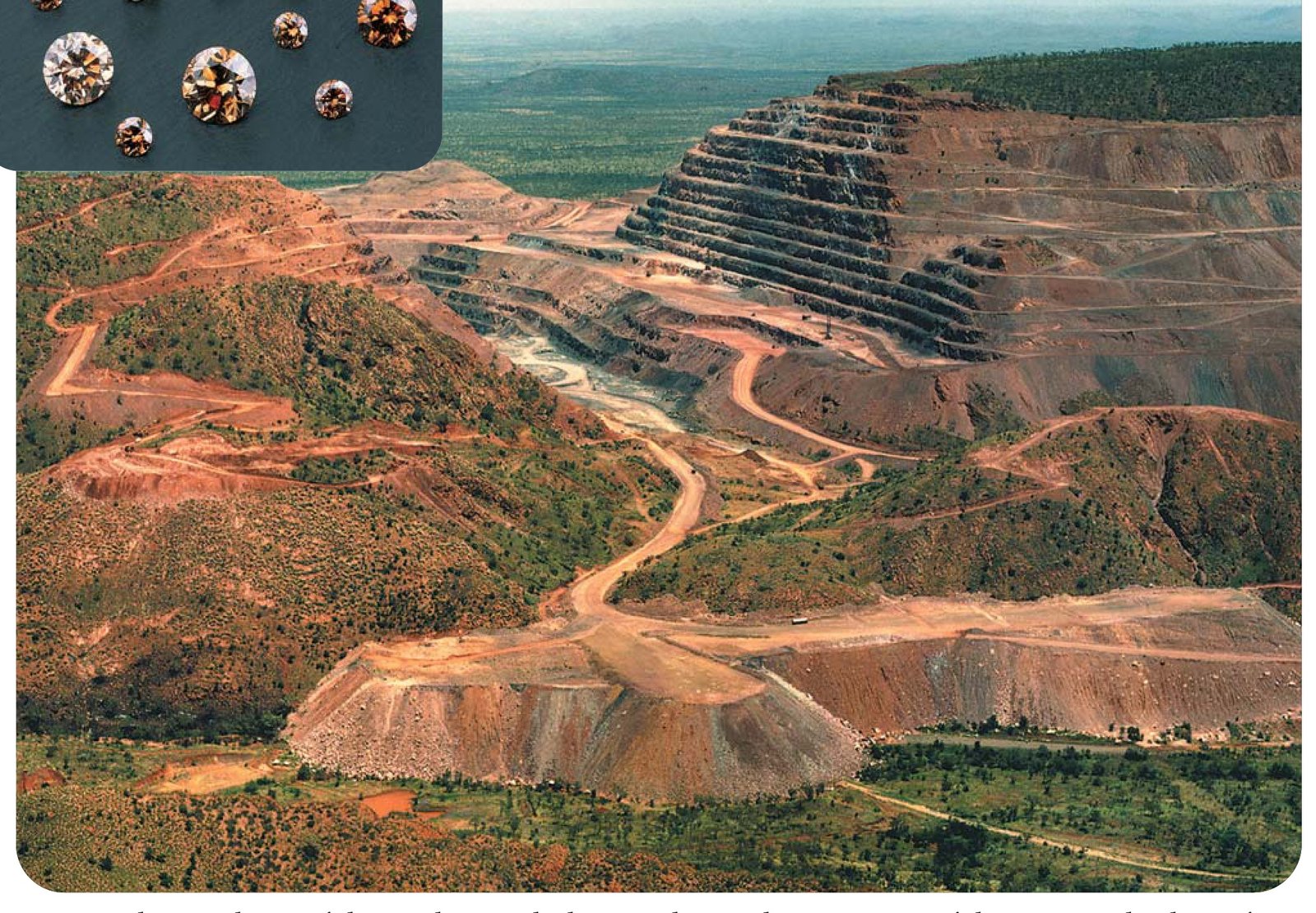
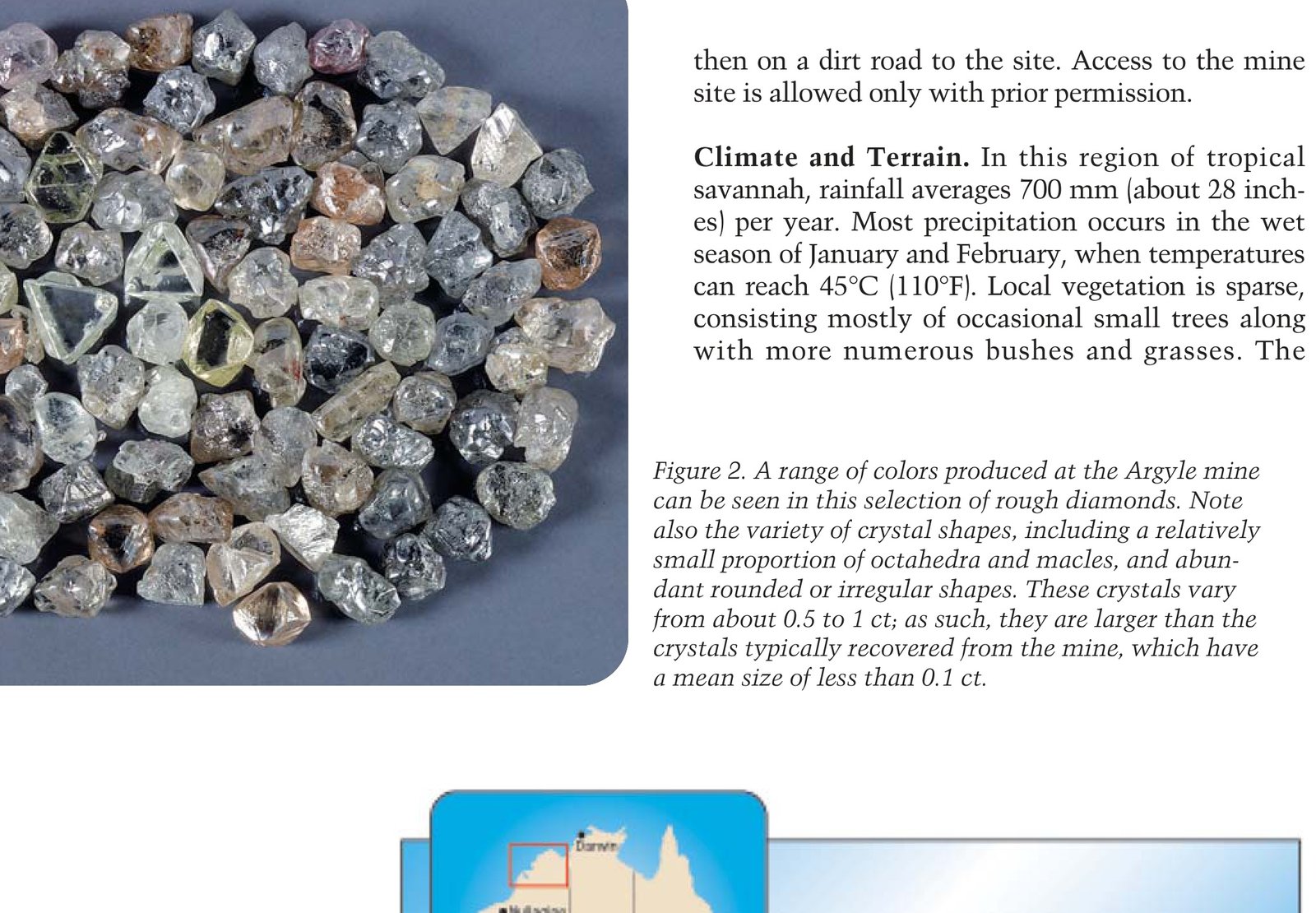
One mine breaks every row — Argyle (Shigley, Chapman & Ellison, G&G Spring 2001): an Australian lamproite, not kimberlite, which “challenged conventional beliefs about diamond geology”; world’s largest by volume, 42+ million carats in peak year 1994 (40% of world production), overwhelmingly small brown-to-yellow goods (feeding the Indian cutting industry — Module 4), plus a “very limited” supply of pink diamonds that made it the most famous name per carat in the world. Argyle’s economics run the opposite direction from Letšeng’s, and both are normal: volume producers sell carats; value producers sell events (Shor’s A6 pair of Letšeng pieces, G&G Fall 2015 and the “Roof of the World” news note, are the trade record of a mine that deliberately sells only large stones and walks away from its small parcels — the anti-Argyle business model).
The production ledger you can quote: Janse 2007
G&G Summer 2007, Global Rough Diamond Production Since 1870 — the macro-chart of this whole bibliography. Its headline figures, verbatim from the abstract, are the safest statistics in the course because they are one author’s compiled life’s work, published in GIA’s journal:
- Antiquity → 2005: ~4.5 billion carats of diamond ever mined, worth ~US$300 billion, average $67/ct.
- 1870–2005 cumulative: South Africa #1 in value (long history), #4 by carats; Botswana #2 in value with a history “dating only from 1970” (Orapa 1971 start — the G&G abstract’s date), #5 by weight.
- 2001–2005 window: ~840 million carats/5 years, $55B, average $65/ct; Russia (USSR successor) #1 by weight, Botswana #1 by value, Australia #2 by weight.
- Structural narrative: Africa dominant until mid-20th century (Janse 1995: southern Africa >98% 1889–1959); Soviet (1960s), then Australian (1983), then Canadian (1998) sources break the monopoly — and each arrival re-shaped the distribution system (Module 4).
Read those rankings as a law for retail training: the source-country mix is never fixed; the grading vocabulary is. Producers rise and fall; Jwaneng’s parcels and Diavik’s parcels both end up on certificates using D-to-Z because GIA’s system (Module 1, 9) is source-blind. That is the unglamorous genius of the standardization story.
Marine mining, the detail most courses skip
Gurney & Levinson (G&G Winter 1991) on De Beers Marine off Namibia: at that time, the sea-floor concessions produced the highest $/ct of any producer, because wave sorting concentrated gem-grade stones in gravels and the recovery plants could stop on encounter rates. The A6 list’s Namdeb updates (Kampf 2007; plus Taylor 2006 on Sierra Leone’s post-conflict trading house) are worth reading when discussing origin credibility with estate pieces: Namibian stones historically came through the same London sorting rooms as everything else (the DTC mixing story, Module 4).
What a professional takes from this module
- Grade is not just the stone; it’s the parcel. The mine’s size distribution (Letšeng vs Argyle vs Diavik) predetermines how many of each clarity/color combination can exist per year. This is the honest, non-spammy way to talk about “rarity” that Module 2 already prepared.
- Every source has a second story. Diamonds are the only commodity where traceability is a live technology question (Module 11’s screening instruments; CanadaMark; KP) rather than a paperwork one.
- Exploration failure is the norm, not a scandal — which is the correct frame for any future mine announcement a client has read about in the press: “kimberlite found” is step 3 of 5.
Self-check
- Name the four indicator minerals and what they’re searched for in.
- Why can geophysics alone never prove a pipe economic?
- What did Argyle break, geologically, commercially, and in what direction did each cut prices?
- Janse 2007: total carats ever mined, total value, Botswana’s two rankings vs its 1970 start.
- Why is value-per-carat the correct lens for Letšeng/Namdeb and volume-per-tonne for Argyle?
- Give one “failure” article from the A5 list and the professional habit it teaches.
- State one thing you will not claim about origin from a polished stone, and why.
Further reading (A5 + A6)
Full annotated list in `references/annotated-bibliography.md`. Highest priority after the four digests here: Janse 1995/1996 (both parts); Shigley et al. 2016 Diavik article; Svisero et al. 2017 (Brazil); Shor & Smit 2016 (Lomonosov’s fancy-color strategy); Levinson et al. 1992; and for the 1960s context the Draper/Polutoff/Hannafold legacy issues via the GIA library.
Counter Simulation: Finding Them, Mining Them — Exploration to Mine Gate
3 Scenarios • Mining Realities
Dismissing ethical inquiries with a defensive “All our diamonds are ethical, we don’t sell blood diamonds.”
“Responsible sourcing is foundational to luxury fine jewelry. For example, our Canadian diamonds originate from mines like Diavik in the Northwest Territories, operating under strict environmental covenants that protect Arctic tundra, preserve indigenous wildlife corridors, and recycle nearly 100% of camp water. Each stone carries an audited chain-of-custody guarantee from the sub-zero permafrost directly to our showroom velvet pad.”
Saying “Diamonds are expensive because mining companies control the market and store vaults of gems.”
“To recover a single one-carat polished gem of gem quality, miners must blast, crush, and process approximately 250 tons of hard rock kimberlite. Out of millions of carats mined annually across the globe, less than 20% possess the optical transparency and colorlessness required for fine jewelry. When you consider the vast exploration, engineering, and sorting required to extract this single gem, its rarity becomes breathtaking.”
Claiming alluvial diamonds are inferior or uncertified compared to pipe-mined stones.
“Hard-rock kimberlite mining extracts rough crystals directly from the volcanic pipe, while alluvial mining recovers diamonds that were eroded out of pipes over millions of years and tumbled down ancient riverbeds. In fact, alluvial tumbling acts as nature’s violent tumbler: only the toughest, cleanest crystals survive the river journey without fracturing. Both origins produce world-class GIA-certified gems, but alluvial diamonds carry a poetic tale of oceanic and river voyage.”
🔬 Scientific Detail: Exploration Geochemistry & Indicator Mineral Suites
Kimberlite Indicator Minerals (KIMs) & Geochemical Fingerprinting
Because diamonds represent less than one part in twenty million within a kimberlite pipe, diamond exploration relies heavily on resistant Kimberlite Indicator Minerals (KIMs) dispersed by glacial and alluvial weathering:
| Indicator Mineral | Chemical Formula | Diagnostic Chemistry & Significance |
|---|---|---|
| G10 Pyrope Garnet | $\text{Mg}_3\text{Al}_2(\text{SiO}_4)_3$ | High $\text{Cr}_2\text{O}_3$ (>4 wt%) and low $\text{CaO}$ (<4 wt%); confirms sub-calcic harzburgitic mantle source inside diamond stability field. |
| Picroilmenite | $(\text{Fe},\text{Mg})\text{TiO}_3$ | High $\text{MgO}$ (8–16 wt%) and low $\text{Fe}^{3+}/\text{Fe}^{2+}$ ratio; indicates low oxygen fugacity preserving diamonds from oxidation. |
| Chromian Diopside | $\text{CaMgSi}_2\text{O}_6 + \text{Cr}^{3+}$ | Vibrant emerald-green clinopyroxene; high chrome (>0.5 wt%) and sodium, indicating extreme mantle pressures. |
| Chromite | $\text{FeCr}_2\text{O}_4$ | Extremely high $\text{Cr}_2\text{O}_3$ (>60 wt%) and high $\text{Mg}/(\text{Mg}+\text{Fe}^{2+})$; diagnostic diamond-inclusion affinity. |
📚 Research References
- Gurney, J.J. (1984). “A Correlation Between Kimberlitic Garnet Compositions and Diamond Content.” Kimberlites: Occurrence and Origins, 11A, 143–149.
- Dawson, J.B. & Stephens, W.E. (1975). “Statistical Classification of Kimberlitic Garnets.” The Journal of Geology, 83(5), 589–607. DOI: 10.1086/628143
- Janse, A.J.A. (2007). “Global Rough Diamond Production: A History.” Gems & Gemology, 43(2), 98–119. DOI: 10.5741/gems.43.2.98
Exploration Chemistry: Geochemical suites and indicator thresholds indexed via OpenAlex and Canadian Mineralogist archives.