Fluorescence, Inclusions and “Is This a Flaw?”
The word on the report that scares clients for no reason
“I read online that fluorescence makes diamonds look cloudy and milky. Should I avoid this stone?”
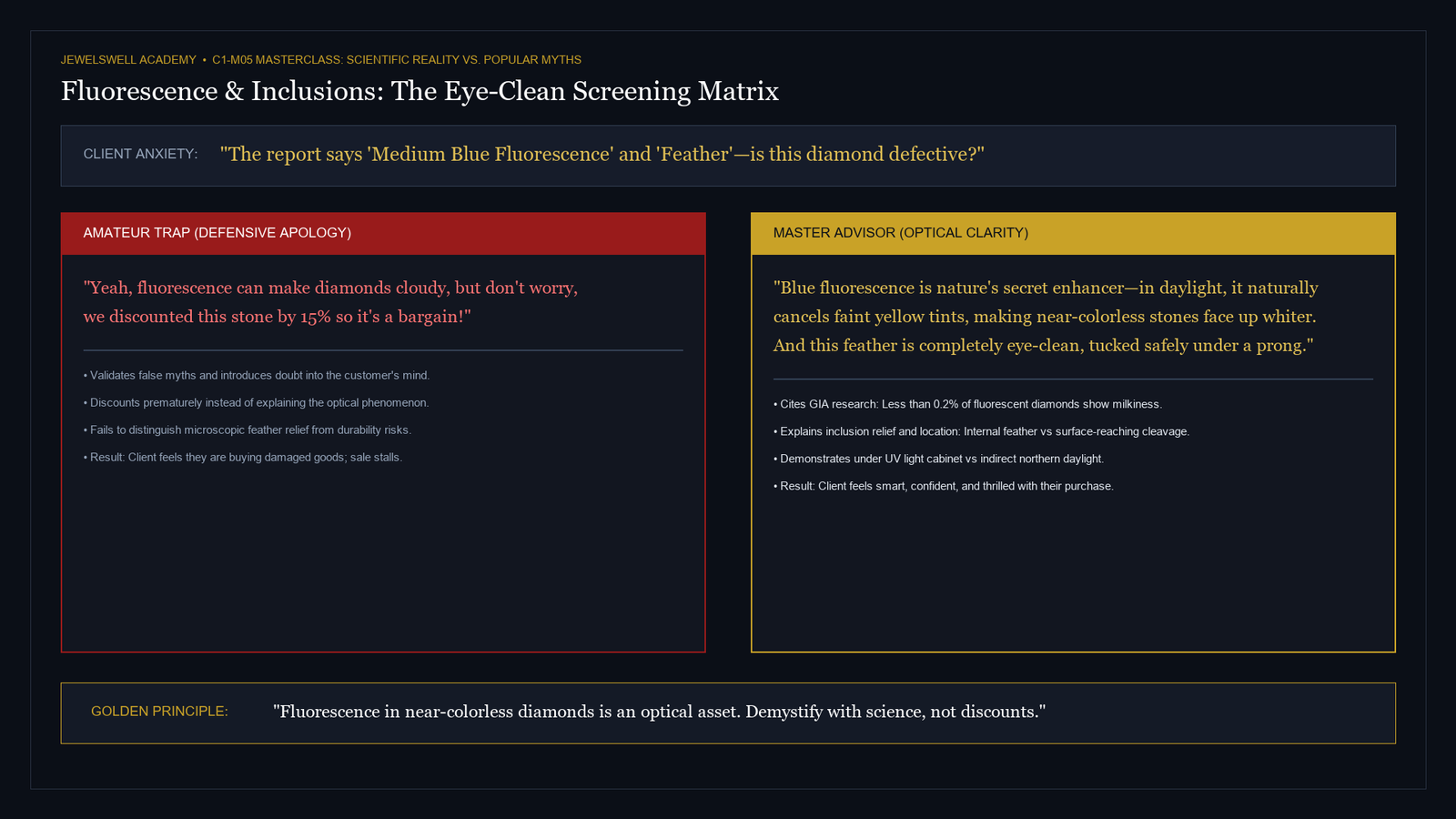
“That is one of the most common internet myths, and I’m so glad you brought it up. Let’s look at what GIA’s extensive optical research actually proved: fewer than two in a thousand fluorescent diamonds ever display any haziness — and haziness is caused by internal clouds, never by fluorescence itself. In fact, in natural sunlight, this blue fluorescence actually flatters a near-colorless stone by neutralizing faint warmth. Let me show you both under the UV light and in daylight so your own eyes can verify its crisp brilliance.”
A client reads her own GIA report on her phone before coming in, sees “Fluorescence: Strong Blue” listed, searches the term, and arrives convinced she bought a defective stone. She wants a refund. You could argue with her, or you could show her what GIA’s own research actually found. This module gives you that research, plus the physical explanation behind it, plus the language to use it on the floor before a client ever gets to the point of asking for a refund.
Why this matters
Fluorescence and inclusions are two of the most misunderstood terms on a diamond report, and both get treated as red flags by clients who have absorbed partial or outdated information online. An associate who can correct these misconceptions with confidence, and explain not just what fluorescence is but why it happens at all, protects a sale that a less-informed associate would lose to an unnecessary panic. This directly affects your close rate on diamond inquiries, since both fluorescence and inclusion questions come up constantly in report-reading conversations covered in Module 2.
What fluorescence actually is
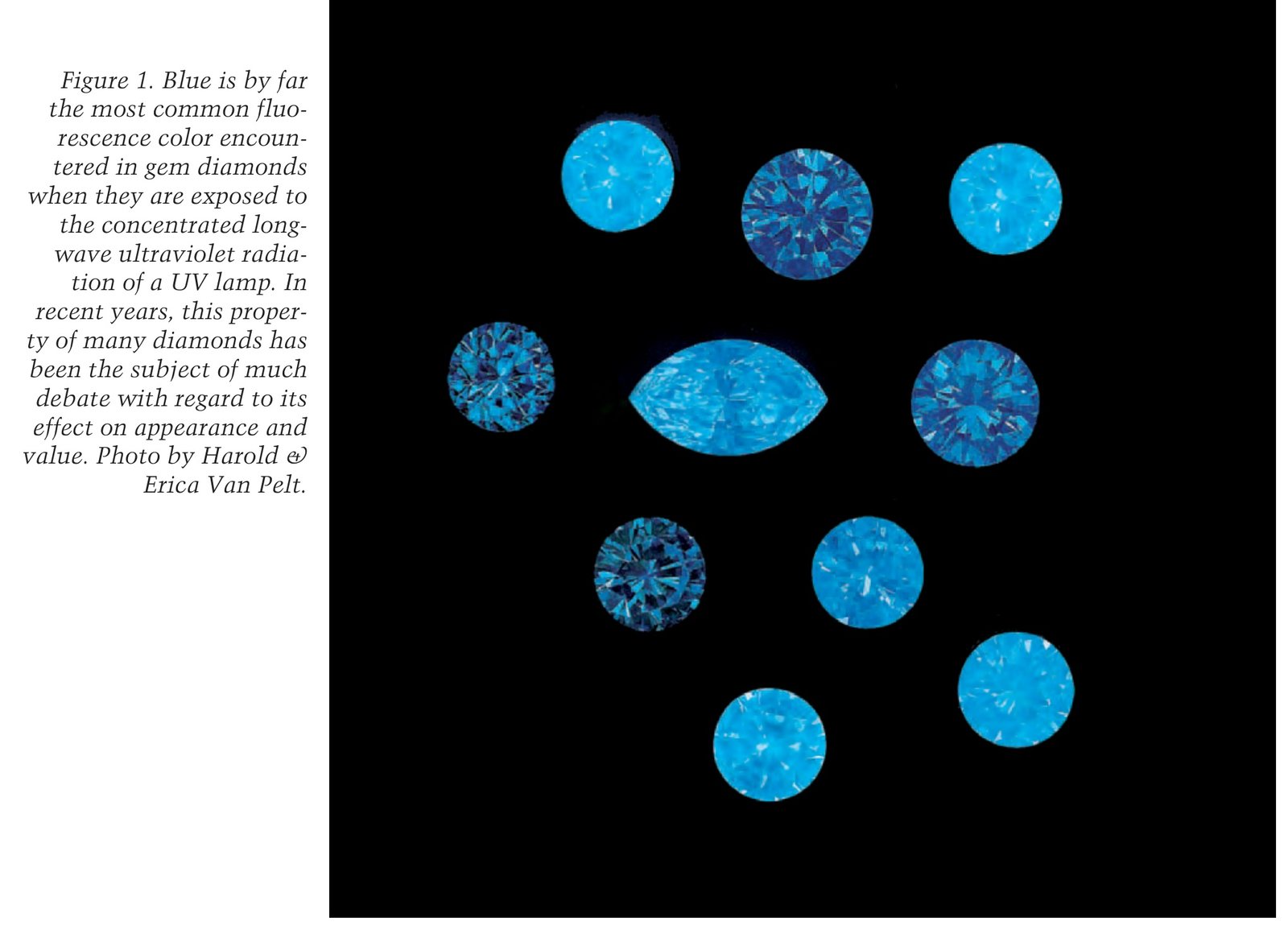

Fluorescence is the visible light some diamonds emit when exposed to ultraviolet light, such as sunlight. GIA diamond grading reports describe fluorescence intensity as None, Faint, Medium, Strong, or Very Strong, and if the intensity is Medium, Strong, or Very Strong, the report also names the fluorescence color, which can be blue, yellow, orange, orangy yellow, red, white, or green.
The single most important framing point: fluorescence is not one of the 4Cs. GIA treats it as an identifying characteristic, additional information that helps distinguish one diamond from another, not a quality factor like color, clarity, cut, or carat weight. Roughly a quarter to a third of diamonds submitted to GIA exhibit some level of fluorescence, so it is common, not rare or alarming.
MEDIA link-out C1-M05-D1 “Fact Checking Diamond Fluorescence: 11 Myths Dispelled” by GIA (official blog)
Why here: GIA’s own myth-by-myth correction of the most common fluorescence misconceptions, including the claim that fluorescence affects color grading or indicates a defect.
Source: https://4cs.gia.edu/en-us/blog/fact-checking-diamond-fluorescence-myths-dispelled/
Use: link-out
Read Myth #4 and Myth #7 on that page closely before your next fluorescence conversation. They are the two claims clients repeat most often, and GIA addresses both directly with its own research.
Why fluorescence happens: the physical cause
Being able to explain what actually causes fluorescence, not just that it exists, is what separates a confident answer from a memorized one. Fluorescence in diamonds is caused by microscopic structural defects in the crystal lattice, specifically trace impurities that became trapped in the carbon structure as the diamond formed. Diamond is pure carbon, but nearly all natural diamonds contain trace amounts of nitrogen, and it is nitrogen-related defects, not the diamond itself, that cause the vast majority of fluorescence.
The specific defect responsible for blue fluorescence, by far the most common color, is called the N3 center, a group of three nitrogen atoms surrounding a single vacancy (a missing carbon atom) in the crystal lattice. According to GIA’s own peer-reviewed research published in its Gems & Gemology journal, this defect produces a characteristic emission with a peak in the blue part of the visible spectrum, and it is responsible for blue fluorescence in the overwhelming majority of fluorescent diamonds, historically cited at somewhere around 95 to 97 percent of all fluorescent stones. When ultraviolet light strikes a diamond containing this defect, it excites electrons around the nitrogen-vacancy structure, which then release that absorbed energy as visible blue light.
Client: “Why does this even happen? It seems strange that a diamond would glow.”
Associate: “It comes down to microscopic trace elements trapped in the diamond as it formed, mostly nitrogen. There’s a specific structure, three nitrogen atoms around a tiny gap in the crystal, that reacts to UV light by giving off a blue glow. It’s a genuine physical property of the stone, not anything artificial or added later.”
Fluorescence color distribution: blue dominates, other colors are rare
Blue fluorescence accounts for the vast majority of all fluorescent diamonds, but a small percentage show other colors, each caused by a different trace element or defect combination.
| Fluorescence color | Approximate rarity among fluorescent diamonds | Underlying cause |
|---|---|---|
| Blue | Vast majority (historically cited around 95-97%) | N3 defect (three nitrogen atoms around a vacancy) |
| Yellow or green | Uncommon | Different nitrogen-related defect combinations |
| White | Rare | Combination of blue and yellow emission appearing together |
| Orange or red | Very rare | Distinct, less common defect structures |
Yellow or orangy fluorescence is worth flagging specifically to a client, since unlike blue fluorescence (which can sometimes visually offset a warmer body color), a yellow or orange fluorescence tends to intensify a diamond’s existing body color rather than counteract it, and many jewelers recommend caution with this combination unless the client is specifically buying a fancy-color stone in a matching hue.
Does fluorescence affect color or value?

GIA grades color in a controlled viewing environment specifically designed to minimize fluorescence’s influence on the color grade itself, so the number on the report is not distorted by it. But under normal viewing conditions, especially in daylight or other UV-rich lighting, moderate-to-strong blue fluorescence can make a diamond with a lower color grade (in the I-to-N range with a yellow tint) appear whiter than its grade would suggest, because the blue fluorescence visually cancels out some of the yellow. GIA’s own studies found that strongly blue fluorescent diamonds were sometimes perceived as having better color appearance than their grade indicated when viewed face-up.
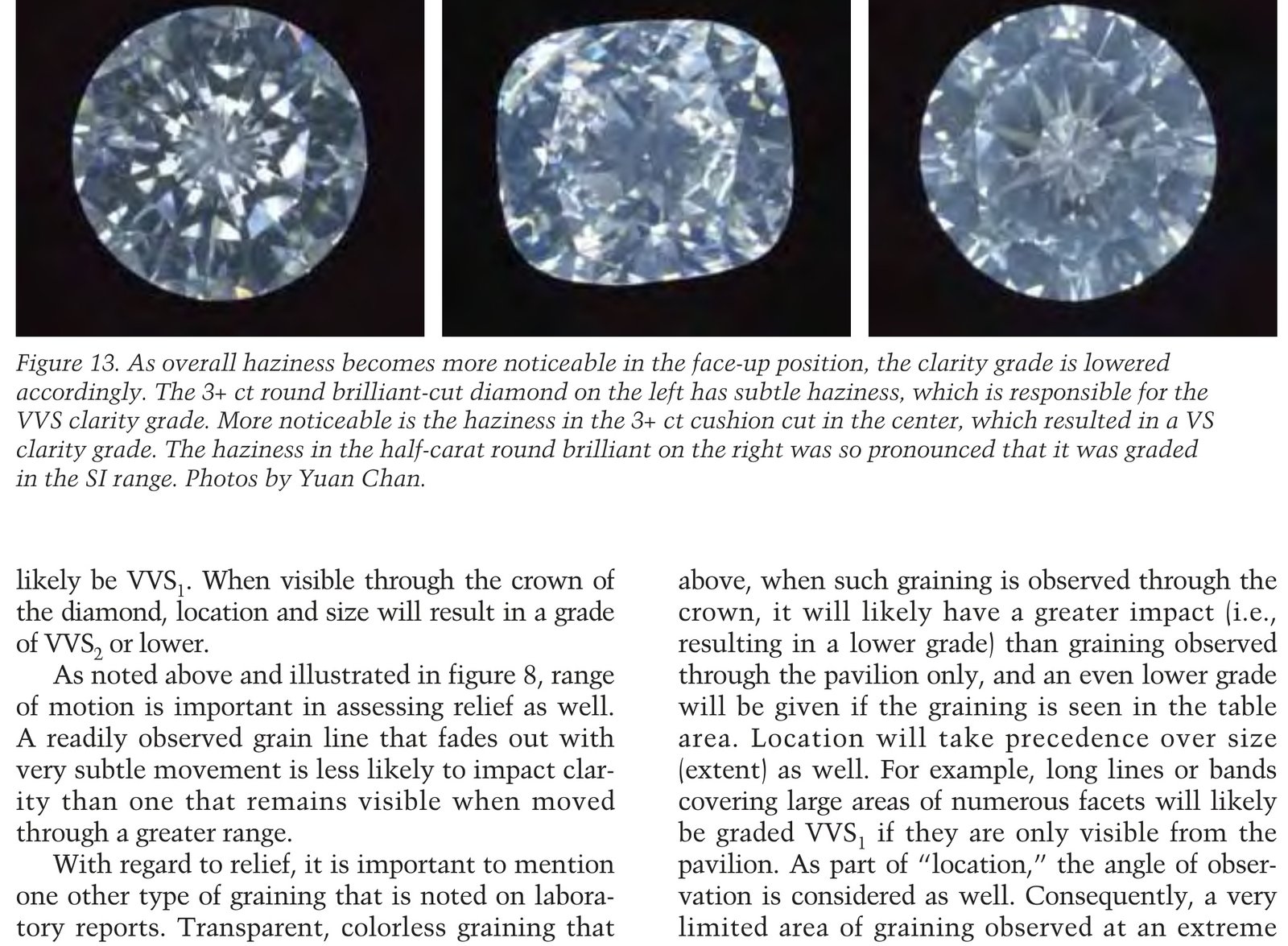
The negative version of this effect, where strong fluorescence makes a diamond look hazy, oily, or milky, is real but rare: GIA found this appearance in fewer than 0.2 percent of the fluorescent diamonds submitted to its labs. For the overwhelming majority of diamonds, fluorescence has no visible effect on appearance at all, and it never affects the physical structure or durability of the stone.
Client: “The report says Strong Blue fluorescence. Is something wrong with this diamond?”
Associate: “No, fluorescence is just how the diamond reacts to UV light. It’s on the report as an identifying trait, not a quality problem. In fact, in a diamond like this one, strong blue fluorescence can sometimes make the color look a little whiter in daylight than the color grade alone would suggest. GIA has studied this closely, and the appearance issue people worry about only shows up in a tiny fraction of stones. Let’s look at it under normal light together.”
Fluorescence versus phosphorescence: a genuinely different phenomenon
Clients occasionally confuse fluorescence with a related but distinct phenomenon called phosphorescence, sometimes after reading about “glow in the dark” diamonds online. Understanding the difference, and being able to explain it clearly, resolves a specific category of confusion this module’s original draft did not address.
| Property | Fluorescence | Phosphorescence |
|---|---|---|
| When the glow appears | Only during exposure to UV light | Continues after the UV light source is removed, an “afterglow” |
| Duration | Stops immediately when the light source is removed | Can persist for several seconds up to several minutes |
| How commonly seen | Roughly 25-35% of diamonds | Less than 1% of diamonds |
| Primary cause | Nitrogen-related defects, especially the N3 center (blue) | Commonly associated with boron, particularly in Type IIb diamonds |
| Listed on GIA reports? | Yes, graded and listed (None to Very Strong, with color) | Not measured or listed on standard grading reports |
| Notable connection | N/A | More commonly observed in certain lab-grown diamonds produced via the HPHT method, making it occasionally useful as one signal (never a sole proof) in origin investigation |
Client: “I read about diamonds that glow in the dark after you take them out of sunlight. Is that the same as fluorescence?”
Associate: “That’s actually a different, rarer phenomenon called phosphorescence, an afterglow that continues briefly once the UV light is removed. Fluorescence, which is what’s on your report, only glows while the UV light is actually hitting the stone, and stops the instant it’s removed. Less than one percent of diamonds show phosphorescence at all, and it isn’t something GIA grades or lists on a standard report the way fluorescence is.”
Do not present phosphorescence as a reliable, sole method of proving a diamond is lab-grown; it is one data point gemologists may consider alongside other tests, not a definitive counter test on its own, and this distinction matters for staying consistent with Module 4’s guidance that no single visual or light-based test alone reliably determines origin.
What fluorescence cannot tell you
Do not treat fluorescence as a shortcut for anything it does not measure. It is not a reliable way to distinguish a natural diamond from a lab-grown one at the counter on its own: lab-grown diamonds can fluoresce, and natural diamonds can be completely inert, so labs use multiple scientific methods to determine origin rather than fluorescence (or phosphorescence) alone. If a client raises a fluorescence-based origin test they read about online, correct it plainly rather than letting the myth stand.
MEDIA link-out C1-M05-D2 “Understanding Diamond Fluorescence” by GIA (official 4Cs blog)
Why here: GIA’s detailed technical explanation of what causes fluorescence and how it interacts with color perception under UV-rich lighting.
Source: https://4cs.gia.edu/en-us/blog/understanding-diamond-fluorescence/
Use: link-out
This is the page to send a skeptical client to if they want to read the primary research themselves rather than take your word for it. Directing someone to the source builds more trust than any script.
A quick-reference table for common inclusion types
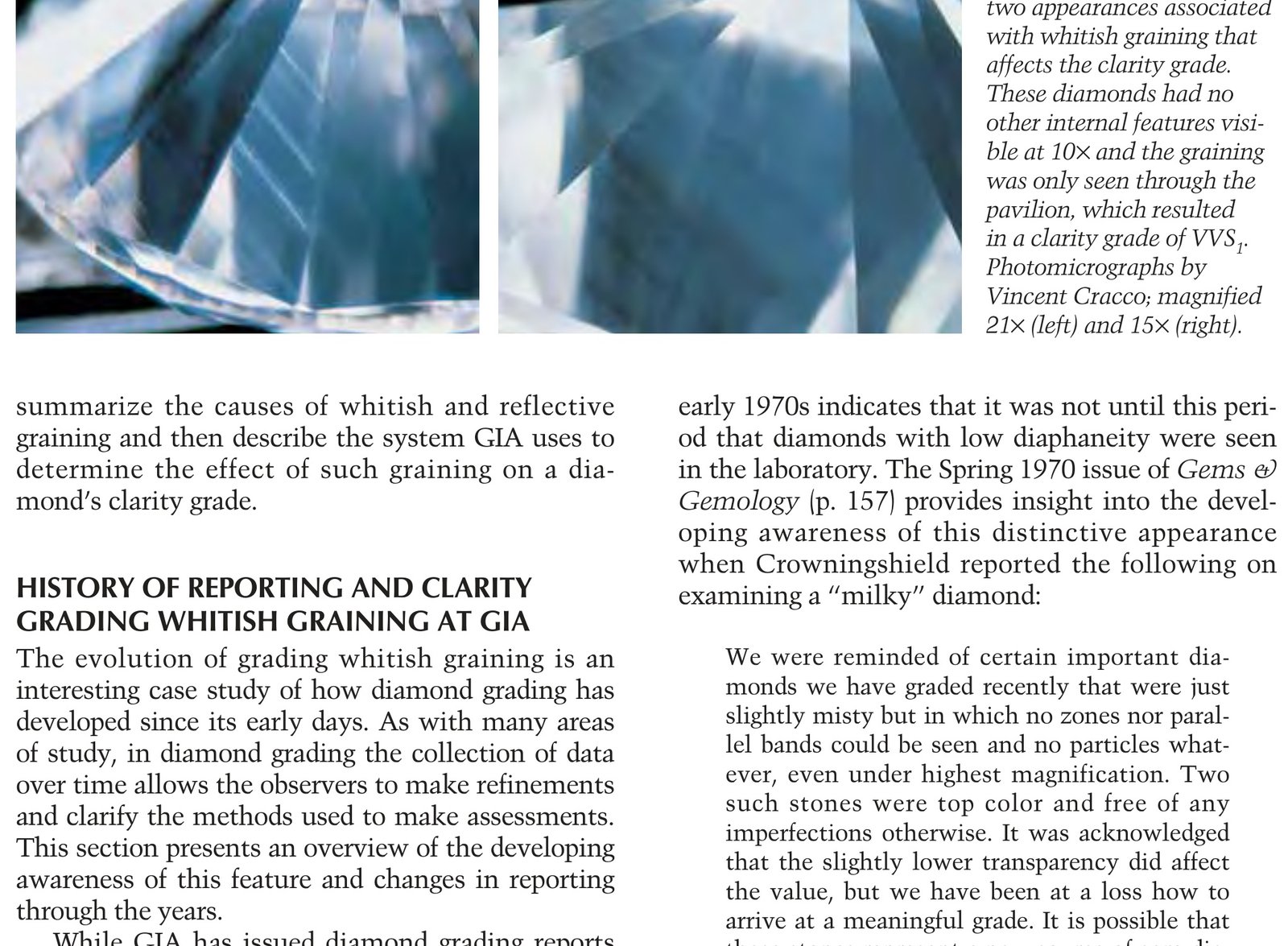
Being able to name what a client sees under the loupe, quickly and without hedging, is what separates a confident report reading from an awkward one. These are the inclusion types you will encounter most often on the sales floor.
| Inclusion type | What it looks like | Talking point |
|---|---|---|
| Feather | A thin, often whitish internal fracture | Usually stable and does not affect durability at typical clarity grades; part of the stone’s individual identity |
| Crystal | A small mineral crystal trapped during formation | Direct evidence the stone formed naturally over geologic time |
| Cloud | A hazy cluster of tiny pinpoints | Common and usually invisible face-up at grades typically sold in stores |
| Pinpoint | A single tiny crystal, visible only under magnification | The most minor and common inclusion type at higher clarity grades |
| Needle | A thin, elongated crystal | Distinct linear feature, often used as an identifying mark on the plot |
| Internal graining | Faint lines from irregular crystal growth | A growth feature, not damage, and generally has no effect on durability |
Knowing these six by sight, and being able to point to one under the loupe and name it correctly, turns “there’s something in there” into “that’s a feather, and here’s what it tells us about how this stone formed.”
Inclusions, revisited: what makes one worth pointing out
Module 1 introduced inclusions as birthmarks rather than defects and covered the five clarity-grading factors. This module goes one step further: knowing which inclusions are worth actively pointing out to a client, and which are better left to the report.
An inclusion becomes a talking point, not a liability, when it does three things: it is invisible or nearly invisible face-up, it is identifiable under a loupe so you can show the client something real, and it demonstrates that the stone is a natural diamond rather than a synthetic or simulant, since natural inclusions are part of what distinguishes a mined stone’s formation history. Turning the conversation toward “this is what makes your diamond unique and identifiable” reframes an inclusion as evidence of authenticity rather than something to apologize for.
The reframe in practice
Client, looking through the loupe for the first time: “I can see something in there. Is that bad?”
Associate: “That’s an inclusion, a tiny natural feature that formed with the diamond. It’s part of what makes this specific stone identifiable as this stone, the same way a fingerprint is unique. It’s already factored into the clarity grade on the report, and at this grade, it’s not something you’ll see with the naked eye once it’s on your hand.”
Regional variation: fluorescence preference by market
Client preference around fluorescence is not uniform globally, and knowing this can help you calibrate how much reassurance a given client needs.
- United States: US buyers researching online frequently encounter forum discussions treating fluorescence negatively, so US associates should expect to do more active myth-correction than in other markets.
- United Kingdom and Europe: Similar research patterns exist, though UK trade culture places somewhat more trust in third-party lab documentation generally, which can make the reframe conversation slightly easier.
- India and the Gulf: Fluorescence is less commonly a point of client concern in markets where gold and karat purity dominate the buying conversation (Module 8), though bridal diamond buyers in these markets increasingly research online the same way US buyers do.
- Cruise and travel retail: Compressed-time selling means a full myth-correction conversation may not fit; a short, confident one-line reassurance (“fluorescence doesn’t affect the diamond’s structure or durability, it’s just an identifying trait”) is usually sufficient unless the client asks for more.
On the floor: applying it this week
- Monday: Read GIA’s fluorescence myths page in full and note which myth you have heard from a client before.
- Tuesday: Pull one stone from your case with Medium, Strong, or Very Strong fluorescence and view it under a UV source if available, then in normal light, and note what you actually see.
- Wednesday: Practice the fluorescence reframe script with a colleague until it sounds conversational, not defensive. Also practice explaining the N3 defect in one sentence.
- Thursday: Practice the inclusion reframe script with a different stone, pointing out one specific inclusion type under the loupe.
- Friday: Write down one client question about fluorescence, phosphorescence, or inclusions that you were not fully confident answering, and research it before your next shift.
Objections, mistakes and edge cases
| Situation | The trap | Better move |
|---|---|---|
| Client thinks Strong fluorescence means low quality | Agreeing or staying silent | Explain that fluorescence is not one of the 4Cs, and that its main effect (when there is one) is often a positive appearance benefit, not a defect. |
| Client cites a fluorescence-based test for lab-grown vs. natural | Reinforcing the myth | State plainly that fluorescence is not a reliable natural-versus-lab-grown test and that labs use other methods. |
| Client worried an inclusion will “get worse” | Guessing | Inclusions do not grow or change over time; they were part of the stone’s formation and are permanent features, not active damage. |
| Client wants a fluorescence-free stone specifically | Assuming this is always better | None fluorescence is a valid preference but is not inherently higher quality; it is simply a different, less common characteristic. |
| Client asks if a haze they see is from fluorescence | Guessing without inspection | Fewer than 0.2 percent of fluorescent diamonds show a hazy appearance; if a stone looks hazy, involve your manager rather than attributing it to fluorescence by default. |
| Client asks why fluorescence happens at all | Saying “it just does” | Explain the N3 defect briefly: trace nitrogen atoms trapped in the crystal structure react to UV light. |
| Client confuses fluorescence with phosphorescence | Not correcting the distinction | Explain that phosphorescence is a separate, much rarer afterglow phenomenon that persists after the UV light is removed, unlike fluorescence. |
| Client has a yellow or orange fluorescent stone | Not mentioning the color-intensifying effect | Explain that unlike blue, warm-colored fluorescence tends to intensify body color rather than offset it, and discuss whether that fits the client’s stone. |
| Client asks if phosphorescence proves a stone is lab-grown | Overstating this as a definitive test | Explain it is one data point among several a lab might consider, not a standalone proof of origin. |
Self-check
- Can you name the five fluorescence intensity grades GIA uses?
- Can you explain why fluorescence is not one of the 4Cs?
- Can you explain, with GIA’s own research, how blue fluorescence can sometimes improve perceived color?
- Do you know the approximate rate of diamonds submitted to GIA that show negative haziness from fluorescence?
- Can you explain why fluorescence is not a reliable natural-versus-lab-grown test?
- Can you reframe an inclusion as an identifying feature rather than a flaw, using the loupe?
- Can you explain why inclusions do not change or worsen over time?
- Can you explain, in one sentence, the physical cause of blue fluorescence (the N3 defect)?
- Can you state the approximate percentage of fluorescent diamonds that fluoresce blue versus other colors?
- Can you explain the key difference between fluorescence and phosphorescence?
- Can you explain why phosphorescence is sometimes associated with certain lab-grown diamonds, without overstating it as a definitive test?
- Can you explain why yellow or orange fluorescence behaves differently from blue fluorescence with respect to body color?
- Can you adjust how much fluorescence explanation you give based on a compressed-time selling environment?
If you missed more than three, revisit the GIA fluorescence myths page before your next report-reading conversation.
Go deeper
- Fact Checking Diamond Fluorescence: 11 Myths Dispelled (4cs.gia.edu) – GIA’s own myth-by-myth research summary; the primary reference for this module. 20 minutes.
- Understanding Diamond Fluorescence (4cs.gia.edu) – GIA’s technical explanation of causes and color-interaction effects. 15 minutes.
- GIA Gems & Gemology, “Glowing Gems: Fluorescence and Phosphorescence” (gia.edu/gems-gemology) – GIA’s own peer-reviewed research on the N3 defect and phosphorescence mechanisms, for readers who want the primary scientific source. 30-45 minutes.
- GIA 4Cs of Diamond Quality site (from Module 1) – revisit the clarity page to reinforce the five inclusion-grading factors. 15 minutes.
- GIA Gem Encyclopedia (gia.edu) – background reading for Module 6’s colored stone survey, useful preparation before that module. 20 minutes.
Media credits
- Article – Fact Checking Diamond Fluorescence: 11 Myths Dispelled, by GIA, https://4cs.gia.edu/en-us/blog/fact-checking-diamond-fluorescence-myths-dispelled/. Linked, not re-hosted.
- Article – Understanding Diamond Fluorescence, by GIA, https://4cs.gia.edu/en-us/blog/understanding-diamond-fluorescence/. Linked, not re-hosted.
🔬 Scientific Detail: Nitrogen Defect Physics & Inclusion Petrology
Atomic Origin of Blue Fluorescence: The N3 Optical Defect
Approximately 25% to 35% of natural gem diamonds exhibit blue fluorescence under long-wave ultraviolet light (365 nm). This luminescence is caused by the N3 defect center — a point defect consisting of three nitrogen atoms bonded to a single common carbon vacancy ($3 ext{N} ext{-} ext{V}$):
- 415.2 nm Absorption: The N3 center absorbs violet light at 415.2 nm (the zero-phonon line) and emits broadband blue light centered around 440–480 nm.
- Color Neutralization Mechanism: Because blue is the exact complementary color to yellow on the color spectrum, blue fluorescence emitted in daylight (which contains natural UV rays) optically cancels trace yellow body color, visibly raising perceived face-up color grades by 1 to 2 intervals in stones in the I–K range.
- The Haziness Myth Disproven: In GIA’s definitive double-blind optical study (Moses et al., 1997), less than 0.2% of fluorescent diamonds exhibited any observable haziness (“milky” effect) under intense sunlight, confirming that fluorescence is overwhelmingly an optical asset rather than a defect.
Mineralogy of Inclusions: Windows into Earth’s Mantle
Diamond inclusions are authentic geologic specimens crystallized 150–250 km deep within Earth’s upper mantle, categorized into two primary petrological suites:
| Inclusion Mineral | Petrological Suite | Chemical Formula | Visual Appearance Under Loupe (10×) |
|---|---|---|---|
| Pyrope Garnet | Peridotitic (Ultramafic) | $ ext{Mg}_3 ext{Al}_2( ext{SiO}_4)_3$ + $ ext{Cr}_2 ext{O}_3$ | Deep purple-red to vibrant orange-red transparent crystals. |
| Chromian Diopside | Peridotitic (Ultramafic) | $ ext{CaMgSi}_2 ext{O}_6$ + $ ext{Cr}^{3+}$ | Vivid emerald-green transparent monoclinic crystals. |
| Chromite | Peridotitic | $ ext{FeCr}_2 ext{O}_4$ | Opaque black octahedral crystals with metallic luster; often surrounded by tension halos. |
| Omphacite | Eclogitic (Recycled crust) | $( ext{Ca}, ext{Na})( ext{Mg}, ext{Fe}, ext{Al}) ext{Si}_2 ext{O}_6$ | Pale to medium green rounded crystals. |
| Pyrrhotite / Pentlandite | Sulfide (Both suites) | $ ext{Fe}_{1-x} ext{S}$ / $( ext{Fe}, ext{Ni})_9 ext{S}_8$ | Brass-yellow to bronze metallic flakes; high relief; cause of internal “feathers”. |
📚 Research References
- Moses, T.M. et al. (1997). “A Contribution to Understanding the Effect of Blue Fluorescence on the Appearance of Diamonds.” Gems & Gemology, 33(4), 244–259. DOI: 10.5741/gems.33.4.244
- Bouman, M. et al. (2018). “The Effect of Blue Fluorescence on the Colour Appearance of Round-Brilliant-Cut Diamonds.” The Journal of Gemmology, 36(4), 298–315. DOI: 10.15506/jog.2018.36.4.298
- Harris, J.W. et al. (2022). “Morphology of Monocrystalline Diamond and its Inclusions.” Reviews in Mineralogy and Geochemistry, 88(1), 119–166. DOI: 10.2138/rmg.2022.88.02
- Smith, E.M. et al. (2022). “Raman Identification of Inclusions in Diamond.” Reviews in Mineralogy and Geochemistry, 88(1), 499–538. DOI: 10.2138/rmg.2022.88.08
- Ashfold, M.N.R. et al. (2020). “Nitrogen in Diamond.” Chemical Reviews, 120(12), 5745–5794. DOI: 10.1021/acs.chemrev.9b00518
✦ Fluorescence & Inclusions: Optical Physics & Durability Safeguards
Master the quantum physics of N3 defect centers, utilize blue fluorescence to whiten I–K colors, and differentiate natural mantle time capsules from cleavage durability hazards.
I read on an internet forum that I should never buy a diamond with fluorescence because it makes the stone cloudy. Why does this ring have Medium Blue fluorescence?
I am so glad you asked—that is one of the most common myths online! Let’s look at the actual science together. GIA conducted an exhaustive study on thousands of diamonds and discovered that fewer than one in five hundred fluorescent stones ever show any cloudiness—and that only occurs in extreme cases in ultra-rare D-color stones. On this diamond, which is an I-color, medium blue fluorescence is an incredible secret weapon. In natural daylight, ultraviolet light causes the diamond to emit a faint blue shimmer. Because blue and yellow are exact opposites, it cancels out the warm tint, making this diamond face up like a G or H color. You get the icy white face-up beauty of a much more expensive diamond while saving over $1,200. Let’s take it over by the window so you can see it in natural sunlight.
◆ Floor Quick-Reference Card: Fluorescence Dynamics & Inclusion Durability Matrix
| Parameter / Inclusion Type | Gemological Mechanism | Floor Strategy & Practical Client Guidance |
|---|---|---|
| Fluorescence in D–F Colors | N3 nitrogen-vacancy defect centers excited by UV | Extremely rare risk of haziness (<0.2%). Carries 5–15% market discount—exceptional buying opportunity if transparency is verified. |
| Fluorescence in I–M Colors | Blue emission (415nm) cancels yellow body tint | Major Value Driver: Faces up 1 to 2 grades whiter in daylight. Saves client 15–25% while delivering icy white appearance. |
| Enclosed Mineral Crystal | Syngenetic olivine, garnet, or chromite | 100% safe. Permanent proof of natural mantle formation. Never affects structural integrity if graded VS1–SI1. |
| Surface-Reaching Feather | Cleavage crack along octahedral {111} plane | Durability Alert: Must be shielded by prongs. Keep away from ultrasonic tanks and high-pressure steam. |
Interactive Luminescence Scenario
Diagnostic Scenario
The Daylight Fluorescence Test
Situation: A client is deciding between two 1.25ct Round Brilliant diamonds: Diamond 1: H Color, VS2, None Fluorescence ($7,800); Diamond 2: J Color, VS2, Strong Blue Fluorescence ($5,900). The client loves the price of Diamond 2 but is terrified it will look yellow or cloudy.
Question: What is the most effective consultative action the advisor should take?
🔬 Reveal Diagnostic Feedback & Floor Rationale →
Misses a major value discovery opportunity and reinforces client fear instead of providing education.
Uses optical physics and real-world lighting observation to prove visual equivalence, closing the sale on high-margin inventory while building immense trust.
Misrepresents fluorescence intensity and confuses phosphorescence with subtle natural luminescence.