The Fakes: Diamond Simulants — and Why “Real vs. Fake” Is the Wrong Frame
Change log: Wave 4 first pass. A18 is the most “practical” of GIA’s assignment lists; every entry is an identification-method paper, so the module is organized as a property-ladder rather than an article-by-article recap.
Sixty years of look-alikes, in five sentences
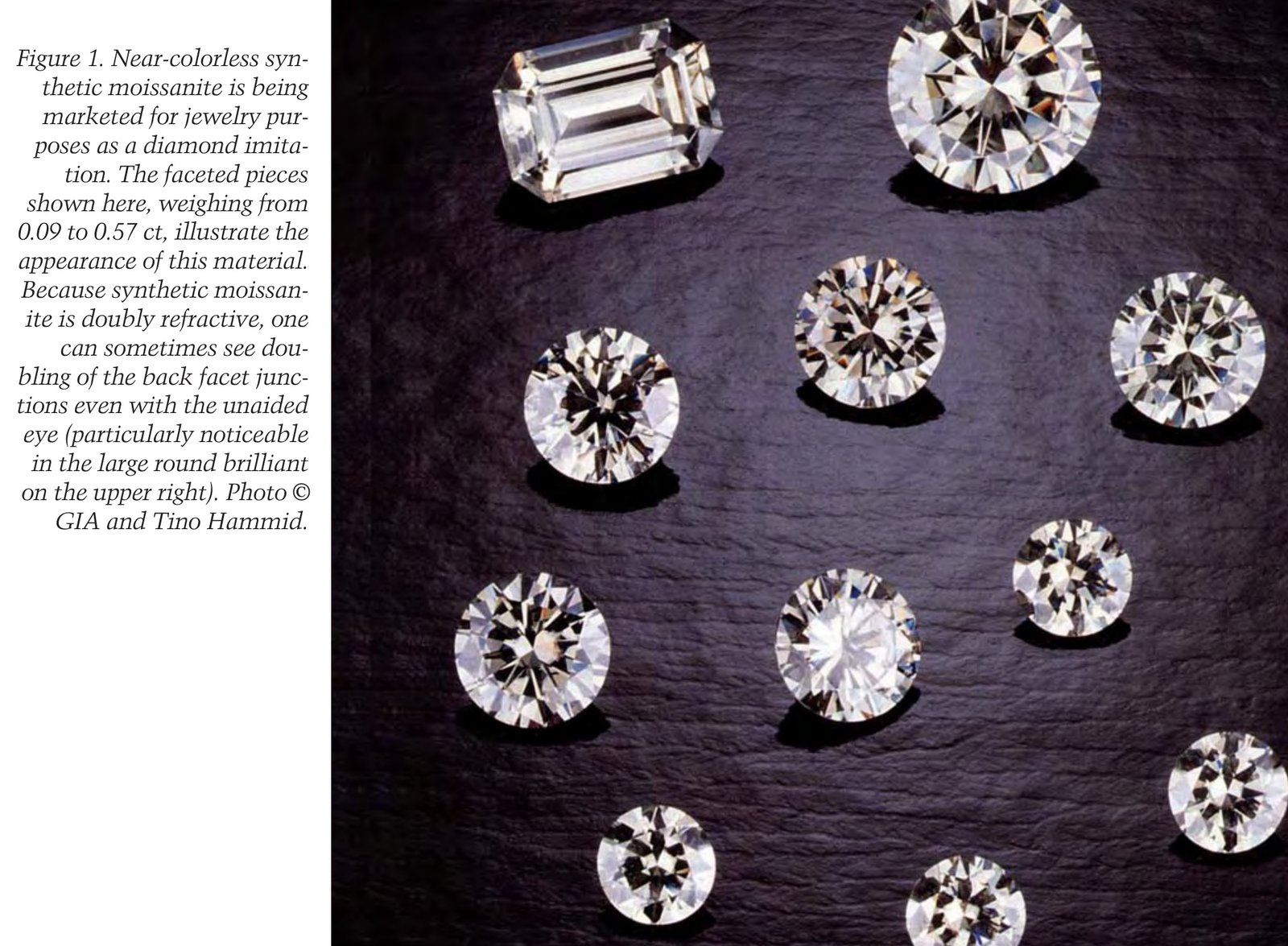
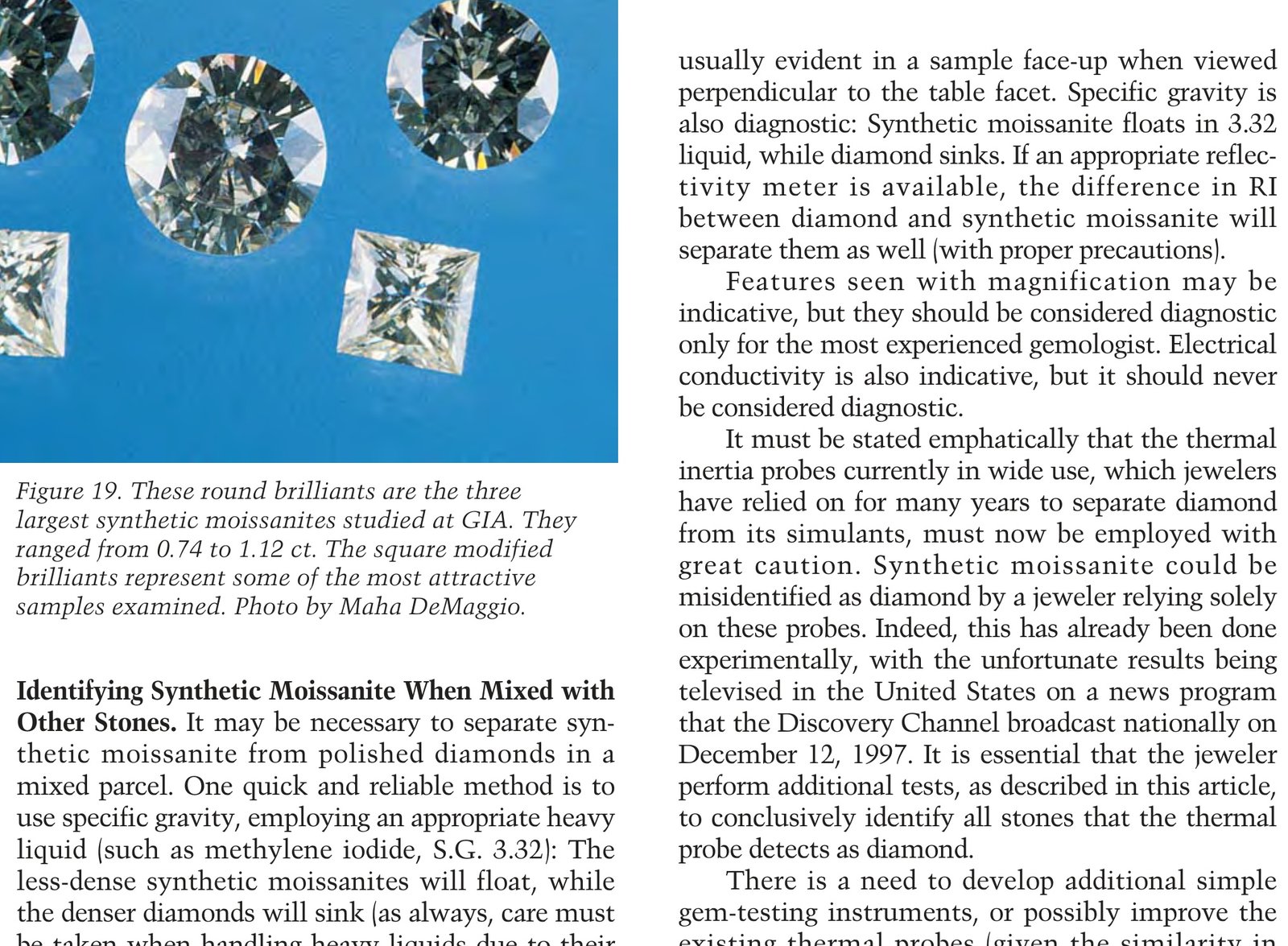
The A18 timeline, read as a story of escalation: 1957 — Benson catalogs “diamond substitutes” (glass, strontium titanate, YAG-era materials: the soft-optics zoo the pre-CZ market traded); 1978 — Liddicoat & Koivula describe cubic zirconia arriving as a production material (“synthetic cubic stabilized zirconia”), not a lab curiosity; 1981 — Nassau updates CZ and Hobbs offers “a simple approach” to separation, the trade’s first mass-detection doctrine; 1990s — Kammerling 1991 examines non-transparent “CZ” from Russia (i.e., fakes outside the normal spec), and 1997 — Nassau et al. publish synthetic moissanite as a new diamond substitute: the first simulant to beat the thermal tester; 2000s–2010s — the arms race turns combinatorial: Shigley et al. 2012 characterize coated CZ (“Diamantine”) — a soft material wearing a thin diamond-like film — while Choudhary 2013 flags boron carbide imitating black diamond; Zhou 2015 and Song et al. 2016 document synthetic moissanite in melee — including moissanite made to imitate lab-grown colored diamonds, the substitution hiding inside a substitution. The pattern every one of these papers encodes: every detector is a property test, and every new material picks off the detectors one by one.
The property ladder (what a professional actually uses)
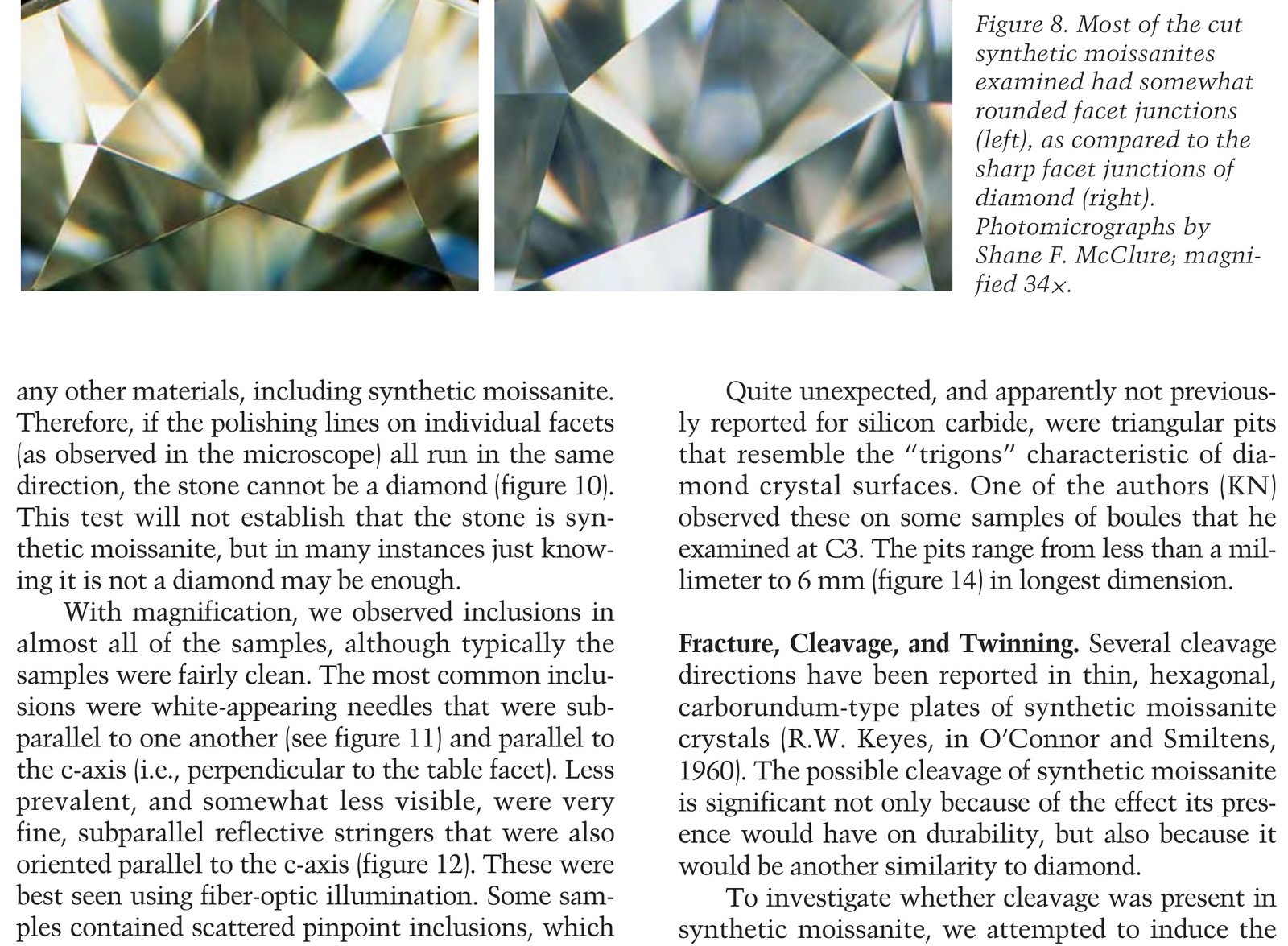
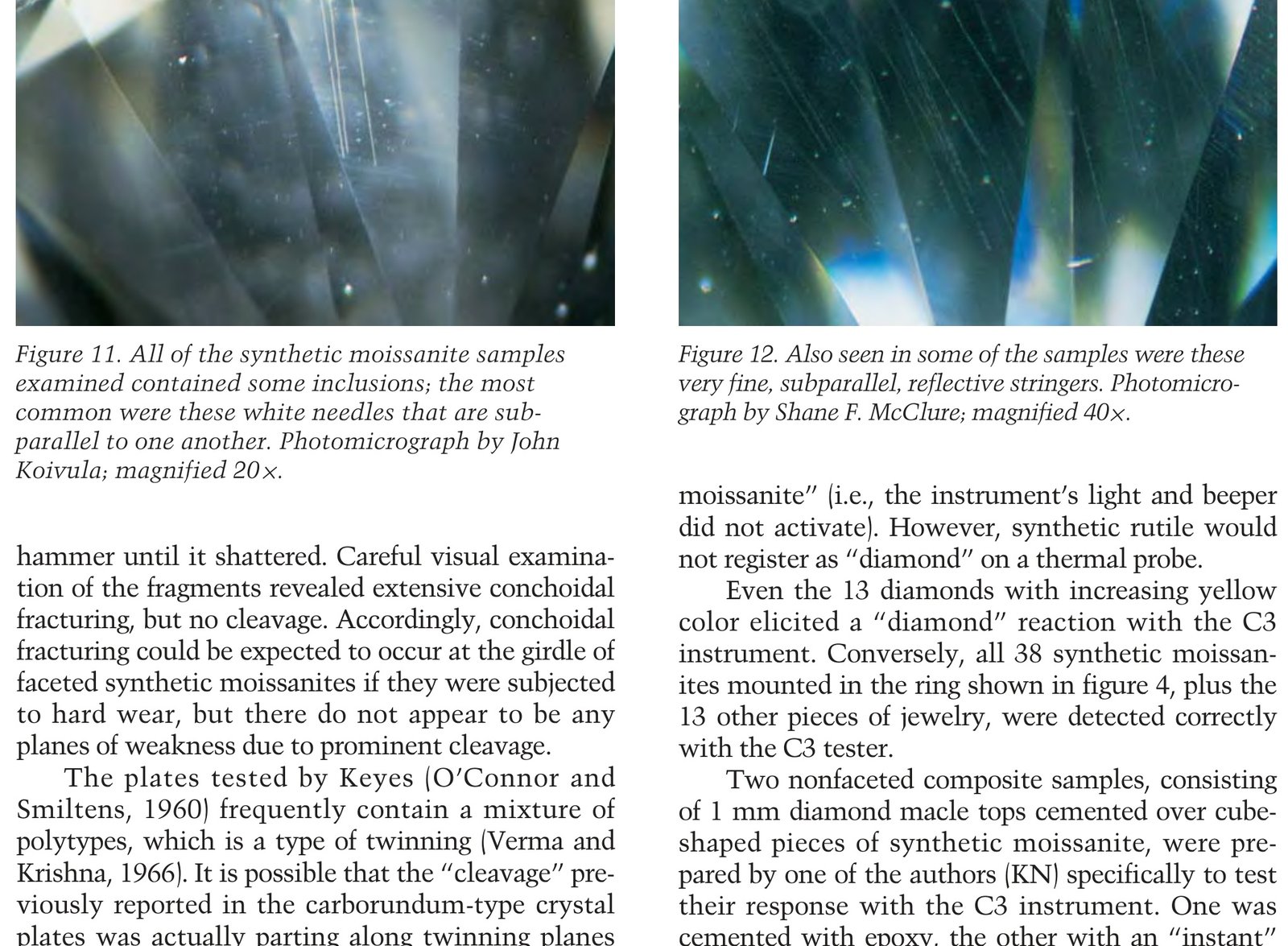
Simulant separation is not tricks; it’s a decision tree over physical properties (textbook values; ranges are standard-reference level — any number you print on a card):
| Test | Diamond | CZ | Moissanite | What the A18 papers add |
|---|---|---|---|---|
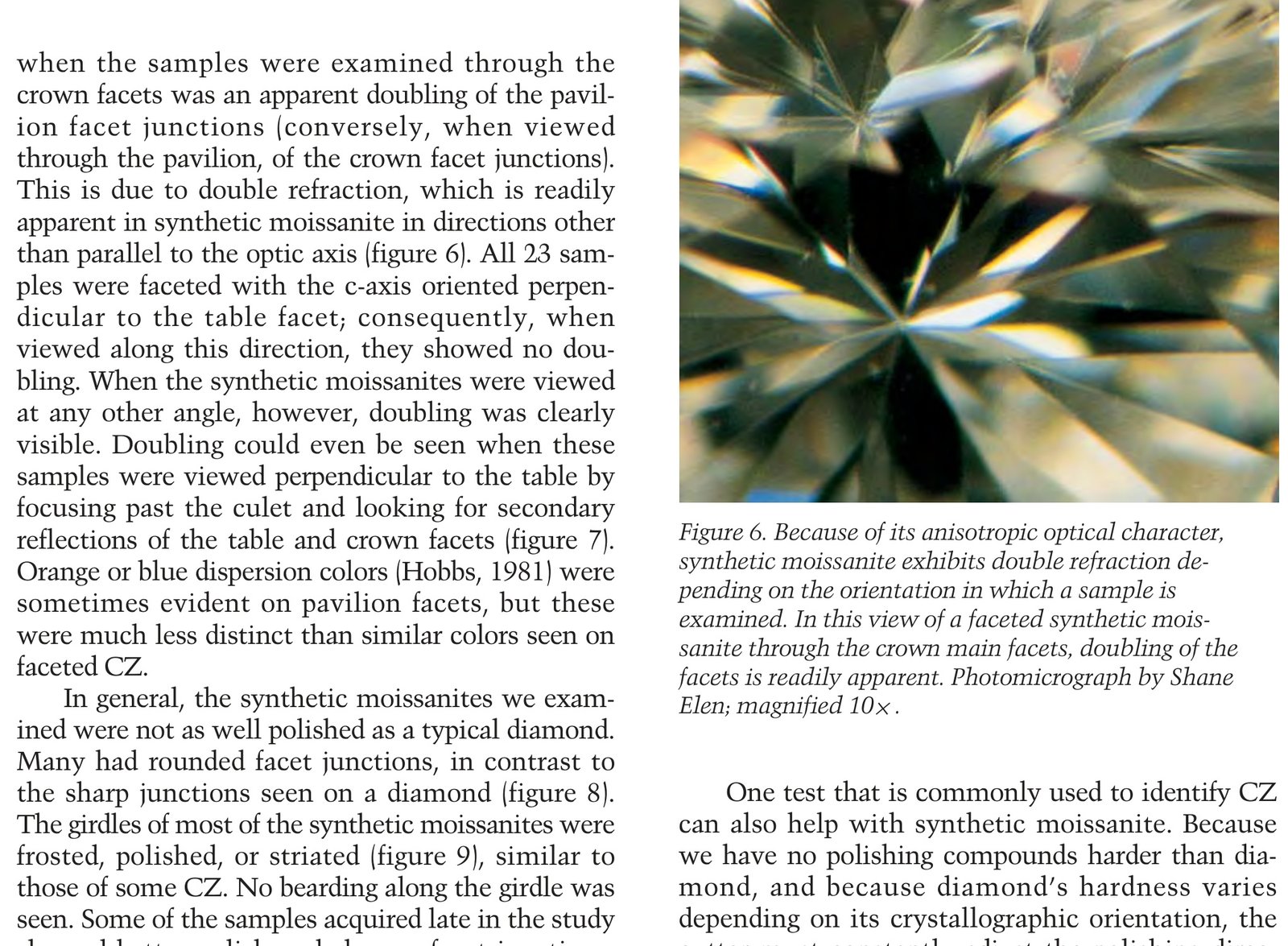
| Read-through (facet junctions) | single, sharp | single, soft, heavy dispersion | doubles at table facets (0.02–0.05 DRL) | Nassau 1997’s shock: moissanite passes thermal probes → the doubling rule returns |
| Luster/edge wear | adamantine, crisp | greasier, abrades | harder than CZ, near-crisp | Hobbs 1981 “simple approach”: edges + wear before any electronics |
| Specific gravity | 3.52 | ~5.6–6.0 (heavy in hand) | 3.22 (light) | hydrostatic/thermal balance era |
| Electrical conductivity | insulator except blue IIb (M08) | insulator | semiconductor — most moissanite conducts | the tester-generation response; today’s multi-testers |
| UV fluorescence | varied | often strong chalky blue | often none/weak | supplementary only |
| Spectroscope/polariscope | single-refraction (except strain) | isotropic + Fe lines common | doubling, strong DR | classic separation before electronics (Benson 1957 era methods) |
The screening narrative you can trust in a store (from GIA’s own verified video narration, GIA-03): “before even stepping into the four Cs, the diamond is tested to determine whether it is natural or lab-grown” — and every report system sits behind that gate. For simulant control the same logic applies one level down: thermal/electrical probes at intake, loupe double-check on anything the probe calls “pass,” and the polariscope/doubling rule as the tie-breaker when moissanite is in play.
The disclosure conversation: retire “fake,” install “different material”
The vocabulary problem is a liability problem. “Fake” accuses; it also teaches the customer that the category CZ exists to deceive — which your own jewelry case disproves (most CZ sold is disclosed fashion jewelry). The honest, sales-safe frame:
- Simulant = a material that simulates diamond appearance (CZ, moissanite, glass, coated goods). It is a product, not a crime.
- Synthetic (lab-grown) = a real diamond, made by another process (M11). Never call it “fake”; that’s legally imprecise and commercially wrong.
- Natural diamond = the M02/M03 story; its trade advantage is provenance and resale norms, not “realness.”
So: the buyer of a CZ ring is buying look; the buyer of a lab-grown is buying material (identical physics, different market); the buyer of a natural is buying material + history. Every complaint the A18 papers exist to answer — undisclosed moissanite melee in a bracelet (Zhou 2015), a coated stone wearing two identities (Shigley 2012) — is a disclosure failure, not a material failure. That’s also the FTC-frame (Overton 2004, A19 list — M12). Your job on the floor is to make the three sentences above automatic.
The melee problem (what the 2013–2016 papers are really about)
Single-stone detection is solved; parcel and repair detection is the open wound the later A18 entries document: loose melee runs through the market untested; a repair or re-polish can swap one stone into a tray of twenty; the “Diamantine” and “synthetic moissanite” waves specifically target the colored melee niche where certificates never existed. Practice consequences:
- Intake screening on parcels (Dieck et al. 2016, “Analysis of Yellow Diamond Melee for Color Treatment and Synthetics,” G&G 52:1 — title-level here): if your shop repairs and a tray looks too clean/too sparkly for its era, screen it.
- The loupe at 10× finds the two big tells: facet-junction doubling (moissanite), and lead-light orange-flash in fracture/rim (filled or coated). Both are A18/A19 paper abstracts’ exact themes.
- Tell the repair story: customers should hear “we screen every stone we touch,” which is precisely the promise the GIA video’s gate makes at lab scale.
Self-check
- Order the five properties that separate CZ from diamond by the loupe route (no electronics).
- Why did moissanite “break” the industry default tool, and what replaced it? (thermal → conductivity; multi-testers)
- Name the two A18-era combination frauds and their telltales. (coated CZ — flash/abrasion, interferometry at lab; moissanite-as-synthetic-colony — polarization/doubling + tester cross-check)
- Give the three-sentence disclosure frame in your own words (simulant/synthetic/natural).
- Which is riskier for a repair shop: a loose 2 ct round or a sealed bracelet of melee — and why? (the melee: no cert, untested intake, swap opportunity)
Further reading (A18)
Full annotations in `references/annotated-bibliography.md`. Priority reads: Nassau 1997 (30 minutes that explain the whole detector-arms-race logic); Shigley 2012 Diamantine (coated-goods methodology); Song 2016 (modern layered fakery). Pair with M12 (fillings/coatings overlap) and M11 (lab-grown vs. simulant language discipline).
Counter Simulation: The Fakes — Diamond Simulants
3 Scenarios • Simulant Detection
Trying to identify CZ by scratching glass or licking the stone at the counter.
“We identify diamond simulants through repeatable physical properties. Cubic zirconia (CZ) has a specific gravity of 5.6 to 6.0—nearly 70% heavier than a natural diamond’s 3.52—meaning a CZ of identical diameter feels significantly heavier in the hand. Furthermore, CZ is a thermal insulator, whereas diamond is an exceptional thermal conductor. Our electronic testers measure heat transfer rates in seconds to provide immediate, nondestructive verification.”
Relying exclusively on an old single-probe thermal tester that falsely reads moissanite as diamond.
“Because synthetic moissanite is also thermally conductive, older basic diamond testers will give a false positive reading. However, diamond is singly refractive (isotropic), while moissanite is doubly refractive (uniaxial). Under a 10x gemological loupe, if you look through the crown facets at the pavilion junctions of a moissanite, you will see distinct ‘doubling’ of the facet lines. Combined with dual thermal-and-electrical conductivity testing, identification is 100% conclusive.”
Bluntly blurting out “This grandmother ring is just cheap fake glass, it’s worth zero dollars.”
“Your grandmother’s ring is an exquisite piece of mid-century jewelry, and its sentiment and family heritage are irreplaceable. Gemologically, however, our non-destructive tests confirm that the center stone is synthetic spinel, a popular and durable gemstone material widely used during that era. While it does not carry the commercial value of a natural diamond, the piece remains a cherished family heirloom that we can clean and polish for your next generation.”
🔬 Scientific Detail: Diamond Simulant Taxonomy & Physical Benchmarks
Comprehensive Discrimination Table: Diamond vs. Historical & Modern Simulants
Diamond simulants are non-diamond materials that imitate diamond visually. Verified PubChem chemical properties and diagnostic separation criteria:
| Material | PubChem Formula & CID | Mohs Hardness | Refractive Index ($n$) | Dispersion | Specific Gravity | Diagnostic Bench Separation |
|---|---|---|---|---|---|---|
| Natural Diamond | $ ext{C}$ (CID 5462310) | 10 | 2.417 | 0.044 | 3.52 | Thermal conductivity (~2,200 W/m·K); single refraction. |
| Synthetic Moissanite | $ ext{SiC}$ (CID 9863) | 9.5 | 2.654 – 2.697 | 0.104 | 3.22 | Doubly refractive ($\Delta n = 0.043$); facet doubling under 10×; electrical conductor. |
| Cubic Zirconia (CZ) | $ ext{ZrO}_2$ (CID 62395) | 8.0 – 8.5 | 2.15 – 2.18 | 0.060 | 5.65 – 5.95 | Thermal insulator; 1.7× heavier than diamond for equal millimeter diameter. |
| Strontium Titanate | $ ext{SrTiO}_3$ (CID 62666) | 5.5 | 2.410 | 0.190 | 5.13 | Extreme rainbow fire (4.3× diamond); very soft (scratches easily); rounded facet junctions. |
| YAG (Yttrium Alum. Garnet) | $ ext{Y}_3 ext{Al}_5 ext{O}_{12}$ | 8.5 | 1.833 | 0.028 | 4.55 | Lacks fire; low luster; sluggish reaction on refractometer. |
| GGG (Gadolinium Gallium) | $ ext{Gd}_3 ext{Ga}_5 ext{O}_{12}$ | 6.5 | 1.970 | 0.045 | 7.08 | Extremely heavy; low hardness; abraded facet edges on older jewelry. |
| Synthetic Rutile | $ ext{TiO}_2$ (CID 26042) | 6.0 – 6.5 | 2.61 – 2.90 | 0.330 | 4.26 | Overwhelming kaleidoscopic dispersion; strong double refraction ($\Delta n = 0.287$). |
📚 Research References
- Nassau, K. (1980). Gems Made by Man. Chilton Book Company. ISBN: 978-0-8019-6867-9.
- O’Donoghue, M. (2006). Gems: Their Sources, Descriptions and Identification. Butterworth-Heinemann.
- Hobbs, J.M. (1981). “A Simple Approach to Detecting Diamond Simulants.” Gems & Gemology, 17(1), 20–33. DOI: 10.5741/gems.17.1.20