Lab-Grown Diamonds: Two Routes, the Arms Race, and the Trust Conversation
Change log: Wave 4 first pass. The 2016 CVD review and the 2004 HPHT chart were fetched this pass at landing level only; where a specific number would be needed to make a claim, the claim is stated as method rather than magnitude, and marked.
The one sentence that should reframe the whole conversation
A lab-grown diamond is the same material — carbon in the same cubic lattice, the same hardness, the same dispersion, the same type classification (M08) — arriving by a different route. Everything commercially interesting about lab-grown diamonds follows from that single fact: identical properties means identical grading scales apply, and the difference is origin, provenance, and market structure — not gemology.
Which is exactly why the 2013 GIA optical-defects intro (read verbatim) matters here: the same sentence that describes color treatments also describes synthetic detection. Separation of natural from synthetic “is not always possible using standard gemological methods”; “advanced spectroscopic analysis at a professional gem-testing laboratory is required.” The lab-grown business is built on that sentence.
Route 1 — HPHT: squeezing carbon in metal


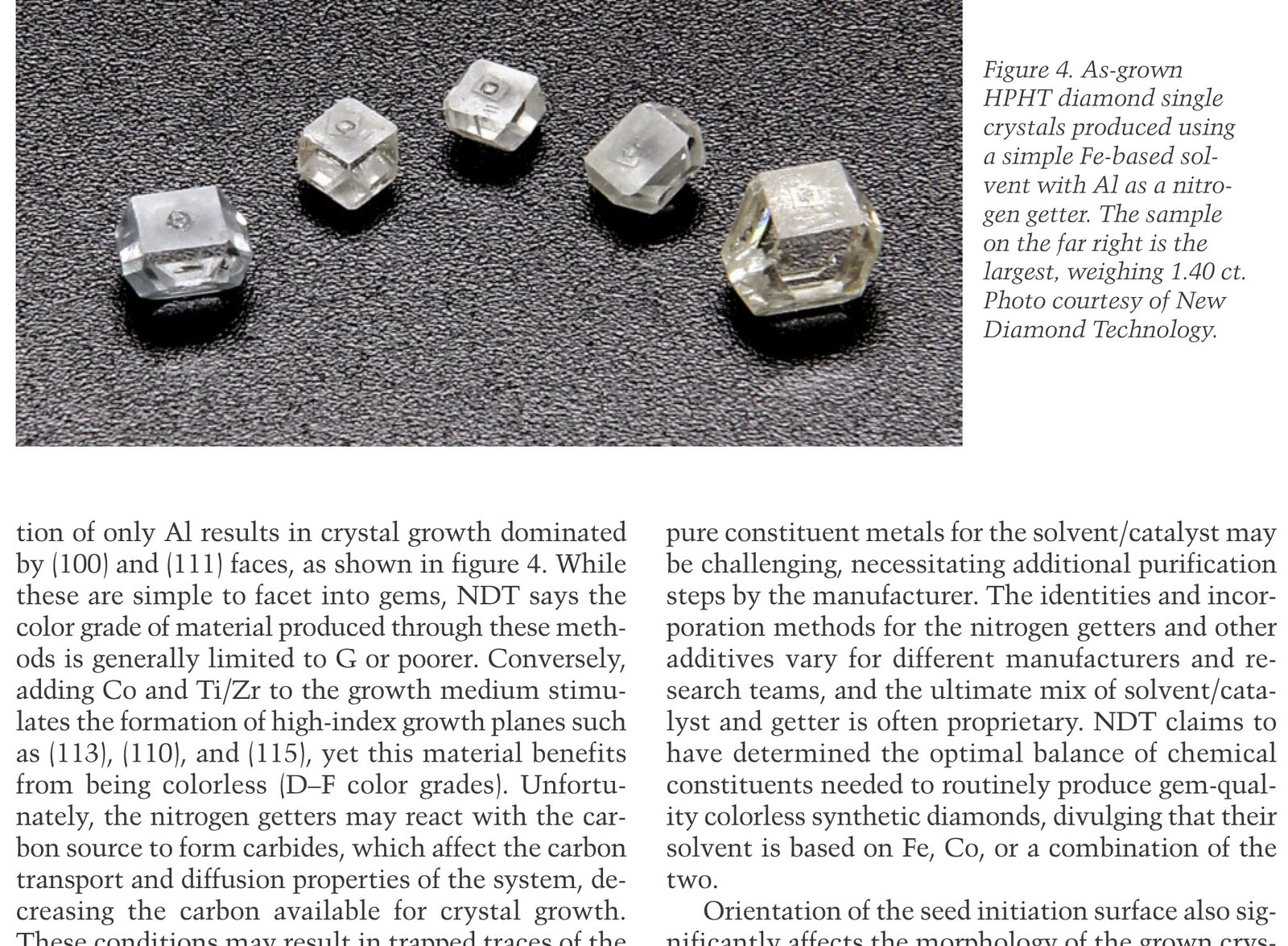
High-Pressure High-Temperature growth (the GIA reference card is Shigley et al., “An Updated Chart on the Characteristics of HPHT-Grown Synthetic Diamonds,” G&G 40:4, 2004 — updating the 1995 chart of the same lineage; title-level here): a diamond seed sits in molten metal solvent (Fe/Ni/Co family) at roughly mantle-like pressure and temperature, with carbon dissolved in the melt precipitating onto the seed. Two fingerprints follow mechanically from that recipe, and both are teaching points:
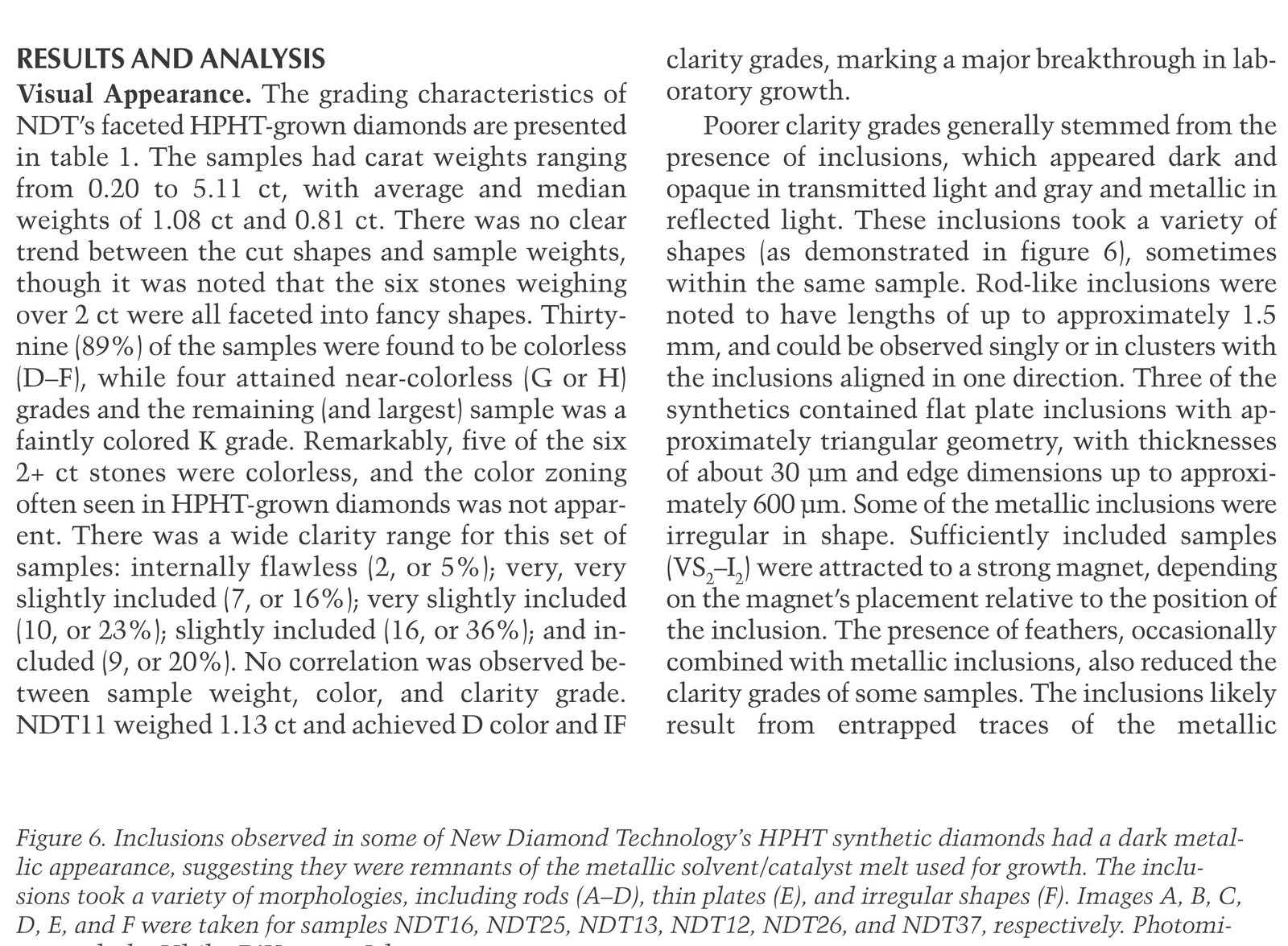
- Metallic flux inclusions. Because the medium is liquid metal, HPHT goods can carry tiny opaque, magnetic-flavored metallic inclusions — the reason “look for black specks and test for magnetism” is an HPHT heuristic (not a universal one; and natural Ilmenite/graphite inclusions complicate it). Feral & Kammerling 2012’s “magnetic properties” study (A19 list) is the documented treatment of that tell.
- Often Type IIb or near-nitrogen-free. The metal solvent getters nitrogen, so HPHT grown goods tend toward colorless-to-gray IIb or low-Ia, and often show strong persistent phosphorescence under longwave UV. The classic screening behavior: switch off the LW lamp and watch whether the stone keeps glowing — naturals rarely do.
HPHT also does something else the market cares about: it anneals color in natural stones (the bridge to M12’s treatment story — same tool, opposite target).
Route 2 — CVD: growing from a gas
Chemical Vapor Deposition (the module’s core source: Eaton-Magaña & Shigley, “Observations of CVD-Grown Synthetic Diamonds: A Review,” G&G Fall 2016 — title + GIA’s own assignment purpose: it is the reference review of CVD observations). Recipe: a carbon-bearing gas (typically methane) is cracked in a vacuum chamber by microwave plasma (or hot filament); carbon rains onto a seed plate, growing a single crystal layer by layer. The fingerprints:
- Growth-sector structure. CVD plates grow in columnar, layer-stacked habit; irregular/parallel graining and “graininess” plus orange-to-pink “silicon-vacancy”-flavored coloration in some goods (the review documents the range; specific defect assignments belong to the PL literature below).
- Weak or absent nitrogen. CVD’s gas phase has no nitrogen source in ordinary operation, so Type Ia absence is the diagnostic frame: a gem that looks Ia-silent under FTIR is an origin question, not an answer.
- Luminescence imaging as the identification workhorse. The 2013 intro (read verbatim) cites exactly this: “Luminescence imaging is also a helpful tool for recognizing synthetic diamonds (Martineau et al., 2004; Shigley et al., 2004).” Phosphorescence imaging (the Martineau 2004 / Shigley 2004 citations in the read intro), and later photoluminescence spectroscopy — GIA’s own primer is Eaton-Magaña & Breeding 2016, G&G 52:1 (title-level here) — became the practical instrument answer.
- Post-growth treatment is common. CVD as-grown material is frequently HPHT-treated to remove gray/brown tint — the “color enhancement” line on a grown-stone report. Which is why the grown/synthetics literature and the treated-diamond literature are one field, and why M12 is required reading after this module.
The type-system payoff
Recall M08: type classification exists to tell you what to suspect. The 2009 paper’s own framing (breeding2009, G&G 45:2) is quoted in the GIA handout as: type “is directly related to color and the lattice defects that are modified by treatments” and “knowledge of type allows gemologists to better evaluate if a diamond might be treated or synthetic, and whether it should be sent to a laboratory.” That is the sentence that connects the color module to this one: a natural-looking stone that is IIb or Ia-absent is a routing decision, not a verdict — it goes to the lab.
Detection, honestly described (the arms race)

The A19 list is essentially a chronological log of the escalation, and teaching it accurately is your best defense against “my tester says it’s natural”:
| Era | What the market used | What defeated it | Documented in |
|---|---|---|---|
| Thermal probes (1990s) | Diamond conductivity of heat | Moissanite (also thermally conductive) | Nassau 1997 (M10) |
| Electrical + UV + IR screens (2000s) | Phosphorescence, IR nitrogen absorption | CVD (no N to see; weak phosphorescence) + HPHT colored goods | Shigley et al. 1995/2004 charts; Wang et al. 2003 |
| Advanced spectroscopy (2010s) | PL spectroscopy, luminescence imaging, deep-UV | Mixed-type coatings, HPHT-annealed CVD, tiny defects at detection thresholds | Eaton-Magaña & Shigley 2016; Eaton-Magaña & Breeding 2016 |
| Instrument-on-the-counter (2010s→) | Dedicated screening devices (DiamondView lineage; tabletop NIR/UV-Vis screeners) | Nothing “beats” them publicly, but screening ≠ grading: labs still hold the definitive answer | Linares 2013 CVD history/properties notes (title-level) |
The professional summary of that table: counter instruments are gates, not verdicts. Which is precisely the position of GIA’s consumer-facing article (Shigley, “Identifying Lab-Grown Diamonds,” gia.edu — title-level here): the identification route runs through a lab.
Disclosure and grading practice
- Reports are explicit. GIA updated its nomenclature in 2019 from “Synthetic” to “Laboratory-Grown Diamond Report”, and in October 2025 introduced the “Laboratory-Grown Diamond Quality Assessment” with distinct format and mandatory girdle inscription “Laboratory-Grown [Report #]”. Full 4Cs grading applies, with clear origin disclosure.
- The four Cs still apply, without the rarity story. Color/clarity/cut grading on grown goods is the same measurement, because the material is the same; what’s different is what the grade is worth. Do not let a customer collapse “same grading” into “same price.”
- Melee and parcels are the soft spot. The Chatham-era yellow synthetic melee (Kitawaki et al. 2008, G&G 44:3) plus the Gemesis color programs (Shigley et al. 2002/2004; Wang et al. 2012 CVD studies — all title-level) plus Zhou 2015/Song 2016 (synthetic-colored and moissanite melee, M10) are the technical reason “screen the parcel, not just the center stone” is standard practice: growers have repeatedly built products that behave opposite to casual expectations (“synthetic yellows that fluoresce like naturals”, “grown goods in antique-looking jewelry”).
Two scripts that work
The customer who wants grown: “Smart buy — same material, same optics, no mine story. It’s graded on the same scale, so the thing to check is that your report says laboratory-grown and your price reflects the grown market. Here’s what that means if you ever resell.” Then show the report line. (Never oversell it as “identical, so it’s a steal on a natural’s terms.”)
The customer who fears grown: “Understandable — the risk isn’t beauty, it’s disclosure. That’s why every stone we touch goes through a screening gate first: heat tester plus UV plus the loupe tells, and anything with a question goes to the lab. The lab can always answer, because grown stones carry process fingerprints: metal flux in HPHT, growth-sector structure and nitrogen silence in CVD.”
What this module does NOT let you claim
- “My tester separates them.” Screeners misread coated, annealed, and unusual-defect stones; the A19 literature is a record of exactly that.
- “Lab-grown is worthless / is the future.” Both claims are market predictions, not gemology; state the price-structure fact (“grown goods price on grown comparables”) and stop.
- Specific device model performance numbers.
Self-check
- Which single physical fact makes grown and mined diamonds “the same material,” and what two market consequences follow?
- Give one inclusion-based and one spectroscopy-based tell for HPHT, and two for CVD.
- Why does nitrogen-silence point to synthetic but not prove it? (N-doped CVD, Skalwold 2012)
- Quote (or paraphrase accurately) the 2013 sentence on the limits of standard gemological methods.
- What is the correct response to “the four Cs are the same, so why isn’t the price?”
- Which post-growth step blurs grown/treated, and which module covers it?
Further reading (A19, synthetic block)
Eaton-Magaña & Shigley 2016 (the review — read it top to bottom); Shigley et al. 2004 updated HPHT chart; Martineau 2004; the 2002–2012 Gemesis/Apollo/Chatham detection series; Linares 2013 (CVD history/properties); then GIA’s consumer page. Full annotations in `references/`.
Counter Simulation: Lab-Grown Diamonds — HPHT, CVD & NPD
3 Scenarios • Lab-Grown Realities
Dismissing lab-grown diamonds as “fake plastic stones that aren’t real diamonds at all.”
“Lab-grown diamonds are real diamond material—possessing the identical chemical composition, crystal structure, and optical brilliance of earth-mined diamonds. They are created via two methods: HPHT, which uses massive cubic or BARS presses to replicate the mantle’s high pressure and heat in molten metal flux, and CVD, which grows diamond carbon atom-by-atom from methane gas plasma inside a vacuum chamber. Both produce genuine diamond crystals, distinguished primarily by their origin.”
Promising clients that lab-grown diamonds will appreciate in value just like natural diamonds.
“When deciding between natural and lab-grown diamonds, we look at both your current budget and long-term intentions. Because lab-grown diamonds are manufactured using rapidly scaling industrial technology, global production increases each year, causing wholesale prices to decline over time. A natural diamond, by contrast, is a finite geological asset that has served as a recognized store of heirloom wealth for centuries. We offer both so you can choose what aligns with your values.”
Claiming a jeweler can tell lab-grown from natural with an ordinary counter loupe.
“Under an ordinary jeweler’s loupe, a top-quality CVD or HPHT diamond is completely indistinguishable from a natural diamond because their physical and optical properties are identical. Definitive screening requires advanced gemological laboratory instruments, such as GIA’s DiamondView, which uses deep short-wave ultraviolet luminescence to image unique growth sectors and metallic flux residues. Every diamond in our cases is verified through this advanced testing.”
🔬 Scientific Detail: Synthesis Kinetics & Spectroscopic Identification
CVD, HPHT & NPD (Nano-Polycrystalline Diamond) Compared
Modern lab-grown diamond synthesis utilizes distinct physical mechanisms leaving diagnostic spectroscopic signatures:
| Synthesis Technology | Process Environment | Rough Crystal Habit | Diagnostic Spectroscopic Features |
|---|---|---|---|
| CVD (Chemical Vapor Deposition) | $ ext{CH}_4 + ext{H}_2$ microwave plasma; 700°–900°C; 10–100 Torr | Tabular / blocky cubic plate ({100} single growth axis) | 737 nm $[ ext{Si-V}]^-$ doublet in photoluminescence; 575 nm ($ ext{NV}^0$) & 637 nm ($ ext{NV}^-$) centers. |
| HPHT (High-Pressure High-Temp) | Graphite in Fe/Ni/Co flux; 1,400°–1,600°C; 5.0–6.0 GPa (BARS / cubic press) | Cuboctahedral with multi-directional growth sectors | Hourglass / cross luminescence zoning under deep UV (DiamondView); ferromagnetic metal flux inclusions. |
| NPD (Nano-Polycrystalline) | Direct conversion of graphite; >15 GPa; >2,000°C (Ultra-high pressure multi-anvil) | Polycrystalline aggregate of 10–50 nm diamond grains | Isotropic ultra-hardness; no cleavage planes; used in extreme industrial tooling and diamond anvil cells. |
📚 Research References
- Schwander, M. & Partes, K. (2011). “A Review of Diamond Synthesis by CVD Processes.” Diamond and Related Materials, 20(9), 1287–1301. DOI: 10.1016/j.diamond.2011.08.005
- Eaton-Magaña, S. & Breeding, C.M. (2021). “Raman and Photoluminescence Mapping of Gem Materials.” Minerals, 11(2), 177. DOI: 10.3390/min11020177
- Sumiya, H. & Irifune, T. (2007). “Indentation Hardness of Nano-Polycrystalline Diamond.” Journal of Materials Research, 22(8), 2341–2345. DOI: 10.1557/jmr.2007.0295