Metals, Marks and Alloys
The stamp nobody looks at until something goes wrong
“This 14K white gold band looks just as bright as the platinum one. Why is platinum so much more expensive?”
“Let me place both in your hands at the same time. Feel the weight difference? Platinum is nearly twice as dense as 14-karat gold — that heft is pure, substantial metal. Furthermore, white gold achieves its bright white shine from an electroplated layer of rhodium that wears away and requires re-plating every 12 to 24 months. Platinum is naturally white through its entire core, hypoallergenic, and never thins out when polished. You are investing in heirloom durability that holds your diamond securely for a lifetime.”
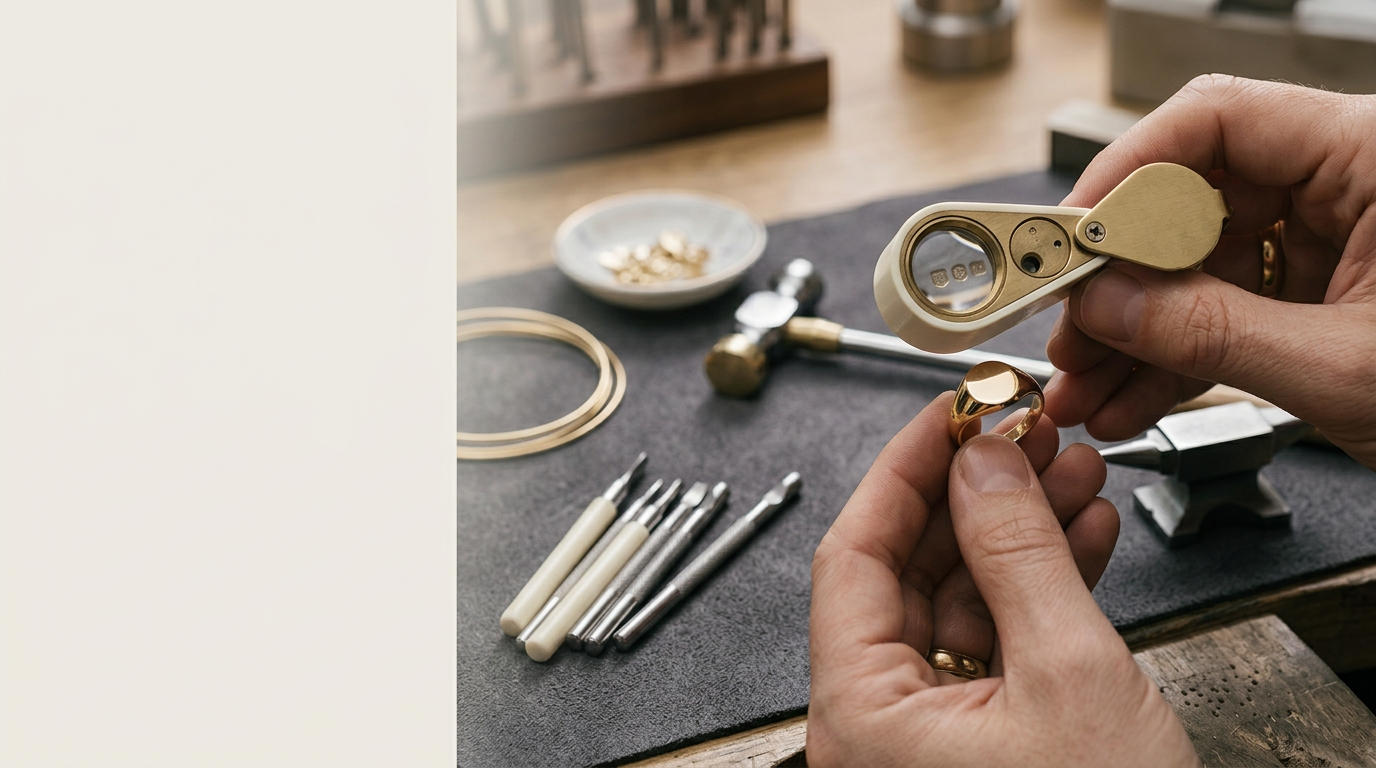
A client returns a ring convinced it is “not real gold” because it bent slightly after a year of daily wear. You look inside the band and find the quality mark: 14K, alongside a maker’s trademark. The ring is exactly what it was sold as. What was missing was an explanation, at the point of sale, of what 14K actually means and why a softer, more wearable alloy was the right choice for a daily ring in the first place. This module gives you that explanation, along with the adjacent terminology (vermeil, gold-filled, rhodium plating) that increasingly comes up as clients shop across a wider range of price points and metal types.
Why this matters
Metal-quality questions come up in nearly every sale, and clients frequently do not know what a karat number means, what platinum’s purity requirements are, or why a hallmark exists at all. An associate who can read a quality mark fluently and explain the trade-offs between metals closes more sales and prevents the kind of confused, distrustful return described above. This also has a compliance dimension: quality marks are governed by federal regulation in the US and by law in the UK and other markets, and getting the vocabulary wrong is not just unpolished, it can misstate a legal disclosure.
Gold karat purity, in one table
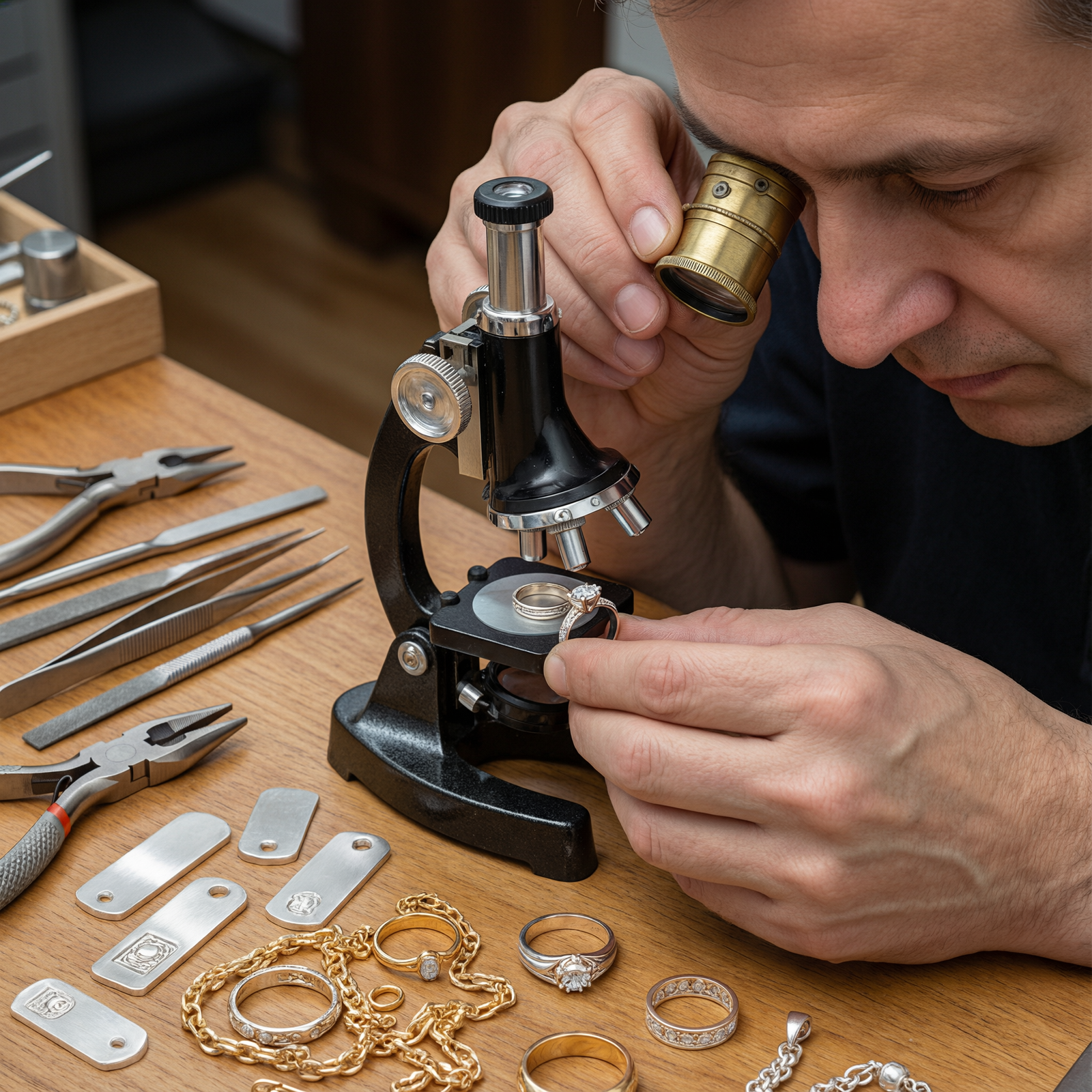

Karat measures the proportion of pure gold in an alloy, out of 24 parts. Pure gold is 24 karat; everything below that is gold mixed with other metals for durability, color, or cost.
| Karat | Fraction pure gold | Approximate percentage | Millesimal fineness mark |
|---|---|---|---|
| 24K | 24/24 | 100% | 999 |
| 22K | 22/24 | 91.6% | 916 |
| 18K | 18/24 | 75.0% | 750 |
| 14K | 14/24 | 58.3% | 583 |
| 10K | 10/24 | 41.7% | 417 |
| 9K | 9/24 | 37.5% | 375 |
MEDIA link-out C1-M08-D1 “Buying Platinum, Gold, and Silver Jewelry” by the Federal Trade Commission (official consumer guidance)
Why here: the FTC’s own explanation of karat quality marks and the requirement that a trademark accompany the karat stamp.
Source: https://consumer.ftc.gov/articles/buying-platinum-gold-and-silver-jewelry
Use: link-out
The FTC’s own framing is the clearest way to explain this to a client: an 18K piece is 18 parts gold mixed with six parts of another metal, and a 14K piece is 14 parts gold mixed with 10 parts of another metal. Higher karat means more pure gold and a richer color, but also a softer, more easily scratched metal. Lower karat trades some of that richness for durability and, generally, a lower price.
Why lower karat is not a lesser choice
A common misconception is that lower karat gold is a compromise or a downgrade. In practice, 14K is often the better choice for an everyday ring precisely because the additional alloy content makes it more scratch- and dent-resistant than 18K, which is why many engagement ring bands are sold in 14K even at price points where 18K would be affordable. Frame this as a durability trade-off, not a quality hierarchy.
Client: “Is 14K gold worse than 18K?”
Associate: “Not worse, just different. 18K has more pure gold, so the color is a little richer, but it’s also softer. 14K has more of the other metals mixed in, which makes it more resistant to scratches and dents. For a ring you’ll wear every day, a lot of people actually prefer 14K for exactly that reason.”
Why white gold needs rhodium plating
A detail that surprises many clients: white gold is not naturally, purely white. Gold in its pure form is yellow, and mixing it with white alloy metals like palladium, nickel, or silver produces an alloy that is closer to a light, creamy off-white or pale yellow, not the bright, cool white most clients picture. To achieve that bright white, reflective look, jewelers apply a thin layer of rhodium, a member of the platinum family of metals, through an electroplating process.
Rhodium plating serves two purposes at once: it gives white gold its characteristic bright white color, and it adds a hard, protective, scratch-resistant surface layer, which also happens to act as a barrier between the wearer’s skin and any nickel present in the underlying alloy, a point that matters for clients with nickel sensitivity. Because this plating is a thin surface layer, not something baked into the metal itself, it wears down gradually with everyday contact, friction from hands, tools, and surfaces, and needs to be periodically reapplied, typically referred to in the trade as a “rhodium re-plate” or “re-rhodium” service.
Client: “Why did my white gold ring start looking a little yellow after a couple of years?”
Associate: “That’s actually really common, and it’s not a defect. White gold on its own is a pale, slightly warm off-white, not bright white, so jewelers add a thin coating of a metal called rhodium to get that crisp white look. That coating wears down gradually with everyday wear, which is why the natural color underneath starts to show through over time. A simple re-plating service brings back the bright white finish, and most jewelers recommend doing it every year or two depending on how the piece is worn.”
Vermeil, gold-filled, and gold-plated: knowing the difference
As clients shop across a wider range of price points, especially in fashion and everyday jewelry categories, three terms come up that are frequently confused with each other and with solid karat gold: vermeil, gold-filled, and gold-plated. Each describes a different construction, with different durability and different legal requirements.
| Term | Legal definition (US, per FTC standards) | Typical construction | Approximate durability |
|---|---|---|---|
| Gold vermeil | Base metal must be 925 sterling silver; gold layer must be at least 10 karat; gold layer must measure at least 2.5 microns thick | Gold electroplated onto sterling silver at a legally defined minimum thickness | Moderate; can wear thin over years of heavy use, but the sterling silver base is itself a precious metal |
| Gold-filled | No single universal legal minimum thickness standard cited here, but a specific gold layer (commonly around 5 percent of total weight) is mechanically bonded to a base metal (commonly brass) using heat and pressure | A thick layer of gold sheet mechanically bonded to a base metal core, not electroplated | Generally the most durable of the three non-solid options; commonly cited to last 10-20 years with normal wear |
| Gold-plated | No standardized minimum thickness; can be extremely thin (a small fraction of a percent of total weight) | Gold electroplated onto a base metal, commonly brass or copper, often with a nickel or copper underlayer first | Least durable; can wear through relatively quickly with regular contact and friction |
The key distinction between vermeil and plain gold-plated jewelry is the base metal and a legally enforced minimum thickness: vermeil must use sterling silver underneath and meet a specific gold-layer-thickness standard, while ordinary gold-plated jewelry has no such requirement and commonly uses a much thinner gold layer over a non-precious base metal. Gold-filled sits apart from both, using a mechanically bonded (not electroplated) thicker gold layer, which is why it tends to outlast standard gold plating significantly.
Client: “What’s the actual difference between vermeil and gold-plated? They both sound like a thin layer of gold.”
Associate: “The base metal and the amount of gold are both different. Vermeil is specifically gold over sterling silver, with a legally required minimum thickness, so there’s an actual regulated standard behind the term. Gold-plated usually means a much thinner layer of gold over a base metal like brass, with no legal minimum thickness required. Gold-filled is different still, it’s a thicker layer of gold mechanically bonded to a base metal, which tends to hold up longer than either of the electroplated options.”
Platinum and palladium: purity rules are different
Platinum and palladium are marked differently than gold, and the purity thresholds for calling something simply “platinum” or “palladium” are much higher. To carry an unqualified platinum quality mark, an item generally must be at least 95% pure platinum, or an alloy that is at least 95% platinum combined specifically with iridium or ruthenium. Lower-purity platinum alloys are marked with their exact composition instead, for example 950 Plat. for 95% platinum, 850 Plat. for 85% platinum, or 800 Pt. 200 Pall. for 80% platinum and 20% palladium. Palladium follows a similar logic: an unqualified palladium mark requires at least 95% pure palladium, or an alloy of at least 90% palladium combined with a short list of specified metals including platinum, iridium, ruthenium, rhodium, osmium, or gold.
MEDIA link-out C1-M08-D2 “Detailed requirements for marking of precious metals” by the Competition Bureau (Canadian federal regulator, comparable framework to FTC rules)
Why here: a clear, plainly stated breakdown of platinum and palladium marking thresholds that mirrors the logic used in FTC guidance.
Source: https://competition-bureau.canada.ca/en/labelling/precious-metals/detailed-requirements-marking-precious-metals
Use: link-out
Nickel allergy: a real client concern connected to white gold alloys
Some white gold alloys, particularly older or lower-cost formulations, use nickel as part of the alloy mix to achieve the pale color base gold needs before rhodium plating. Nickel is one of the most common contact allergens, and a genuine subset of clients will react to nickel-containing jewelry with skin irritation, redness, or a rash, particularly with prolonged skin contact.
This is not just a US anecdotal concern; it is directly regulated in the European Union. The EU’s Nickel Directive, first established in 1994 and now incorporated into the broader REACH chemical regulation framework, restricts the rate of nickel release from items intended for direct and prolonged skin contact, including earrings, necklaces, bracelets, rings, and watch cases. The regulation sets a release limit of 0.5 micrograms per square centimeter per week for most jewelry items, and a stricter limit of 0.2 micrograms per square centimeter per week specifically for posts inserted into piercings, reflecting the more sensitive, prolonged contact of pierced jewelry.
While the US does not have an identical federal nickel release standard, being aware that this regulation exists in the EU is useful if you serve international clients or work in a market with EU ties, and it also explains why many modern white gold alloys use palladium instead of nickel specifically to reduce allergy risk, and why rhodium plating (discussed above) provides an additional barrier layer between the skin and any nickel in the base alloy.
Client: “I think I might be allergic to nickel. Is white gold safe for me?”
Associate: “It depends on the specific alloy. Some white gold uses nickel as part of the mix, and if you have a nickel sensitivity, that can cause irritation with prolonged contact. Many modern white gold pieces use palladium instead of nickel specifically to avoid this, and the rhodium plating on top also acts as a barrier layer. I’d recommend we check the specific alloy in a piece you’re interested in, or consider platinum or a nickel-free white gold alternative if you know you’re sensitive.”
The trademark requirement
A karat or platinum mark alone is not the full picture. The FTC’s own guidance is direct: near the karat quality mark, a client should also see the name or registered trademark of the company standing behind that mark, and if a piece of gold jewelry has a karat mark but no accompanying trademark, that is a signal not to buy it. Knowing this rule protects you as much as it protects the client, since it is a concrete, checkable standard you can point to rather than a vague reassurance.
Hallmarks: a stricter system outside the US
Outside the US, particularly in the UK and other Commonwealth markets, hallmarking is a legal requirement, not an optional quality mark. A full UK hallmark consists of three compulsory elements: the sponsor’s or maker’s mark identifying who is responsible for the article, the metal and fineness mark showing the precious metal type and purity as a millesimal number, and the assay office mark identifying which independent office tested and marked the item. This is a meaningfully stricter system than the US’s trademark-plus-karat-stamp approach, since every hallmarked item has been independently tested by a government-recognized assay office, not just self-certified by the maker.
Regional variation: metal preferences and terminology by market
- United States: 14K is the most common karat for everyday fine jewelry, with 18K reserved for higher-end pieces; vermeil and gold-filled terminology is increasingly common in the growing fashion/demi-fine jewelry segment.
- United Kingdom and Europe: 18K and 9K are both common (9K is the UK’s traditional minimum legal karat for a “gold” hallmark), and hallmarking is a legal requirement, unlike the US system.
- India and the Gulf: 22K and 18K gold dominate, with purity verification and hallmarking (BIS hallmarking in India specifically) carrying significant cultural and regulatory weight; karat expectations in these markets run meaningfully higher than typical US 14K norms.
- Cruise and travel retail: Platinum and higher-karat gold pieces often perform well as premium, memorable purchases in these settings, while duty-free positioning can make metal-purity education an important trust-building step in a compressed sales window.
On the floor: applying it this week
- Monday: Find the quality mark on five pieces in your case and read them aloud, converting each karat number to its approximate percentage.
- Tuesday: Locate the accompanying trademark next to each karat mark and confirm you can find it without help.
- Wednesday: Practice the 14K-vs-18K durability conversation with a colleague until it sounds like guidance, not a downgrade pitch. Also practice explaining rhodium plating and re-plating in under 30 seconds.
- Thursday: If your store carries platinum, palladium, vermeil, or gold-filled pieces, read their exact marks or documentation and confirm what each represents.
- Friday: Ask your manager whether your store sources any hallmarked international pieces, and if so, review what a full hallmark looks like on one of them. Also ask how your store handles nickel-allergy questions from clients.
Objections, mistakes and edge cases
| Situation | The trap | Better move |
|---|---|---|
| Client assumes 18K is always better than 14K | Not correcting the assumption | Explain the purity-versus-durability trade-off honestly, and recommend based on how the piece will be worn |
| Client finds a karat stamp with no trademark nearby | Not knowing this is a red flag | Explain that a legitimate US gold piece should carry a trademark alongside the karat mark |
| Client confuses platinum and white gold | Treating them as the same metal | Platinum is a distinct, denser, naturally white metal with its own purity marking system; white gold is a gold alloy plated to appear white |
| Client sees an unfamiliar mark like “800 Pt. 200 Pall.” | Guessing at the meaning | Read it literally: this indicates 80% platinum and 20% palladium in the alloy |
| Client asks why a UK-made piece has more stamps than a US piece | Not knowing hallmarking is a legal requirement abroad | Explain that hallmarking is legally mandatory in the UK and involves independent third-party testing, unlike the US system |
| Client’s white gold ring looks yellowish after a couple years | Assuming it is defective or low quality | Explain rhodium plating wear and offer a re-plating service, framing it as normal maintenance |
| Client confuses vermeil with solid gold or basic gold-plated | Not clarifying the construction difference | Explain the base-metal and thickness differences between vermeil, gold-filled, and gold-plated |
| Client asks if white gold is safe for a nickel allergy | Guessing without checking the alloy | Check the specific alloy, mention that many modern formulations use palladium instead of nickel, and offer platinum as an alternative if needed |
| Client asks why gold-filled costs more than gold-plated at a similar look | Not knowing the construction difference | Explain that gold-filled uses a much thicker, mechanically bonded gold layer that lasts significantly longer than thin electroplating |
Self-check
- Can you convert 10K, 14K, 18K, 22K, and 24K to their approximate gold percentages without a reference?
- Can you explain why a lower karat is not necessarily a lower-quality choice?
- Can you state the minimum platinum percentage required for an unqualified platinum mark?
- Can you decode a mixed platinum-palladium mark like “800 Pt. 200 Pall.”?
- Can you explain the FTC’s trademark-accompaniment rule for karat marks?
- Can you name the three compulsory elements of a UK hallmark?
- Can you explain the practical difference between platinum and white gold to a client?
- Can you explain why white gold is not naturally pure white, and what rhodium plating does?
- Can you explain why rhodium plating wears down and needs periodic reapplication?
- Can you state the FTC’s legal definition of gold vermeil, including the base metal and minimum thickness?
- Can you distinguish gold-filled from gold-plated construction?
- Can you explain the EU Nickel Directive’s basic purpose and release-limit structure?
- Can you explain why many modern white gold alloys use palladium instead of nickel?
If you missed more than three, review the FTC and Competition Bureau resources before your next metal-quality conversation.
Go deeper
- Buying Platinum, Gold, and Silver Jewelry (consumer.ftc.gov) – the FTC’s own consumer-facing guidance on karat marks, platinum purity, and the trademark requirement. 15 minutes.
- Detailed requirements for marking of precious metals (competition-bureau.canada.ca) – a clear breakdown of platinum and palladium marking thresholds. 15 minutes.
- Hallmarking guidance notes (assayofficelondon.co.uk) – for context on the stricter international hallmarking system referenced in this module. 20 minutes.
- Nickel Directive (background reading via EU regulatory and dermatological literature) – for understanding nickel release limits and their connection to white gold alloys. 15 minutes.
Media credits
- Consumer guide – Buying Platinum, Gold, and Silver Jewelry, by the Federal Trade Commission, https://consumer.ftc.gov/articles/buying-platinum-gold-and-silver-jewelry. Linked, not re-hosted.
- Regulatory reference – Detailed requirements for marking of precious metals, by the Competition Bureau (Canada), https://competition-bureau.canada.ca/en/labelling/precious-metals/detailed-requirements-marking-precious-metals. Linked, not re-hosted.
🔬 Scientific Detail: Precious Metal Metallurgy & Dermatological Immunology
Metallurgical Benchmarks: Density, Purity & Mechanical Profiles
Precious jewelry metals are engineered alloys designed to balance workability, tensile strength, and tarnish resistance (PubChem verified data):
| Alloy / Karatage | Hallmark Stamp | Precious Metal Content | Alloy System Composition | Specific Gravity (Density) | Vickers Hardness (HV) |
|---|---|---|---|---|---|
| 24K Pure Gold | 999 / 24K | 99.9% Au (CID 23985) | Pure elemental gold (no alloy) | 19.32 g/cm³ | 25 – 30 (Too soft for jewelry) |
| 18K Yellow Gold | 750 / 18K | 75.0% Au | 75% Au + 12.5% Ag + 12.5% Cu | 15.2 – 15.6 g/cm³ | 130 – 160 (Annealed) |
| 18K Rose Gold | 750 / 18K | 75.0% Au | 75% Au + 22.2% Cu + 2.8% Ag | 15.1 – 15.4 g/cm³ | 160 – 190 (High strength) |
| 14K White Gold | 585 / 14K | 58.3% Au | 58.3% Au + 25% Cu + 10% Ni + 6.7% Zn | 12.8 – 13.2 g/cm³ | 140 – 180 (Needs Rhodium plating) |
| Platinum 950 | 950 Pt / PLAT | 95.0% Pt (CID 23939) | 95% Pt + 5% Ru or 5% Ir / Co | 21.45 g/cm³ (Extremely dense) | 110 – 135 (Develops patina) |
| Sterling Silver | 925 / STER | 92.5% Ag (CID 23954) | 92.5% Ag + 7.5% Cu | 10.36 g/cm³ | 75 – 90 (Tarnishes via $ ext{Ag}_2 ext{S}$) |
Dermatological Science: Nickel Allergic Contact Dermatitis (ACD)
According to epidemiological clinical data indexed in PubMed and ClinicalTrials.gov, nickel hypersensitivity is the single most prevalent contact allergy in North America and Europe:
- Immunological Mechanism: A Type IV cell-mediated delayed hypersensitivity reaction. $ ext{Ni}^{2+}$ ions released by sweat corrode metal surfaces, cross the epidermal barrier, and bind to human Toll-like receptor 4 (TLR4), triggering an inflammatory T-cell cascade (erythema, pruritus, blistering).
- Prevalence: Affects approximately 17% of adult females and 3% of adult males, strongly correlated with ear and body piercings.
- Regulatory Standards: Under the EU REACH Regulation (Annex XVII, entry 27), jewelry in direct skin contact must release less than $0.5 ext{ }\mu ext{g/cm}^2/ ext{week}$ of nickel ($<0.2 ext{ }\mu ext{g/cm}^2/ ext{week}$ for piercing post assemblies). While the US has no federal numerical threshold, the FTC Guides (16 CFR § 23.4) prohibit marketing nickel-bearing alloys as "hypoallergenic."
- The Hypoallergenic Solution: Platinum (950 Pt), Titanium, and Palladium-based white golds are naturally bio-inert and strictly hypoallergenic.
📚 Research References
- Thyssen, J.P. et al. (2007). “The Epidemiology of Nickel Allergy in the General Population: A Systematic Review.” Contact Dermatitis, 57(5), 287–299. DOI: 10.1111/j.1600-0536.2007.01220.x
- Grimwade, M. (2009). Introduction to Precious Metals: Metallurgy to Applications. Brynmorgen Press. ISBN: 978-1-929565-30-6.
- Cortes, R. et al. (2014). “Nickel Allergy and Orthopedic and Dental Implants.” Dermatologic Therapy, 27(5), 283–289. DOI: 10.1111/dth.12142
- Ott, D. (2002). “Handbook on Precious Metals.” Gold Bulletin, 35(4), 136–143. DOI: 10.1007/BF03214852
✦ Precious Metals, Hallmarks & Alloys: Metallurgy & Bench Care
Master precious metal density, explain platinum displacement patina vs gold metal loss, decode Vienna Convention hallmarks, and set flawless client expectations for rhodium replating.
This platinum setting is $1,200 more than the white gold setting, but they look almost identical in the vitrine. Why should I spend the extra money on platinum?
Place one in each of your palms for just a moment. Feel that substantial, grounding weight in your left hand? That is platinum. Platinum is 60% denser than gold, so you immediately feel the rich, heirloom quality on your finger. But the true magic is what happens over the next fifty years. White gold is an alloy plated with rhodium to make it white, which means every year or two you’ll bring it back to us for replating to keep its icy shine. Platinum is naturally white through and through—it will never turn yellow, and it is 100% hypoallergenic, so it will never irritate your skin. When platinum gets scratched from daily life, it doesn’t lose metal like gold does; the metal simply shifts, creating a soft, satiny patina that protects your diamond with unbreakable strength for a lifetime.
◆ Floor Quick-Reference Card: Precious Metal Purity, Density & Hallmarks
| Metal & Alloy | Purity Stamp | Density (g/cm³) | Physical Hallmarks & Durability Reality | Maintenance Mandates |
|---|---|---|---|---|
| Platinum (Pt950) | PT950, PLAT |
21.45 | 95% pure; 60% denser than 14K; hypoallergenic; develops satiny patina with zero volume loss. | Prongs hold diamonds with maximum grip. Buff annually to refresh finish if desired. |
| 18K Gold (750) | 18K, 750 |
15.58 | 75% pure gold; high tarnish resistance; rich color; European luxury standard. | Polish gently with jeweler cloth. Harder than platinum initially, but loses metal over decades. |
| 14K Gold (585) | 14K, 585 |
13.07 | 58.5% pure gold; highly durable and hard; North American commercial benchmark. | Standard setting metal; requires rhodium replating in white gold. |
| Sterling Silver (925) | 925, STER |
10.49 | 92.5% pure silver alloyed with copper; oxidizes in air; soft. | Keep away from sulfur and chlorine; clean with silver dip or anti-tarnish cloth. |
Interactive Metallurgy Scenario
Diagnostic Scenario
The Yellowing White Gold Mystery
Situation: A customer returns to the boutique 14 months after purchasing an 18K white gold engagement ring. She is upset: “Look at the bottom of the band—it’s turning yellowish! Is this ring defective?”
Question: How should the advisor consultatively diagnose and resolve this client concern?
🔬 Reveal Diagnostic Feedback & Floor Rationale →
Destroys store credibility and reveals total lack of metallurgical competence.
Explains the scientific reality of rhodium plating, reassures the client, delivers immediate hospitality, and restores the piece to factory perfection.
Blaming the client turns routine maintenance into an adversarial conflict.