The Market: From the London Syndicate to the Auction Floor
Change log: Wave 2 first pass. Built around Shor 2014’s history of rough distribution — the single most useful market article in the whole bibliography — with the A3 list as the extension layer.
Why this module is different
Modules 2–3 were about stones. This one is about the machine that turns stones into prices. When a client asks “why did the price move last year?”, the honest answer lives here. GIA’s own market chronicler for roughly two decades, Russell Shor, wrote the core reading; his G&G Winter 2014 article Rough Diamond Auctions: Sweeping Changes in Pricing and Distribution is a history of the entire distribution system in one paper, and we build on his text.

One century of one seller (verbatim history)
- 1888: De Beers Consolidated Mines, born from Rhodes defeating Barnato, takes control of the Kimberley mines. The problem it solved: those mines yielded “millions of carats each year, most of which were sold into the market at wildly fluctuating prices.”
- The London Syndicate: De Beers contracts 10 London diamond houses to buy its entire output — the idea, per Shor, of syndicate member Solly Joel: “regulating sales through a small number of noncompetitive outlets was the key to maintaining stable rough prices and an orderly supply chain.” (A young Dunkelsbuhler broker on the same roster: Ernest Oppenheimer.)
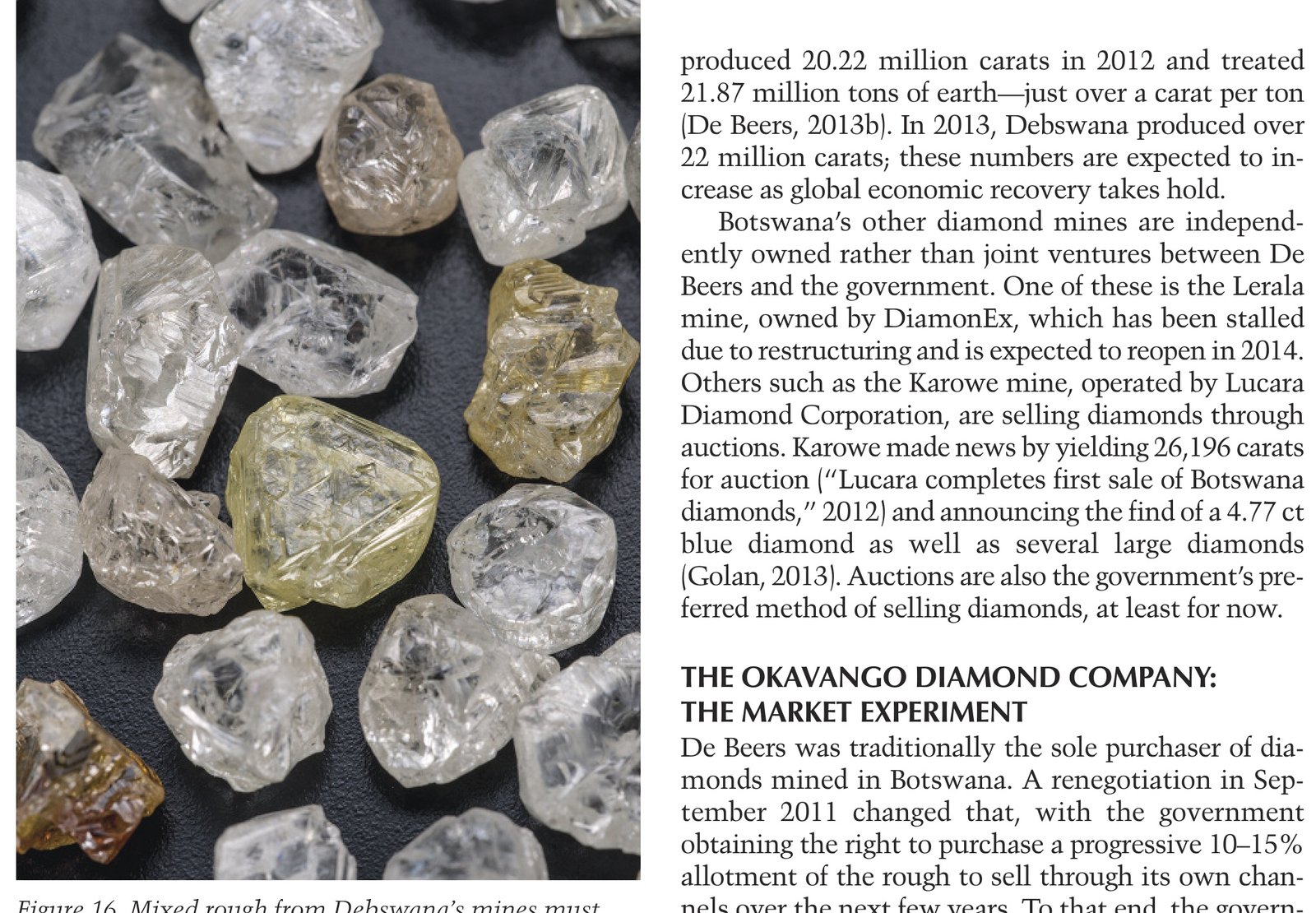
- 1929–1935: Oppenheimer’s Anglo American absorbs the Syndicate and De Beers; the Depression dissolves the syndicate structure into the Diamond Trading Company (DTC) — which mixed rough from all sources, sorted it by quality/shape/weight, set one standard price per category, and sold at 10 six-day “sights” a year, take-it-or-leave-it, no negotiation, immediate payment. When demand slumped, DTC stockpiled or imposed production quotas. That is the entire 20th-century market in one paragraph.
- 2001: “Supplier of Choice” overhauls sightholders: 2-year terms (later 30 months), renewal conditional on downstream brand-building obligations. 2008–09: for the first time, sightholders may defer sight parcels. The fixed-price machine bends toward the market.
- The market share backdrop: “Through nearly all of the last century, the company commanded 75–80% of world rough diamond sales” — controlling not just its mines but Soviet output (~1963 on), Argyle (1983), part of Ekati (1998), plus buying offices across Africa. The 15–20% outside the channels moved through Antwerp dealers, the legally sanctioned diamond clubs, and the gray market (Shor citing King 2009 and Even-Zohar 2007).
The structure only looks monolithic in retrospect: it was a response to volatility, and — as Module 3’s Janse data shows — it survived only as long as supply concentrated faster than demand. The USSR (1960s), Argyle (1980s), then Angola/Congo/Sierra Leone and Canada (1990s) fractured the supply base; De Beers’ own retreat to “customer of choice” (post-2011) and mixed sight/auction/tender sales is Shor’s 2014–2017 arc (see the A3 industry analyses: “De Beers Optimistic as Sales Revive; Luxury Houses Remain Cautious”, 2017).
Sights vs. tenders vs. live auctions — know the three sales floors
| Mechanism | Who bids | Price signal | Learner takeaway |
|---|---|---|---|
| Sights | Pre-selected sightholders, ~10×/yr, fixed categories | Administered price: raised in strength, “never downward” (Shor on the DTC rule) | Stability culture — and the resentment of rigidity |
| Tenders | Broader buyer pool, silent written bids, tallied at close | Clears at what the market says that day | Rough becomes a commodity line-item; volatility enters at step 1 |
| Live online auctions | Global pool, real-time, highest bidder | Instant price discovery; open entry | Shor’s own critics’ case: “speculative buying… much more volatile, especially since 2009”; proponents: “true market prices” and access |
Shor’s verdict in the abstract is dry and correct: “the evidence supports the volatility theory,” with the 2008 crisis and industry bank lending policy as co-culprits. For anyone quoting price moves at a counter, the mechanism matters more than the number: post-2007, parcels that once cleared at administered prices now clear daily — polished retail price cycles inherited the volatility of rough. This is the professional answer to “why did my upgrade quote change?”
Everything else on the A3 list, in one framework
The remaining ~15 citations are the same story from different vantage points; group them, and the bibliography teaches itself:
- Demand geography: U.S. ≈ “nearly 50% of world consumption” (Shor 2005) while “new markets such as India and China” take the growth baton — hence Zbird/China Diamond Exchange visits (2014) and India’s Surat polishing rise (Sevdermish 1998; also Module 5).
- E-commerce pressure: online diamond sales already 17% of U.S. retail by 2014 (Shor, GNI) — the prehistory of today’s omnichannel floor; price transparency is why the report (not the retailer’s memory) is the unit of comparison.
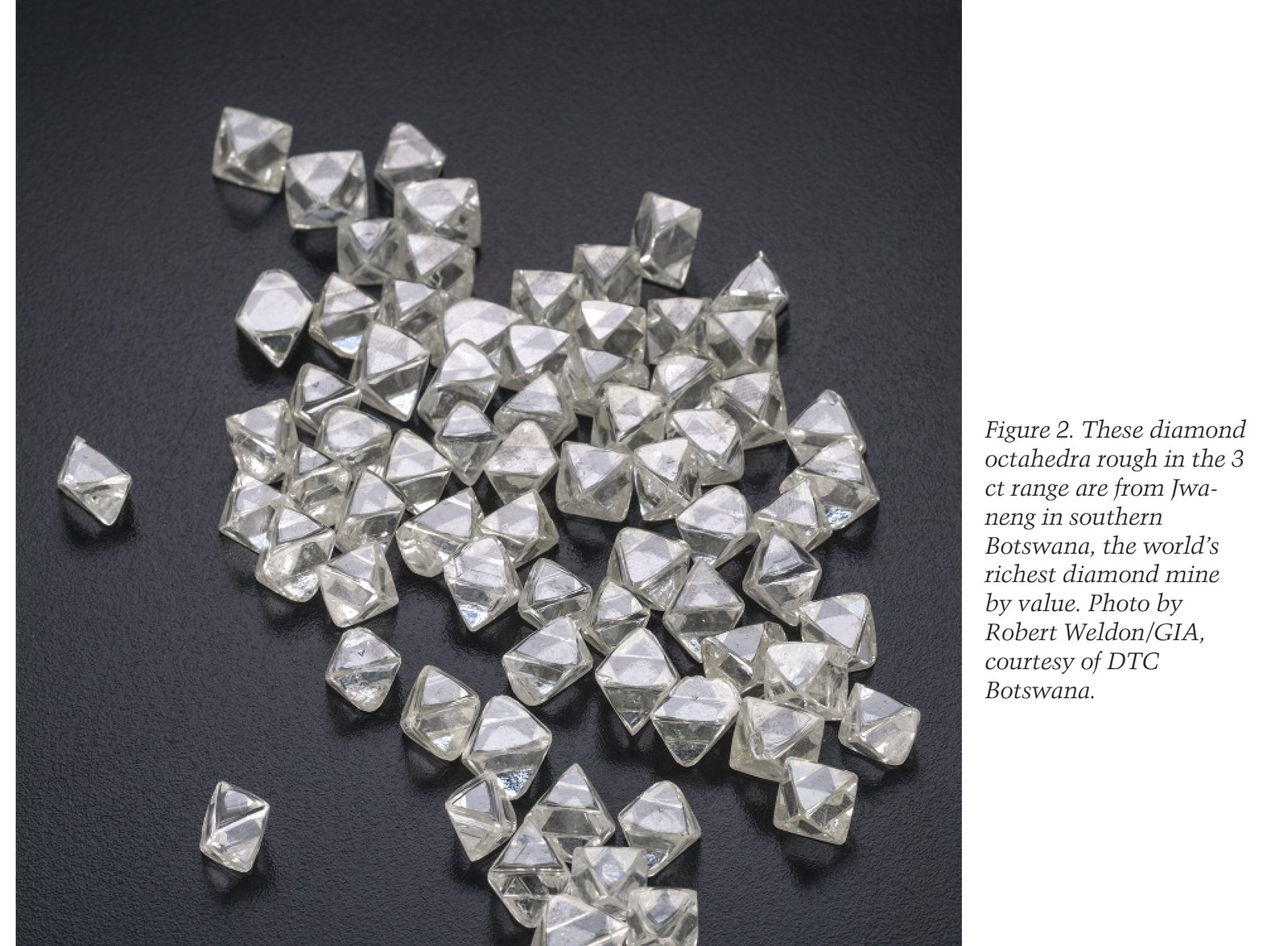
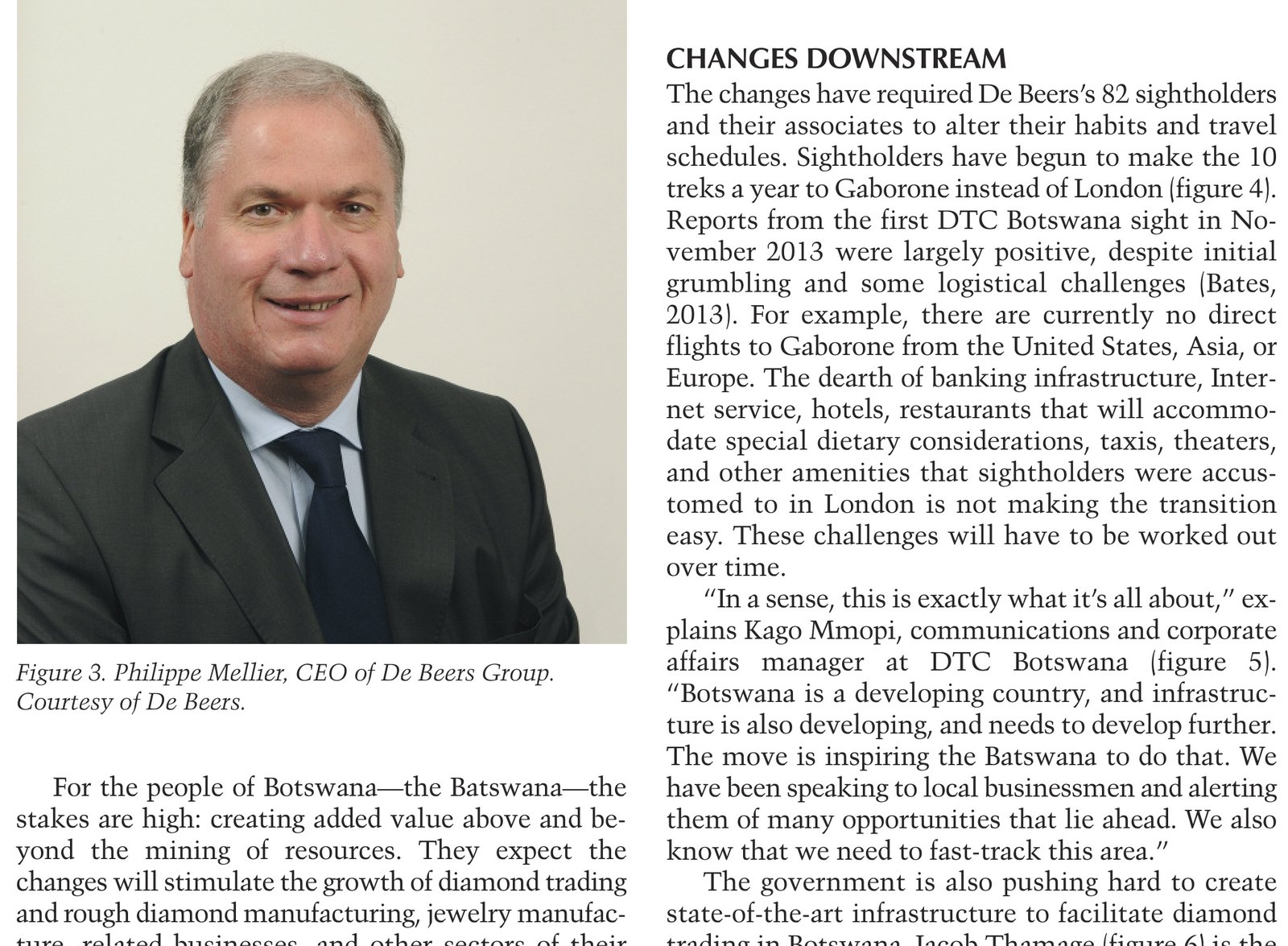
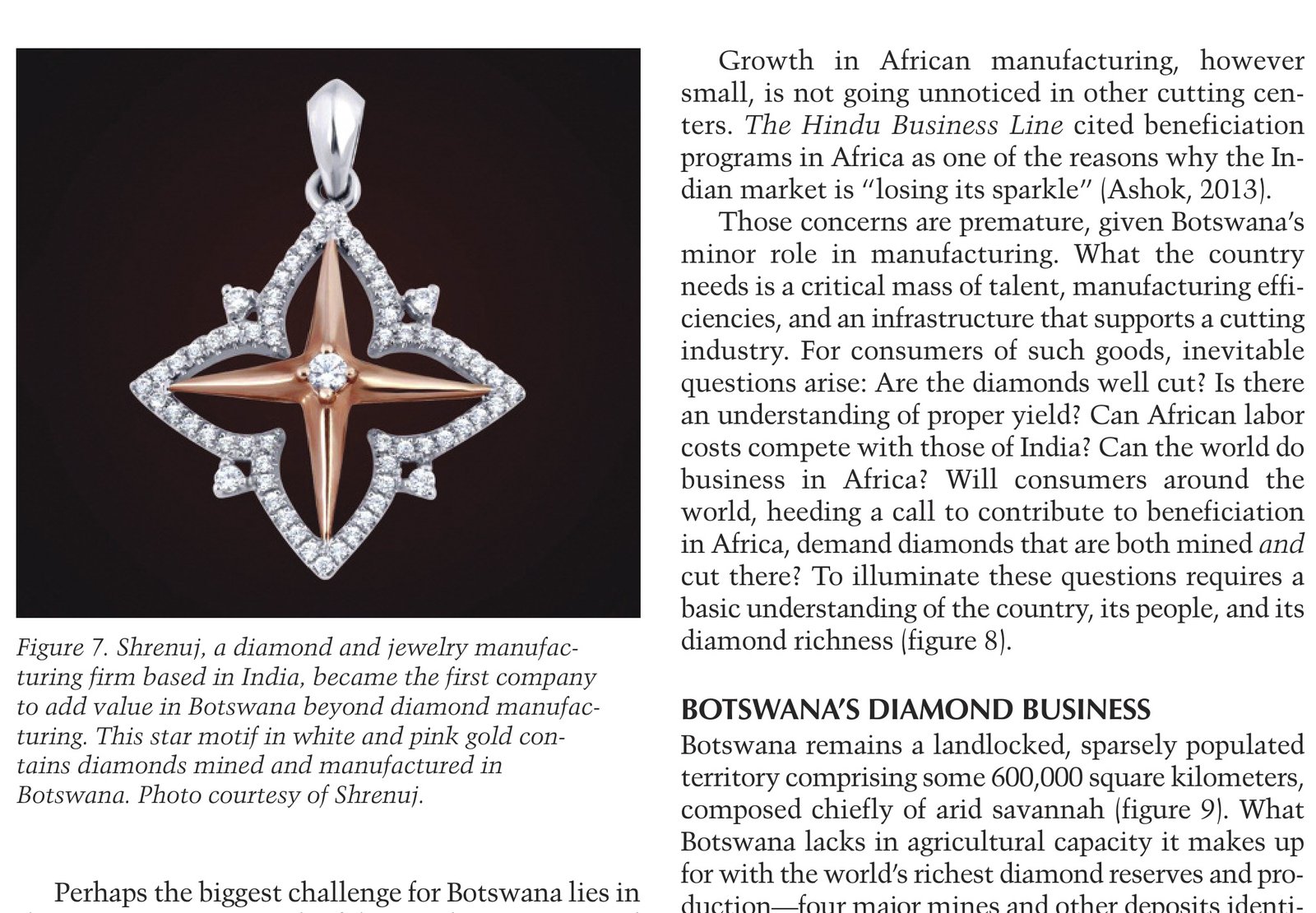
- Source-country economics: Botswana beneficiation (“Making Beneficiation Work” 2013; “Scintillating Moment” 2014) — De Beers signed a 10-year sales agreement with the Government of Botswana in 2011, and completed the physical move of its rough-diamond sales operation from London to Gaborone in November 2013, the centerpiece of Botswana’s beneficiation policy. Zimbabwe/Marange politics (“Taming Zimbabwe’s Diamond Production” 2014; KP suspension — see next), recycled diamonds as the above-ground “world’s largest resource” (2014).
- Governance: the Kimberley Process ratified winter 2002–03 (Shor, GNI 38:4; the Vancouver World Diamond Conference 2001 report), a government-industry WGC scheme with a single definition (“rough diamonds used by rebel movements to finance wars”) — which is precisely why later critics found it narrow (Marange, DRC “conflict-free” disputes live in the A3 list). Teach it as a floor, not a virtue badge.
- Price ceiling management: “Auction Houses: A Powerful Market Influence” (Shor 2013, G&G 49:1) + the 118.28 ct record-price note: Christie’s/Sotheby’s sales of big stones are the market’s published ceiling; their hammer prices ladder down into parcel pricing at the top of the goods. Major historical auction records — such as the 118.28 ct D-Flawless Oval sold at Sotheby’s Hong Kong in October 2013 for $30.6 million ($258,708/ct) and the 100.09 ct Graff Vivid Yellow sold at Sotheby’s Geneva in May 2014 for $16.3 million ($162,853/ct) (Module 13’s famous-stones economics) — are market infrastructure at 100+ ct.
The 2014 shock wave, told from inside the trade
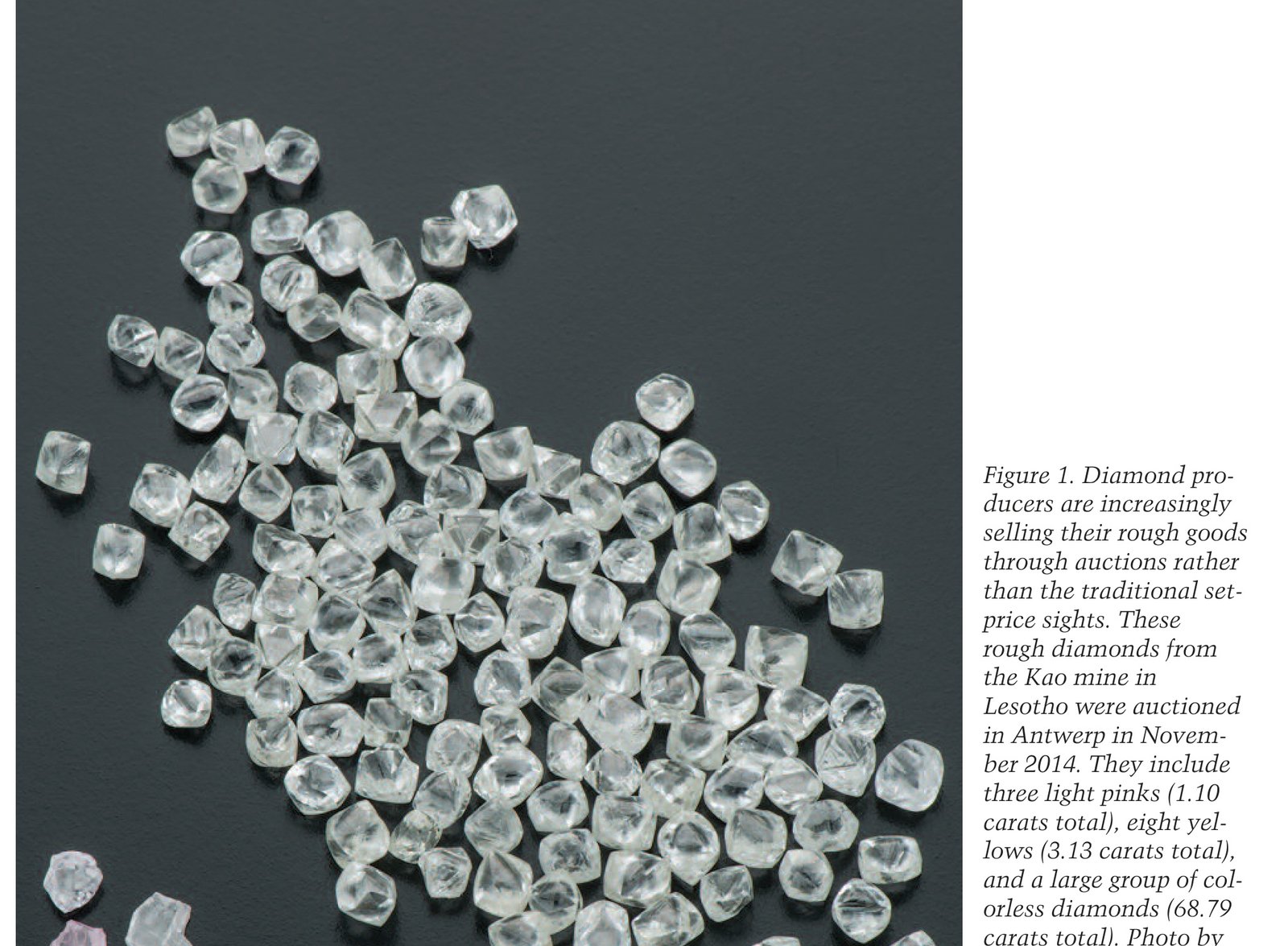
Shor & Weldon 2010 (“An Era of Sweeping Change”), plus the 2013–2015 industry analyses in the list, give the arc a student can narrate: post-2008 demand recovery → Chinese/Indian buying power → 2011–13 overstock of parcels → sightholders deferring or rejecting sight offers → producers diverting more rough to auctions and tenders to find price → 2014’s retailers-vs-trade price fight (Shor May 2014: “Retailers, Diamond Trade Still Vying over Prices”) → the 2015-16 correction De Beers answered by finally abandoning exclusive sights for “sights or sale” mixed models (2017 note). If you only take one line to the floor: rough-side distress shows up on your quote sheet three to nine months later.
Provenance-as-marketing: the market logic (forward map)
Once distribution decentralized, origin became a product: CanadaMark (Shor 2014 note — revived as an Ekati+Diavik seal, cut wholly in Canada), Botswana’s state-backed brand posture (2013–14 notes), De Beers’ TBC/Forevermark lineage (Module 11–13 tech context). Each is an access-control device: whoever owns the story of a parcel owns the margin above it. The same logic underlies proprietary cuts (Module 13) and, on the other side, the lab-grown price collapse — when a provenance premium floats free of geology, markets re-anchor fast.
Self-check
- Name the two problems Joel’s syndicate solved; which one returned with tenders/auctions.
- What did the DTC’s “mixing and sorting” do to price behavior, mechanically?
- Give De Beers’ approximate century-long share of world rough sales — and the three external supply events that eroded it.
- Define a tender vs a live auction; what does each add to price volatility, and per Shor what else (non-market) drove 2008–09?
- What is the one-sentence definition of “conflict diamonds” under the KP, and why does that make it a floor not a halo?
- How do auction-house records reach an ordinary parcel price three levels down?
- What is CanadaMark structurally (three constraints) and why does such a brand exist at all?
Further reading (A3)
Shor 2014 (read this module’s core PDF), Shor 2005, Shor & Weldon 2010, Shor 2013 auction houses, Shor 2014 online-sales + rough-auctions GNI pair, the China pair (Lucas/Hsu 2014), Botswana pair, Zimbabwe 2014, recycled 2014, Kimberley 2002 + Vancouver 2001, Boyajian 1988, Shipley 1949 for the pre-DTC world (Module 1). All links + annotations in `references/annotated-bibliography.md`.
Counter Simulation: The Market — Sights, Auctions & the Rise of the East
3 Scenarios • Market Mechanics
Telling clients “Diamonds just go straight from the mine to the store display case.”
“The global diamond pipeline is an intricate journey of specialized mastery. Rough diamonds are sorted in primary hubs like Gaborone and Antwerp, then allocated to contracted sightholders or auctioned in specialized tenders. From there, master cutters in Antwerp, Tel Aviv, and Surat analyze each crystal using 3D optical scanning to plan the cut, followed by grading at independent GIA laboratories before reaching our salon curated for your collection.”
Agreeing with the client that online discounters buy directly from factories, offering to match their price without inspection.
“Online discount platforms list virtual inventories aggregated from hundreds of overseas cutters, sight unseen. In contrast, our master buyers reject more than 85% of GIA-graded stones because a certificate only records baseline measurements, not visual personality. Two diamonds with identical paper specs can look completely different in life due to milky internal graining or dull facet luster. We curate only the top tier of live brilliance.”
Saying “Conflict diamonds haven’t existed since the 1990s, everyone follows the rules now.”
“Since the establishment of the Kimberley Process in 2003, certified by the United Nations, more than 99.8% of global diamonds flow through tamper-proof government-monitored channels. Beyond the Kimberley Process, our house enforces strict audited warranties and provenance tracking protocols that guarantee your diamond supported fair-wage employment, local community schools, and hospital infrastructure in producing nations like Botswana.”
🔬 Scientific Detail: Diamond Pipeline Logistics & Provenance Tracking
The Modern Pipeline: From Sightholder System to Forensic Traceability
The transformation of global rough distribution from a centralized monopoly to a multi-channel market involves strict custody protocols and modern trace-element forensics:
- The Kimberley Process Certification Scheme (KPCS): Established in 2003 under UN General Assembly Resolution 55/56; mandates tamper-resistant container certification for rough diamond export/import across 85 participating countries, reducing illicit conflict diamonds to under 1% of international trade.
- Manufacturing Distribution Hubs: Approximately 90% of global rough diamonds by volume are cut and polished in Surat, Gujarat (India), leveraging advanced CNC laser sawing and automated robotic scaifes, while diamond tenders and financial clearing remain anchored in Antwerp, Tel Aviv, and Dubai.
- Geochemical Origin Fingerprinting: State-of-the-art provenance tracking utilizes Laser Ablation Inductively Coupled Plasma Mass Spectrometry (LA-ICP-MS) to profile trace element concentrations (ppb-level impurities of K, Ca, Ti, Mn, Sr, Ba) to distinguish regional cratonic sources.
📚 Research References
- Even-Zohar, C. (2007). From Mine to Mistress: Corporate Strategies and Government Policies in the International Diamond Industry. Mining Journal Books.
- Kiefert, L. et al. (2019). “The Role of Advanced Analytics (LA-ICP-MS) in Gemological Origin Determination.” The Journal of Gemmology, 36(8), 712–727.
- Bieri, F. (2010). From Conflict to Coping: The Kimberley Process and Global Governance. Ashgate Publishing. ISBN: 978-0-7546-7888-5.