Grading Color: Masterstones, the D-to-Z System, and Fancy-Color Grading
Change log: Wave 4 first pass, built directly on the 2008 laboratory article’s abstract and two verified video narrations. M08 (defect physics) is the prerequisite; Module 7 (clarity) shares the process narrative.
What the article says about its own system
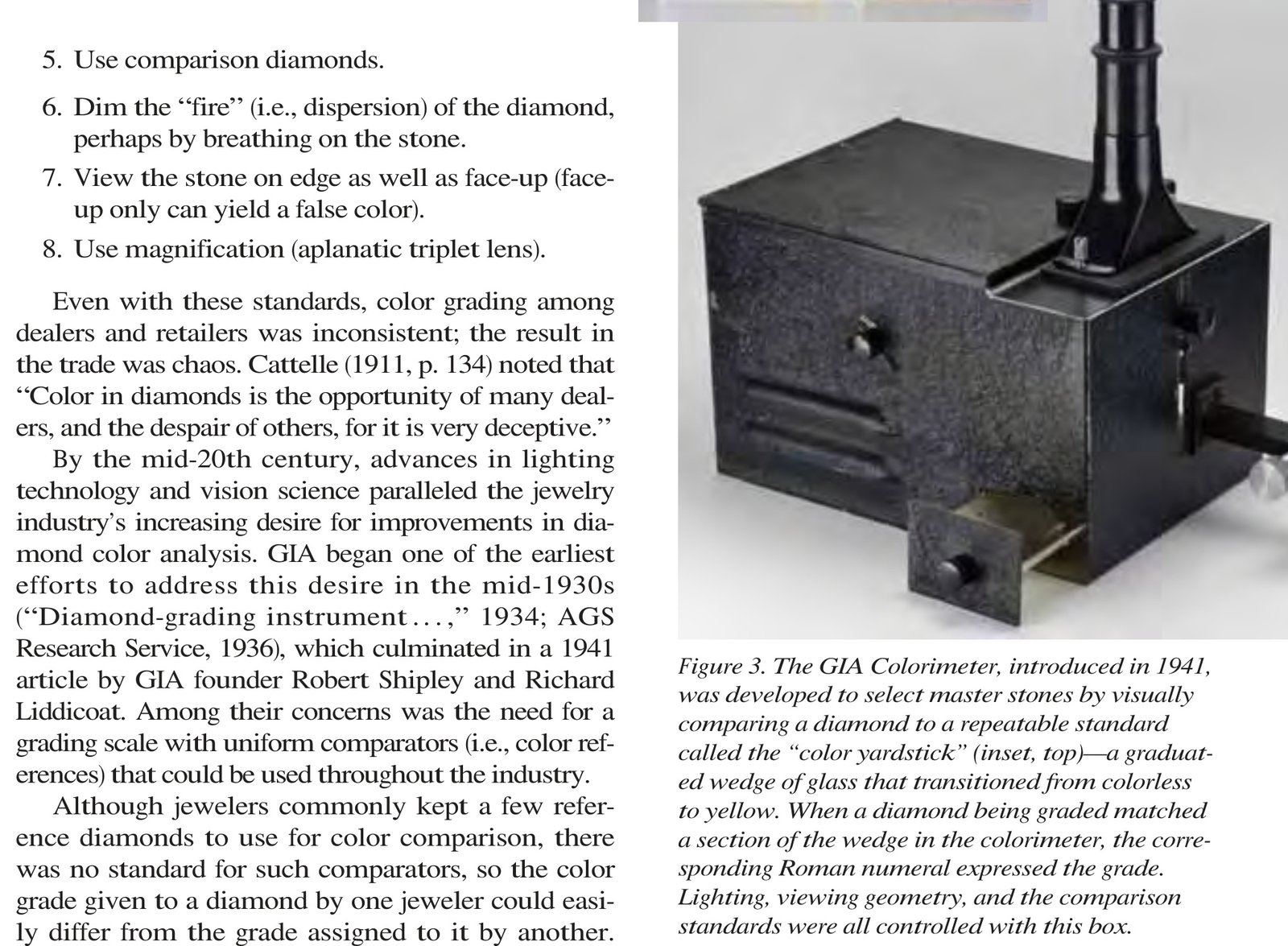
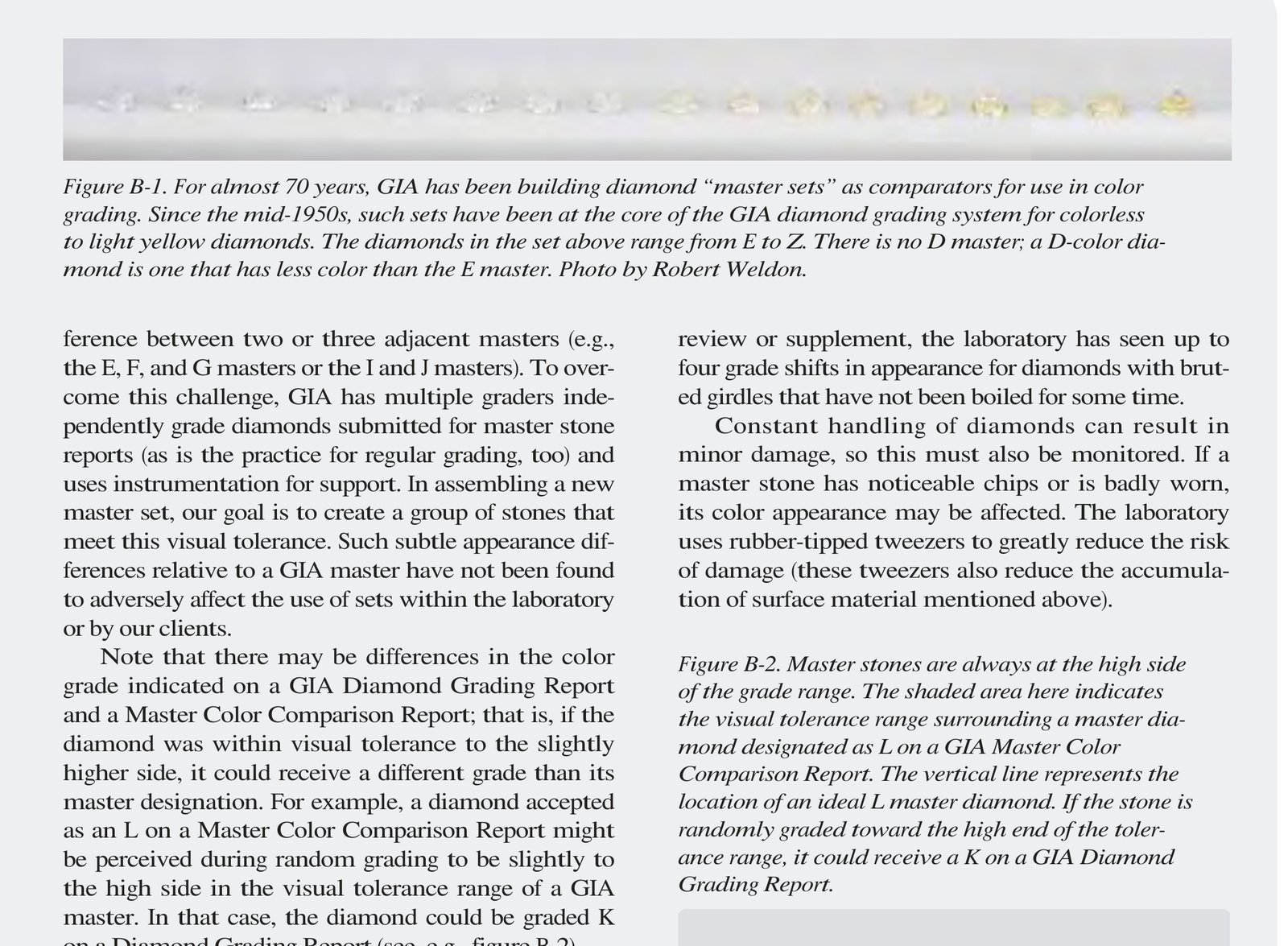
King, Geurts, Gilbertson & Shigley (G&G Winter 2008, the definitive GIA Lab description) open, verbatim from the abstract, with two facts most sellers don’t know they’re quoting:

- Age & universality: GIA’s D-to-Z scale was “introduced in the early 1950s” and since then “has been used to color grade the overwhelming majority of colorless to light yellow gem-quality polished diamonds on which laboratory reports have been issued.” The letters are now “virtually universal in the gem and jewelry industry” —
- — but: “the use of GIA color grading standards and procedures is not [universal].”
That gap — everyone borrows the alphabet, nobody necessarily shares the method — is the sentence that makes you valuable. Three method components the abstract names: a specific methodology for judging absence of color, standard illumination and viewing environment, and color reference diamonds (“master stones”) for visual comparison. (The video narrations confirm: “a color grade is determined by comparing each diamond to a master set assembled by carefully matching diamonds to the original set” — GIA-03, verified today.)
The D origin, honestly
The popular story — “they started at D so nobody could confuse it with the old A/B/C” — is consistent with the 2008 paper’s history section (title-level here) and is repeated in GIA-adjacent sources, but since we read only the abstract, mark it before publishing. What is safely quotable from our verified sources: the scale runs D→Z for colorless→light yellow/brown, each letter is “a range of color… a measure of how noticeable a color is” (GIA-03 narration), and pre-1940s merchant language (“tincture,” “river water,” “Cape”) is what standardization replaced (M01’s Gilbertson article).
Why a boundary is the right place to argue — and how labs decide it
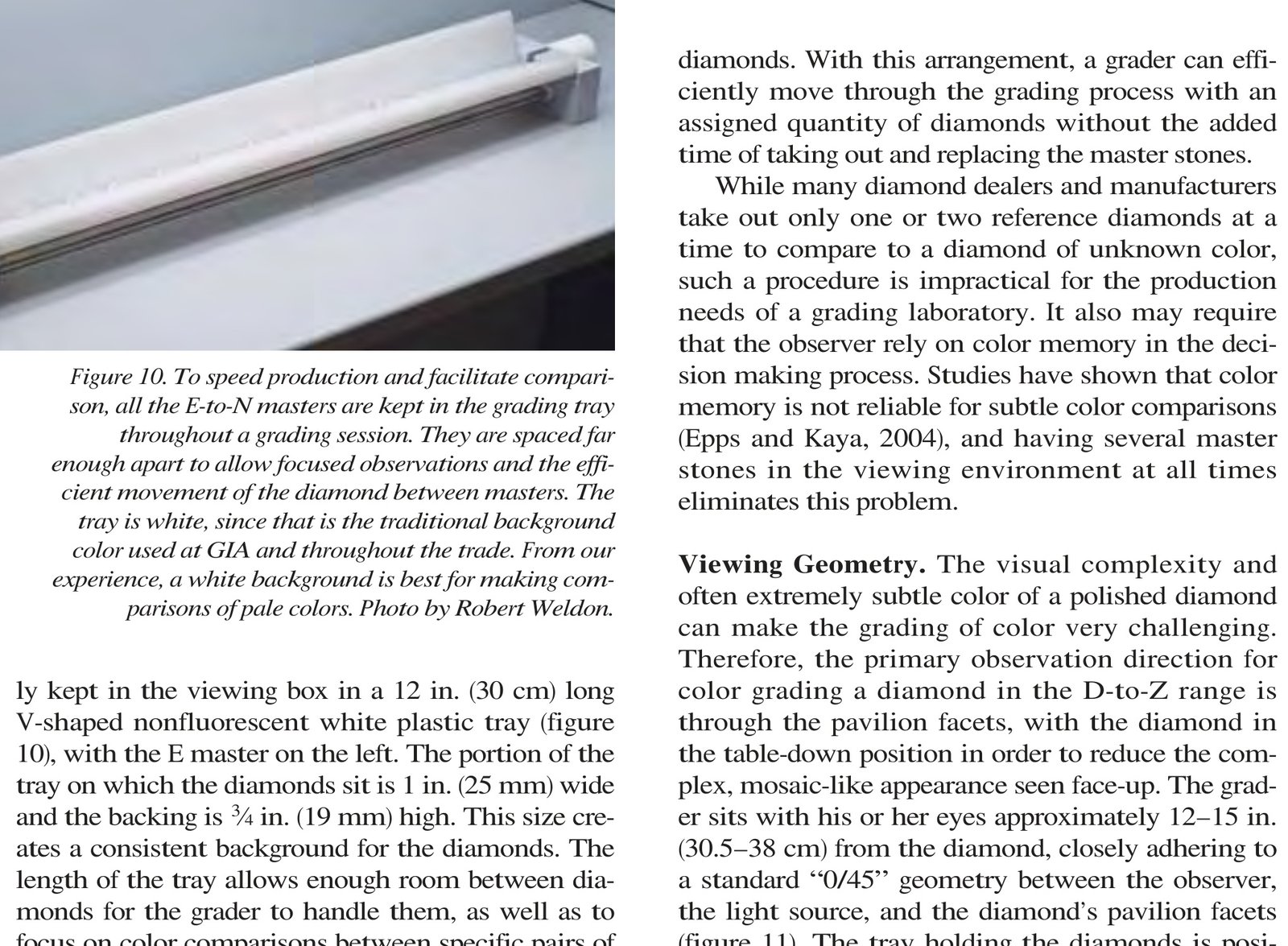
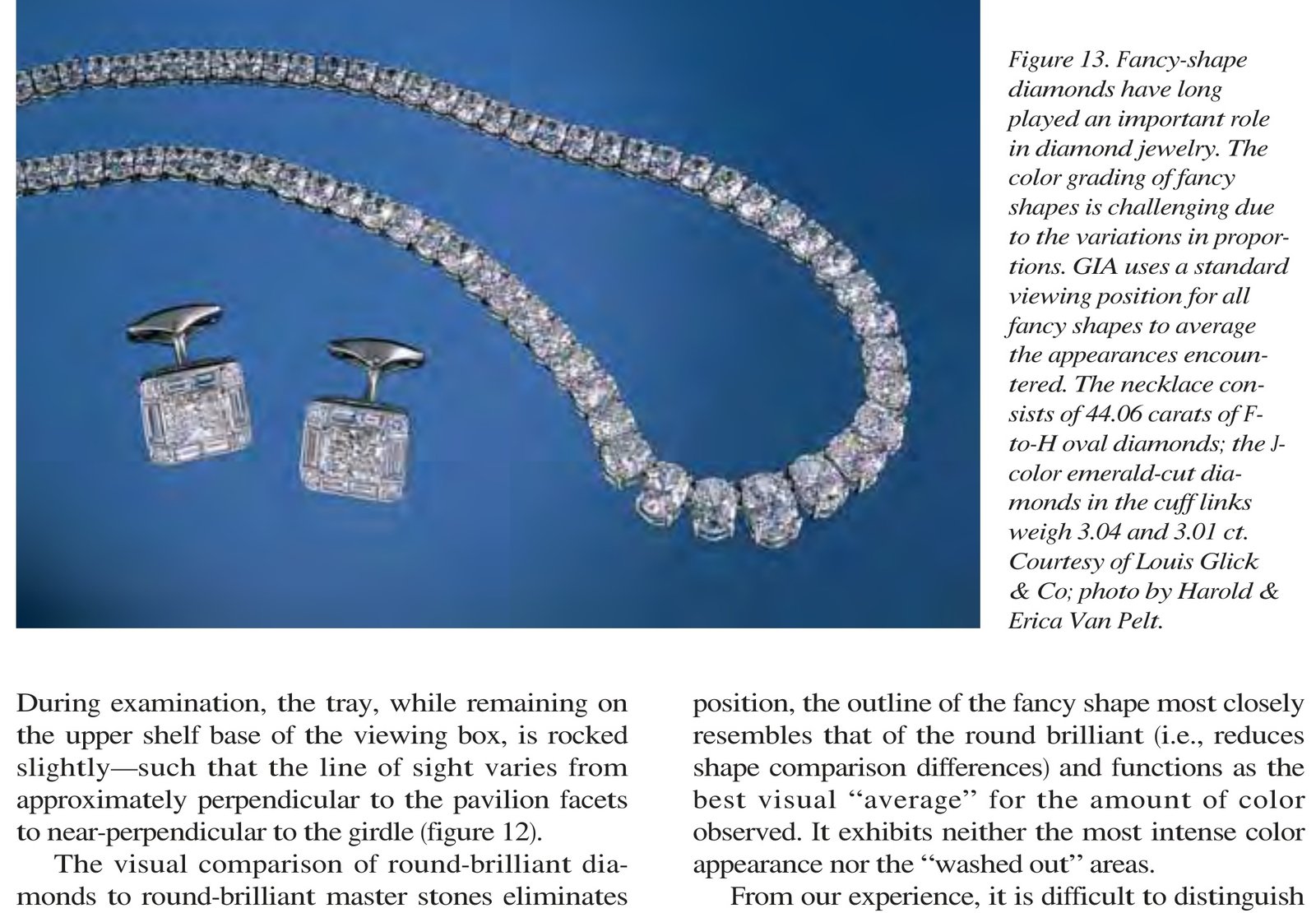
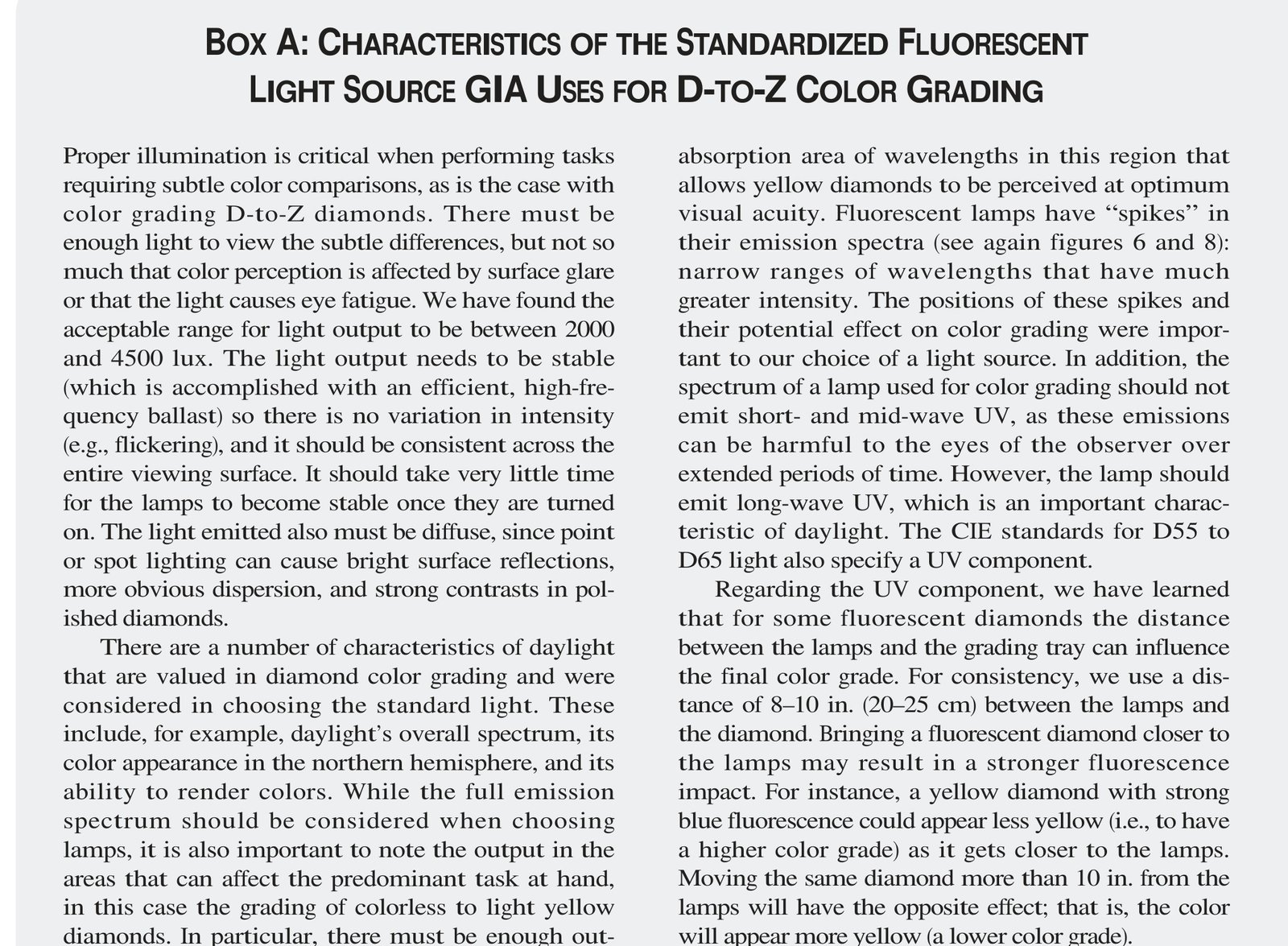
The literature in the A13 list converges on one design principle: the scale is built to absorb uncertainty without lying. Consequences worth teaching:
- Comparison beats memory. Graders never “recall” G; they bracket between masters. (The video’s “meticulously assembled” masterstone-set language is the lab’s own.) A stone lands in a grade; near-edge stones go to a second (and third) grader — the 2008 paper’s process description covers 100%-independent color grading at GIA’s Carlsbad-era lab; the video notes graders re-check near boundaries [phrasing generic — full detail in PDF].
- Conditions are part of the grade. Face-up, through the pavilion, daylight-equivalent source, neutral surround: change the environment and you change what “absence of color” means. That is why a stone can look whiter in daylight than its report suggests and the report is not wrong: GIA’s own Winter 1997 research (Moses, Reinitz, King, et al.) found that strongly blue-fluorescent stones are perceived as having better color face-up, with the largest benefit at lower color grades (I/K sets more than E/G sets), for average observers specifically. Fluorescence is not cosmetic trivia in a color conversation; it is a documented, favorable interaction at exactly the price point where clients scrutinize color hardest.
- Setting metal is an anchor. A yellow-tinted H in a yellow gold mount is invisible by design; the same G in platinum looks warmer. King et al.’s methodology exists precisely so that setting taste and lighting can be discussed instead of being confused with the grade. (Standard practice; consistent with the video framing.)
The one script that settles boundary disputes: “The report is the lab’s comparison of this stone, under their conditions, against masterstones — the letters are honest brackets, not promises about your lamp. Here’s your stone between the F and G masters in our case light — what we’re allowed to say is: it grades G, and it behaves like a G.”
Fancies: grading where the D-to-Z system ends
At Z, “lack of color” stops being the question. GIA’s fancy system (King et al. 1994, G&G 30:4 — the framework paper: hue, modifiers, tone, saturation; per-title from A12/A13): descriptive color name (Fancy Light Yellow… Fancy Vivid Blue), not a letter. Supporting studies in the list each map one color family’s grading boundary problem: yellows (2005: where Z vs Fancy Yellow cuts, and detection of treatment in yellow goods), blues (1998: type IIb characterization), pinks (2002: pink grading; Argyle tender study 2014), and the Argyle gray-to-violet hydrogen family (van der Bogert 2009). The mechanism base is M08’s chart; the market base is M04’s auction-house ladder.
The commercial truth of fancy grading, stated in the lab’s own terms (M08’s abstract, read): color origin verification often exceeds what visual grading can do — “separation of natural from treated is not always possible using standard gemological methods” — so a fancy color name on a report is a description, and the words “natural cause” appear in the report’s comments only when the lab could support them. GIA Fancy Color Diamond Grading Reports state the color grade (e.g. “Fancy Vivid Yellow”) and specify origin as “Natural” or “Treated” in the Origin line. If origin cannot be determined conclusively, it is explicitly disclosed, and treatments (e.g. irradiation, HPHT) are detailed in comments.
The GIA-02 video (verified) as training aid
GIA’s own 58-second color grading clip (verified live this build; GIA-02) walks the D-to-Z chart; pair with GIA-03’s full 10-minute lab walkthrough — both indexed in `videos/video-library.md` with timestamps. Use them for onboarding, not as substitutes for the method discussion above.
What this module does NOT let you claim
- “The report is always right at the boundary.” It is repeatable within its design; near-boundary stones are a legitimate second-opportunity zone — a re-grade request is normal commerce, not an accusation.
- “GIA grade > other labs by law.” The 2008 abstract’s point is standards/procedures differ, not market legality; describe differences in method and risk tolerance, never in “real vs fake cert.”
- Color = beauty. The M06 cut research and M08 defect logic both beat that drum; D-to-Z is an absence measurement.
Self-check
- Name the three method components of D-to-Z grading per King 2008.
- Quote the 2008 finding on letter usage vs. standards usage (verbatim from abstract).
- How does the masterstone-compare method answer “looks yellow in my window”?
- What can a report comment state about fancy color that the color name cannot?
- Where does “started at D” evidence stand right now in this course (tier + next action)?
- Why is an H-in-yellow-gold a method-first story, not a grade-first story?
Further reading (A13)
King et al. 2008 (read the full PDF — it’s the whole process); Shipley & Liddicoat 1941 (the pre-masterstone era); King 1994 (fancy framework), 2005 yellows, 1998 blues; van der Bogert 2009; the Moses 1997 fluorescence link (A12). Annotated list in `references/`.
Counter Simulation: Grading Color — Masterstones & the D-to-Z System
3 Scenarios • Color Grading
Attempting to judge diamond color by holding the stone upright under yellow store spotlights.
“When looking at a diamond face-up, an exceptional cut generates so much refractive brilliance that it masks subtle body color. To grade color objectively, GIA places the unmounted stone upside-down on its table facet against a dead-white background inside a standardized light box calibrated to D65 daylight (equivalent to northern noon sky). By viewing through the pavilion, gemologists eliminate sparkle and evaluate the pure, unmasked crystal body color.”
Telling the buyer “Anything below an F looks yellow and looks cheap in an engagement ring.”
“The D, E, and F grades represent the rare ‘Colorless’ tier, representing total chemical water-purity. However, G, H, and I belong to the ‘Near-Colorless’ family; once set in platinum or white gold, an H-color diamond facing up appears crisp and icy white to 99% of observers. In fact, if you choose a yellow or rose gold mounting, an I or J color stone blends harmoniously with the warm metal, freeing budget for a substantially larger carat size.”
Telling the customer “Never buy a diamond with fluorescence because it makes the stone defective and blurry.”
“Fluorescence is a natural optical phenomenon: when exposed to ultraviolet light, trace mineral structures emit a soft glow, most commonly blue. In diamonds in the I-to-M color range, medium-to-strong blue fluorescence actually cancels out faint yellow tones, making the diamond appear one to two shades whiter in natural sunlight! Less than 0.2% of fluorescent diamonds exhibit a hazy or milky appearance under normal light, and we inspect every stone to guarantee crisp, diamond transparency.”
🔬 Scientific Detail: Colorimetric Calibration & Masterstone Standards
GIA Physical Masterstone Selection Criteria & Viewing Geometries
Color grading in the D-to-Z range does not measure color saturation; it measures the degree of absence of color against tightly specified physical masterstones:
- Masterstone Specification Mandate: Each masterstone in a GIA-certified set must be at least 0.50 carat, round brilliant cut with at least Very Good proportions, graded SI1 or better with no eye-visible inclusions, and must exhibit zero UV fluorescence under long-wave ultraviolet light to prevent apparent color shift.
- Standardized Illuminant (D65): Graded under CIE Standard Illuminant D65 (6500 K correlated color temperature) with a color rendering index (CRI) > 90, housed in a Munsell neutral matte gray (N7/ or N8/) grading cabinet.
- Face-Down Pavilion Viewing: Stones are placed table-down in a grooved white grading tray and viewed perpendicular to the pavilion facets. This eliminates misleading optical brilliance and dispersion (“fire”) from masking subtle yellow tints.
📚 Research References
- King, J.M. et al. (2008). “Color Grading ‘D-to-Z’ Diamonds at the GIA Laboratory.” Gems & Gemology, 44(4), 296–321. DOI: 10.5741/gems.44.4.296
- Eaton-Magaña, S. et al. (2020). “Natural-Color D-to-Z Diamonds: A Crystal-Clear Perspective.” Gems & Gemology, 56(3), 335–365. DOI: 10.5741/gems.56.3.335