Light into Beauty: How the GIA Cut Grade Was Researched Into Existence
Change log: Wave 3 first pass. This is the module sales professionals push back on (“cut is subjective”) — so every quantitative claim here is anchored to a read source; everything else is marked by citation tier.
The claim you’ll make, and the receipts
“Excellent cut” is one letter-grade on a report, but it is the only one of the 4Cs whose standard was not invented and imposed — it was measured out of human observers and then predicted back. GIA’s own research summary (Jan 2016, “Cut: The 4th C”) documents the pipeline end to end; it is the single best source in the entire further-reading list for converting a price objection. Here is the arc in six moves.
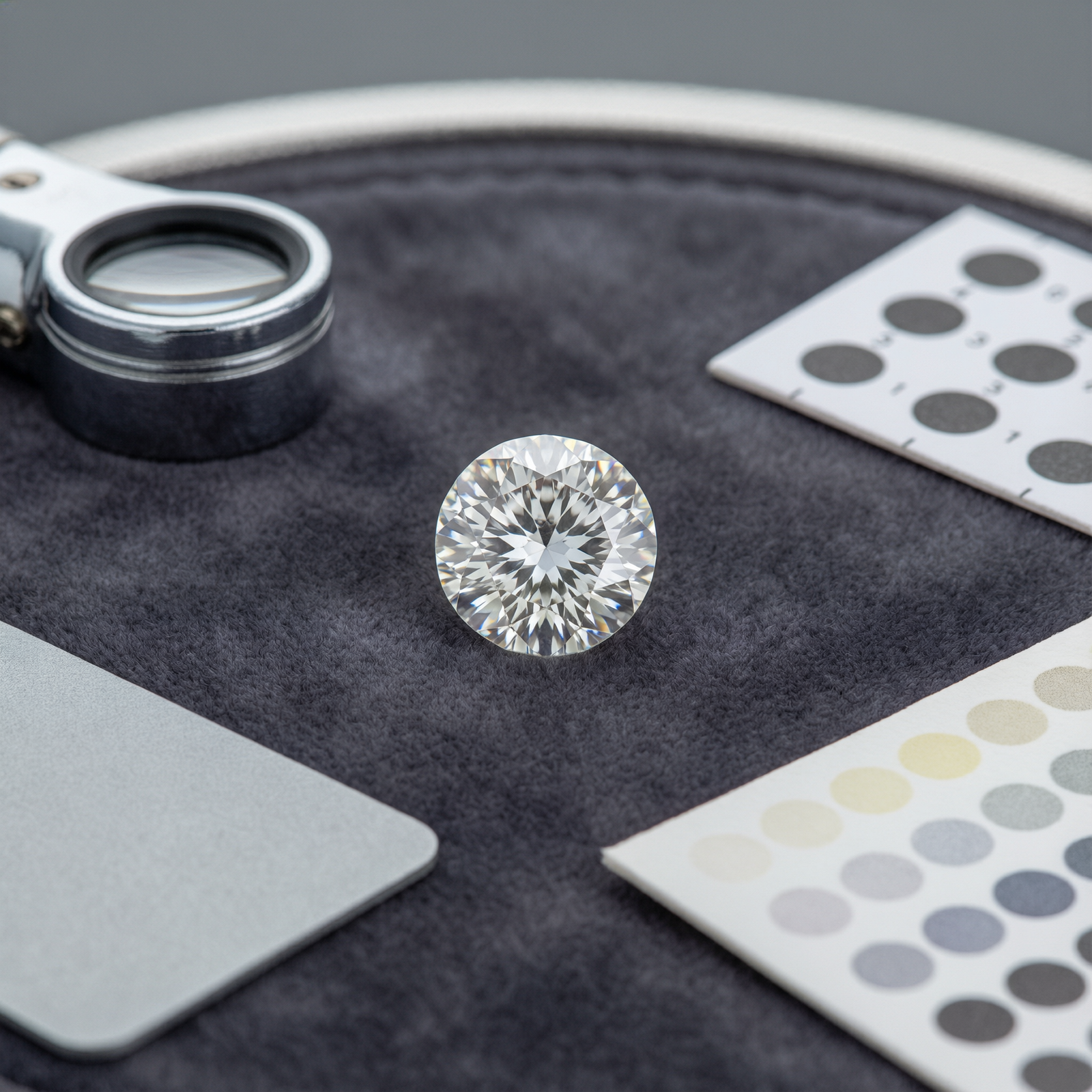
1. Modeling (1989 onward): thousands of proportion sets, one finding
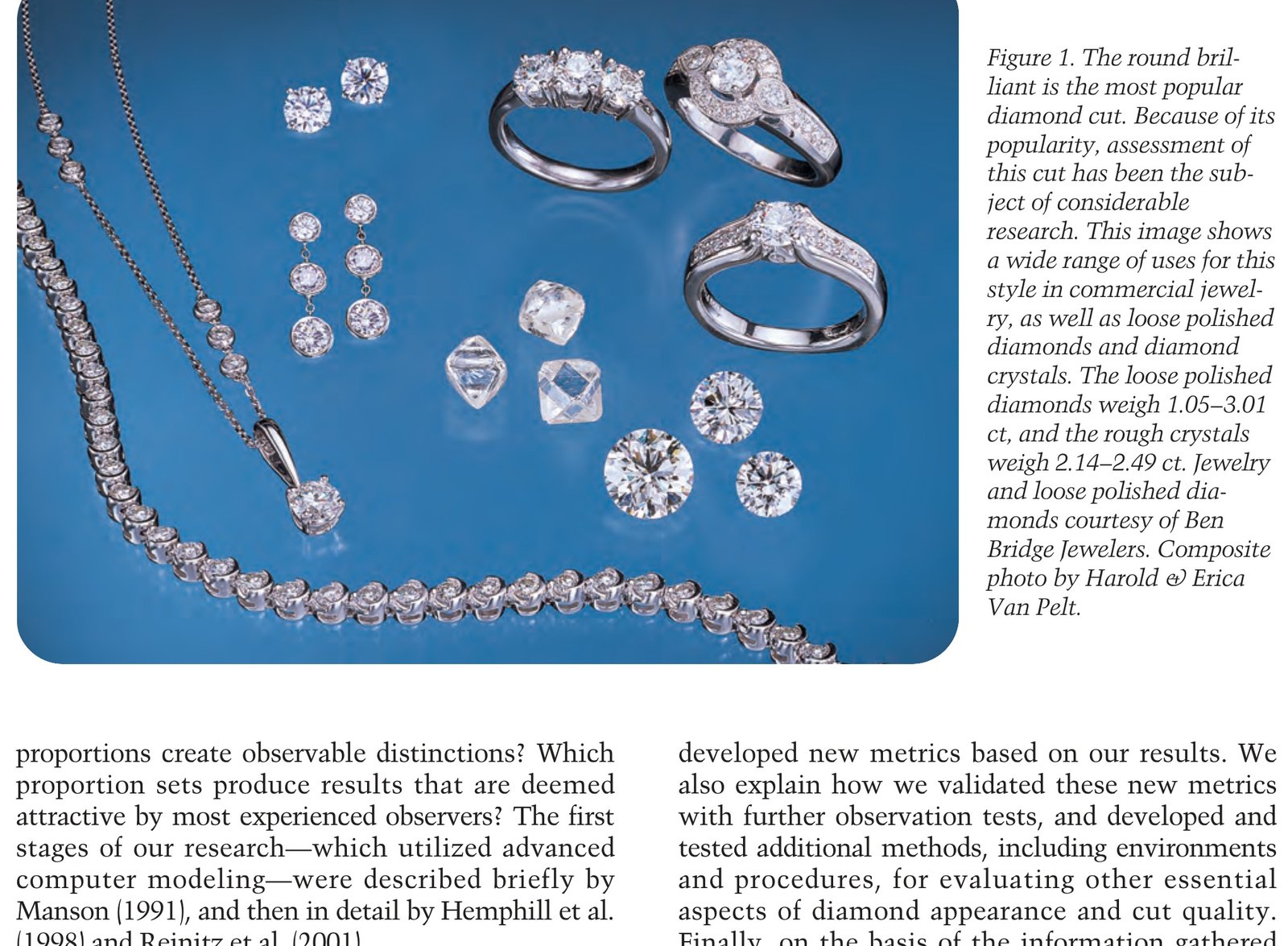

With new computer technology “GIA developed an advanced ray-tracing program to understand how light interacts within a round brilliant,” analyzing tens of thousands of proportion sets across table size, crown angle, pavilion angle, star length, lower-half length, girdle thickness, culet size, and total depth — plus polish and symmetry’s effect on appearance. Two findings killed folklore:
- “All of these parameters were interrelated… no single proportion, or subset of proportions, could be considered alone.” — the citation that ends every “61/57 table” sales myth (see §5).
- “There was a wide range of proportions that had the potential for high quality light performance.” — Excellent is a region, not a needle.
The research-lineage citations in the handout are the papers behind this stage: Hemphill et al. 1998 (brilliance modeling) and Reinitz et al. 2001 (fire + further brilliance) in G&G, continuing the modeling tradition of the trade’s earlier optics — the GIA page frames Marcel Tolkowsky’s 1919 Diamond Design as the ancestor everyone cites; the journal itself notes the 1919 book’s model was a first theoretical pass, not the grading standard. [Title-level for Tolkowsky specifics.]
2. Observation: the largest study of its kind, with the industry as its subjects
To make the model human, GIA ran standardized-lighting observation tests: over 70,000 observations on more than 2,300 diamonds, by observers from every sector — manufacturers, dealers, retailers, consumers (“without a doubt, the largest study of this type ever conducted”). The result that should change how you grade-speak:
- Observers consistently discerned five overall cut categories — Excellent → Poor — and
- “personal and regional preferences in appearance were an inherent part of a truly functional cut grading system”: within a grade, taste picked favorites. The system was therefore built to sort what everyone can see, not to legislate what only some prefer.
This is the sentence for the client who “doesn’t like” an Excellent-cut stone’s look: five tiers exist because that’s how many humans can reliably tell apart — and being able to say that is the expertise.
3. A predictive system, not a checklist
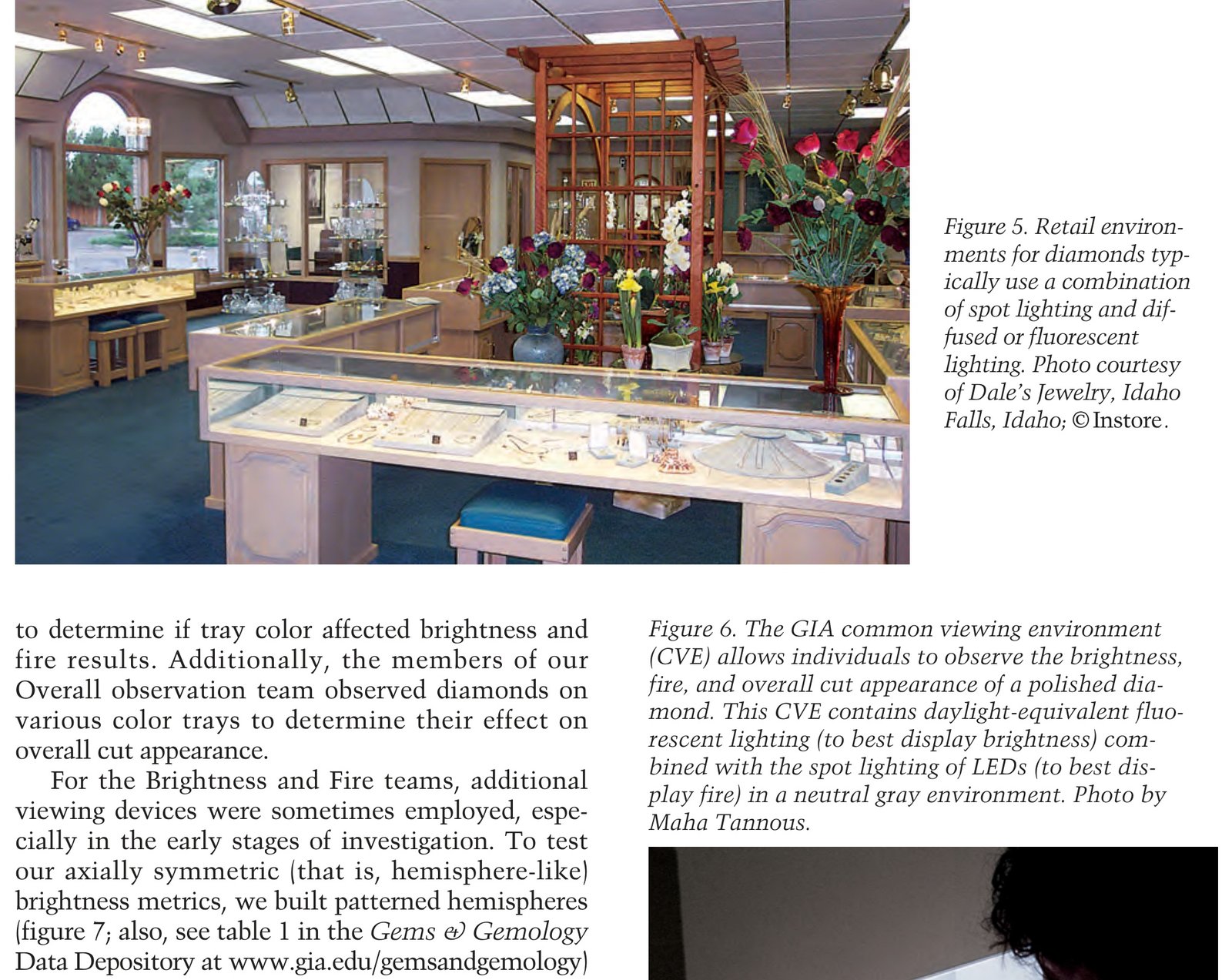
The grade is generated from a database: input the complete proportion set, get the grade the study says most observers would give — “cut grading results for over 38.5 million proportion combinations.” GIA publicly announced the comprehensive cut grading system for round brilliants in 2005, and began issuing cut grades on standard grading reports on January 1, 2006, “to establish standards for cut in the same manner as it has for color and clarity,” supported by its 38.5 million proportion database.
4. Seven components: the anatomy
The video narrations GIA published (verified 2026-09-09, GIA-01/-04) recite the same list twice: the grade “takes into account seven components — brightness, fire, scintillation, weight ratio, durability, polish, symmetry.” Three are face-up appearance, three are craftsmanship and design, one — weight ratio — is economics wearing an optical hat (too deep = weight hoarded in a dark center; too shallow = spread, but a fish-eyed ghost). The 2016 page adds exactly what the modeling proved about each appearance component:
| Component | Physical basis (per the modeling papers) | What to look for |
|---|---|---|
| Brightness | total internal return through crown facets | white light face-up; no dead center |
| Fire | dispersion at facet edges | colored flashes at facet junctions |
| Scintillation | contrast pattern of bright/dark + its breakup with tilt | pattern crispness, not count of sparkles |
5. Finish: where “visual grading” got boundaries
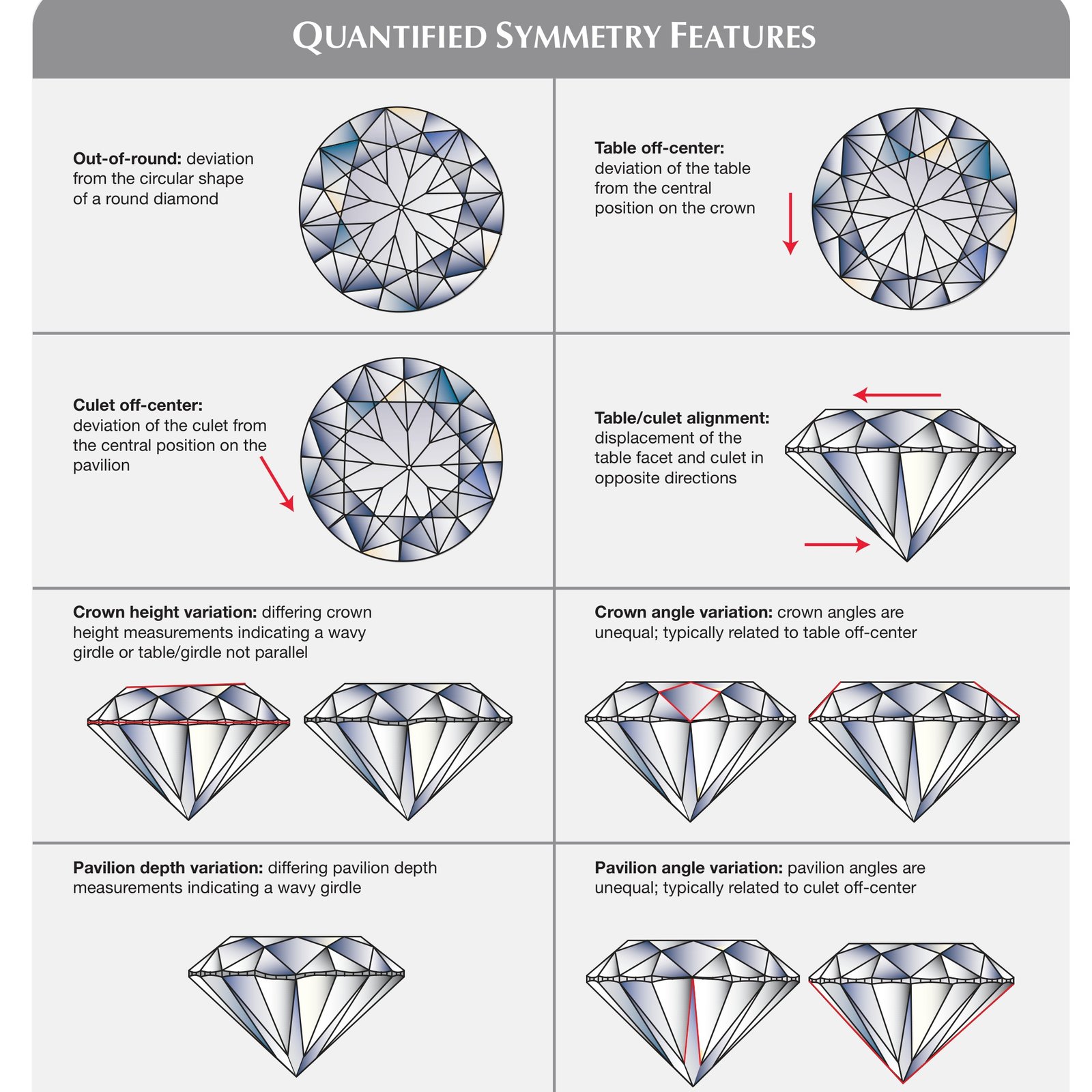
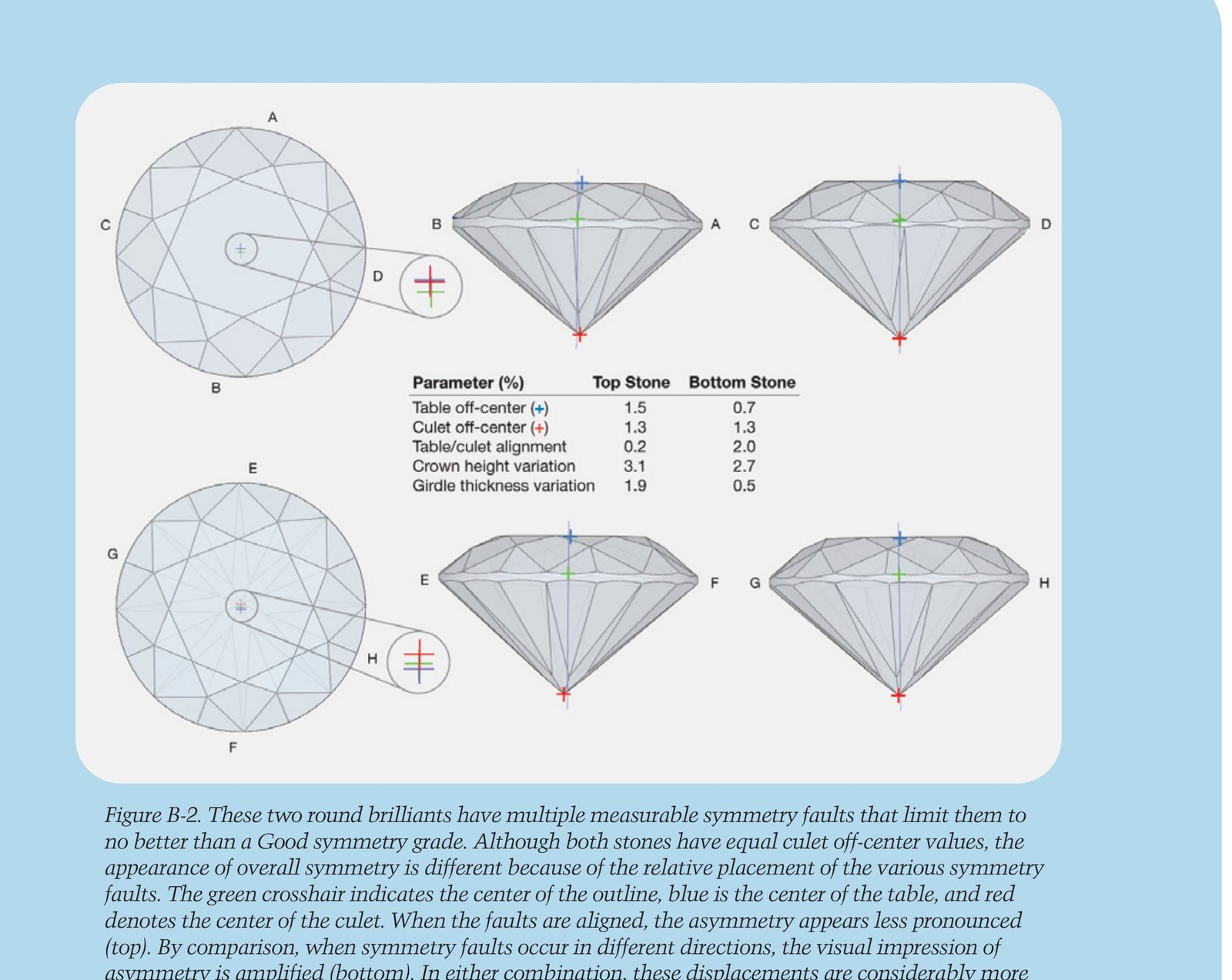
Moses et al. 2004 (“A Foundation for Grading the Overall Cut Quality…,” G&G 40:3) is the handout’s paper that set the criteria later folded into the DMO era and final system; Geurts et al. 2011 (abstract read) is its mechanical epilogue: grade boundary limits for 10 symmetry parameters, in force from early 2012 to “support and constrain visual symmetry grading,” while other symmetry features stayed visual. Polish & symmetry vocabulary per the GIA guide cited in A15: graders describe what they see; the boundaries say how far it may move the grade.
Liddicoat’s own era appears in A14 — his ProportionScope (1967) and “Rapid Sight Estimates” (1962) articles are the pre-research pedagogy: train the eye to catch shallow/deep. The 2011 study is what eventually replaced “experienced eye” with “calibrated instrument + bounded judgment” at the lab. History arc complete: 1949’s “Cutting” → 2006’s cut grade → 2012’s bounded finish grading.
6. The one experiment worth doing (dispersion as proof)
Gilbertson et al. (2009) — the cut-research team at GIA cutting sub-micron diffraction gratings onto diamond facets to increase dispersion efficiency and fire by a factor of 4 to 5 under directed spot lighting (Gems & Gemology, Vol. 45, No. 4, pp. 244–256) — is the module’s mic-drop demonstration that “fire” is a controllable optical engineering variable, not magic.
Pseudoscience field guide (what this module now lets you kill)
- “The best cut is 61.1% depth / 57% table with 34.5° crown.” No — interrelation finding: no single proportion decides; that number pair was a 20th-century heuristic that predates 2006 and now causes mispriced diamonds.
- “Super-ideal cuts return more light than Excellent.” Excellent covers a range; multiple Excellent stones with different proportions can be equally “maximal” within model error.
- Hearts-and-arrows = cut grade. H&A is a pattern symmetry of certain proportion sets — a marketing photograph, not the GIA grade; a Poor-cut stone can show hearts and arrows in the right viewer (and lab graders evaluate the 7 components regardless).
- “My stone doesn’t look like the video’s.” Regionality finding: preference within grade is built in; five tiers is the human limit, not a quality ceiling.
Counter scripts
“Why $2,000 more for Excellent than Very Good — they look the same to me?” — “GIA tested 70,000+ observations to draw the lines between grades; Very Good is ‘slightly less than ideal appearance’ — the difference is engineered contrast, visible when tilted, not a story about sparkle quantity. If two stones look identical, price the one you like — but that’s a taste argument, not a grade argument.”
“Is a certified Excellent guaranteed to be the most brilliant stone in the case?” — “Guaranteed to be in the top tier the lab could measure; the model also says several different proportion designs can reach that tier — which is why we can find your balance of brightness versus bold faceted pattern.”
Self-check
- Recite the 1989→2006 research pipeline in six moves without looking.
- Quote the two findings that (a) killed single-number cut claims, (b) validated the 5-grade structure.
- Name the 7 components and which is really economics.
- What did 2004’s Moses paper and 2011’s Geurts paper each change at the lab?
- Give the H&A correction and the “looks identical” correction.
- Which finding makes “personal preference” part of the system rather than a bug?
Further reading (A8 + A14 + A15)
GIA “Cut: The 4th C” (this module’s backbone); Moses 2004, Hemphill 1998, Reinitz 2001, Gilbertson 2009; Liddicoat 1962 (×2) + 1967; Geurts 2011; GIA polish/symmetry terminology guide; the A9 cutting-history pieces (M05) as prequel. All annotated in `references/`.
Counter Simulation: Light into Beauty — The GIA Cut Grade
3 Scenarios • Cut Excellence
Telling the client “Just look for a 57% table and 62% depth on the certificate and you have a perfect stone.”
“Table and depth percentages are only two components of a complex three-dimensional puzzle. A diamond can have a textbook 57% table, but if its crown angle is 36 degrees paired with an overly steep 41.6-degree pavilion angle, the stone enters the ‘steep-deep’ zone where light escapes through the pavilion base. GIA evaluates cut quality using a computerized database of over 70,000 ray-traced combinations. We look at the total harmonic relationship of all 57 facets.”
Only showing the diamond under intense showroom halogen spotlights where every stone looks bright.
“Notice how this diamond behaves under our focused spotlight: that rainbow shower of spectral colors is its ‘fire’. Now let’s step across the room into diffuse natural daylight near the window. Do you see those crisp, alternating flashes of light and dark as we tilt the tray? That is ‘scintillation’, combined with deep white ‘brightness’. A premier GIA Excellent cut is engineered to look alive in a candlelit restaurant, an office boardroom, or outdoor sunlight.”
Saying “Very Good and Excellent look completely identical, it’s just a marketing trick to charge more.”
“Let’s examine both stones under the gemological loupe. In the Excellent cut, every facet junction meets at a razor-sharp point, and the pavilion angles reflect light with perfect symmetry, creating a crisp, uniform pattern of light return. In the Very Good stone, slight deviations in facet symmetry or minor crown steepness mean about 10% more light leaks through the base. While both are beautiful, the Excellent cut delivers the purest light return modern physics can achieve.”
🔬 Scientific Detail: Optical Physics of Brilliance & The GIA Cut System
Snell’s Law & Total Internal Reflection (TIR) in Diamond
The fiery optical performance of a round brilliant diamond is governed by rigorous optical physics and Snell’s Law ($n_1 \sin \theta_1 = n_2 \sin \theta_2$):
- Extremely Small Critical Angle ($ heta_c$): With a high refractive index ($n = 2.417$), diamond’s critical angle is calculated as:
$$\theta_c = \arcsin\left(\frac{1}{n}\right) = \arcsin\left(\frac{1}{2.417}\right) \approx 24.4^\circ$$
Any light ray within the diamond striking an internal facet at an angle greater than $24.4^\circ$ undergoes 100% Total Internal Reflection (TIR) rather than escaping. - Chromatic Dispersion ($0.044$): Diamond slows red light ($\lambda = 687\text{ nm}$) to $n = 2.407$ and violet light ($\lambda = 431\text{ nm}$) to $n = 2.451$. This refractive index differential splits white rays into rainbow spectral flashes (“fire”).
- The Multi-Dimensional GIA Cut Matrix: In Moses et al. (2004), GIA completed 70,000+ computer ray-tracing simulations combined with visual human observation trials across 2,300+ diamonds, establishing that proportions interact holistically: a steep crown angle ($35.5^\circ$) can be optically balanced by a shallower pavilion angle ($40.6^\circ$) to achieve an Excellent cut grade.
📚 Research References
- Moses, T.M. et al. (2004). “A Foundation for Grading the Overall Cut Quality of Round Brilliant Cut Diamonds.” Gems & Gemology, 40(3), 202–228. DOI: 10.5741/gems.40.3.202
- Hemphill, T.S. et al. (1998). “Modeling the Appearance of the Round Brilliant Cut Diamond: An Analysis of Brilliance.” Gems & Gemology, 34(3), 158–183. DOI: 10.5741/gems.34.3.158
- Reinitz, I. et al. (2001). “Modeling the Appearance of the Round Brilliant Cut Diamond: An Analysis of Fire, and More About Brilliance.” Gems & Gemology, 37(3), 174–197. DOI: 10.5741/gems.37.3.174
- Dodson, J.S. (1978). “A Statistical Assessment of Brilliance and Fire for the Round Brilliant Cut Diamond.” Optica Acta, 25(7), 581–592. DOI: 10.1080/713819843