Module 3: Shape, Setting, Metal: Guiding Without Overwhelming
When an engagement ring customer experiences decision fatigue, the sale dies.
Modern buyers face an overwhelming catalog of choices. Diamond shapes span round, oval, emerald, radiant, pear, marquise, and cushion cuts. Mounting architectures range from delicate four-prong peg heads to cathedral bridges, hidden halos, and full bezels. Metal alloys vary between 950 platinum, 18k yellow gold, and rose gold.
Untrained sales associates compound this confusion. They pull ten rings onto the counter, lecture the client on every nuance, and ask: “Which one do you like best?”
The client’s eyes glaze over. They feel pressured, exhausted, and uncertain. Inevitably, they utter the retail brush-off: “We need to go home and think about it.”
Elite bridal consultants take the opposite approach. They operate as visual editors. They understand how hand anatomy guides stone proportions, how daily lifestyle dictates setting security, and how metal color influences diamond perception.
—
—
1. Diamond Shapes and Hand Anatomy
A diamond does not exist in isolation; it lives on a human hand. The same 2.0-carat oval looks entirely different on a long, slender finger than on a short, athletic hand with prominent knuckles.
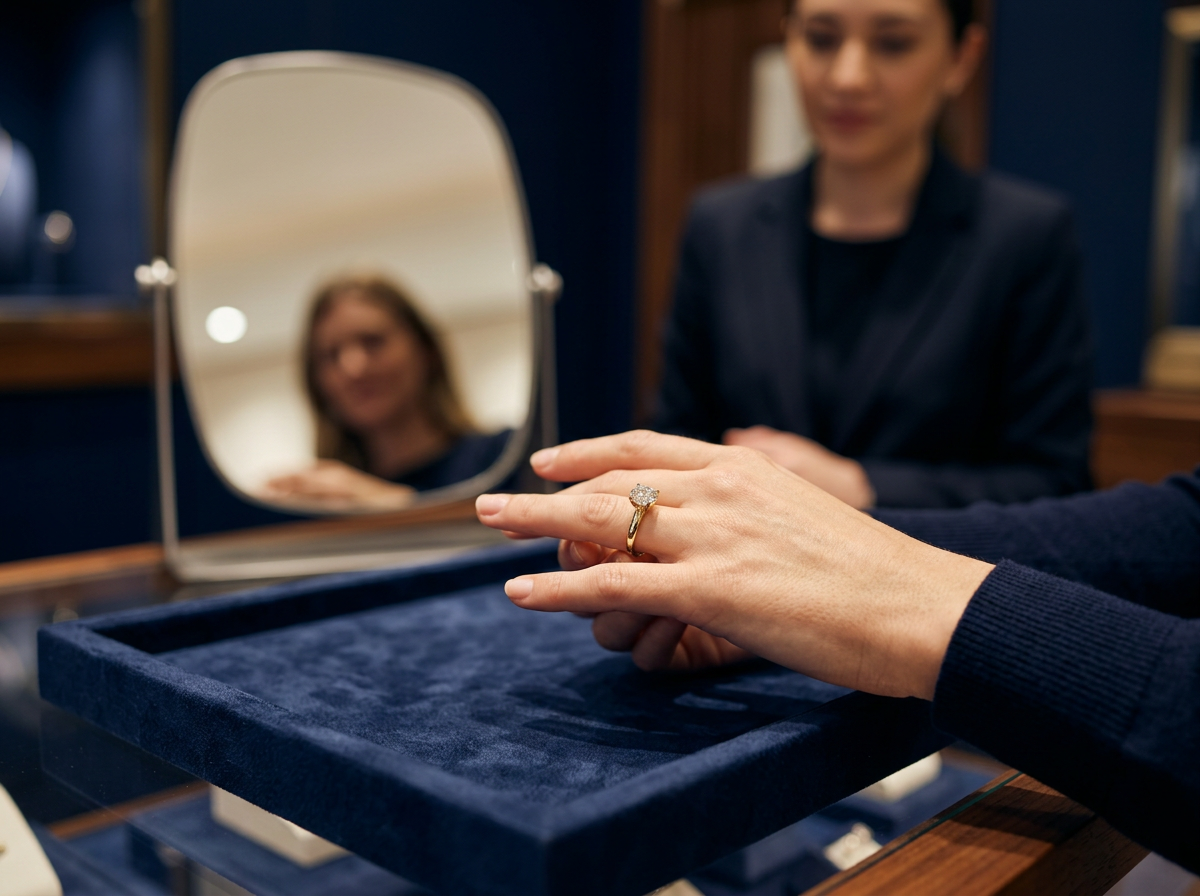
Understanding length-to-width ratios allows you to guide clients toward shapes that look harmonious on their hands:
– Long, Slender Fingers (Ring Size 3.5 to 5.0): These hands can wear almost any shape. Wide-spread stones like emerald cuts, cushions, and classic rounds look balanced without overwhelming the phalanx.
– Shorter Fingers (Ring Size 5.5 to 7.0): Elongated shapes create an optical lengthening effect. Ovals with a 1.35 to 1.45 ratio, marquise cuts, and elongated radiants draw the eye upward along the finger.
– Prominent Knuckles: Wider bands, three-stone silhouettes, and substantial split shanks draw visual weight down toward the finger base, balancing the width of the joint.
When a client tries on a shape that looks out of proportion, do not criticize their choice. Hand them an alternative and let their own eyes make the comparison:
“Notice how the length on this oval cut follows the natural line of your finger. It gives you generous finger coverage while feeling light and graceful.”
—
—
2. Mounting Architecture and Everyday Durability
A bride wears her engagement ring every day for decades. It endures car doors, desk drawers, fitness weights, and fabric snags. If a ring is engineered solely for Instagram photos without considering structural durability, it will fail at the bench within twelve months.
Guide clients through three foundational setting profiles:
1. The High-Set Peg Head
The center stone sits elevated above the shank on four or six prongs, leaving an open bridge underneath.
– Advantage: Maximum versatility for wedding bands. Any straight diamond band slides flush underneath with zero gap.
– Trade-off: Sits higher off the finger, making it more prone to catching on sweaters or gloves.
2. The Cathedral Bridge
Sloping metal shoulders rise from the shank to support the center diamond basket.
– Advantage: Superior structural protection. The cathedral arches absorb lateral impact and keep the head from bending when bumped.
– Trade-off: Slightly wider profile on the finger.
3. The Low-Profile Basket and Bezel
The diamond sits directly against the base of the finger, surrounded by a metal rim or low basket.
– Advantage: Effortless everyday wear. It never snags clothing, making it ideal for healthcare professionals, athletes, and hands-on lifestyles.
– Trade-off: Straight wedding bands cannot slide underneath. It requires a custom curved or contoured band to sit flush.
—
—
3. Precious Metal Selection: Color and Hardness
The choice of metal shapes both the aesthetic warmth and the long-term maintenance of the ring.
– Platinum (950 Purity): Naturally white, dense, and hypoallergenic. Platinum does not wear away when scratched; the metal simply displaces, developing a soft, satin patina over time. It holds diamonds with unmatched tensile grip.
– 18k Yellow Gold (750 Purity): Offers a deep, warm glow that flatters olive and warm skin tones. The yellow alloy also allows clients to comfortably choose near-colorless diamonds (G to J color), as the warm metal reflection naturally masks faint body warmth.
– 18k White Gold: Alloyed with nickel or palladium and finished with rhodium plating for a bright mirror finish. Requires periodic rhodium re-dipping every eighteen to twenty-four months to maintain its cool white tone.
—
—
4. The Three-Ring Presentation Discipline
To prevent decision fatigue, enforce one strict counter rule: Never show more than three rings on the presentation pad at the same time.
When introducing a new ring to the conversation:
1. Place the new design beside their current favorite.
2. Ask a simple comparison question: “Between these two profiles, which feels more comfortable on your hand?”
3. As soon as the client picks a preference, remove the rejected ring immediately and return it to the vitrine.
By keeping the tray clear, you protect the client’s decision stamina and guide them steadily toward a confident choice.
—
—
5. Daily Floor Summary
Guiding without overwhelming requires restraint. You do not need to show every ring in the case to prove your expertise.
When you diagnose finger anatomy, explain structural durability with honesty, and maintain a calm, edited presentation pad, the right ring reveals itself with effortless clarity.
—
6. Morning Team Briefing
– Diagnose Hand Proportions: Suggest elongated shapes for shorter fingers and substantial cathedral shanks for prominent knuckles.
– Match Lifestyle to Setting: Recommend low-profile cathedral or bezel mounts for active clients and healthcare workers.
– Highlight Platinum’s Density: Explain that platinum displaces rather than wearing away, making it the most secure choice for diamond prongs.
– Enforce the Three-Ring Limit: Keep only three rings on the pad. Remove rejected styles immediately to eliminate visual clutter.
– Yellow Gold Advantage: Educate clients on how warm gold alloys make G and H color diamonds look sparkling and white, unlocking better budget efficiency.
—
7. Fact-Check Verification
| Principle / Specification | Industry Standard | Retail Execution Rule |
| :— | :— | :— |
| Oval Length-to-Width Ratio | 1.35 to 1.45 classic spread | Provides graceful finger elongation without excessive bow-tie shadow. |
| Minimum Shank Width | 1.6mm to 1.8mm for longevity | Avoid ultra-thin 1.2mm shanks that bend under daily hand pressure. |
| Platinum vs White Gold | 950 Pt vs 18k Rhodium Plated | Disclose rhodium replating cycle (18-24 mos) transparently. |
| Color Masking in Yellow Gold | G to J color face-up white | Metal reflection masks faint yellow body color, saving budget. |
| Presentation Tray Limit | 3 rings maximum on pad | Binary elimination protects decision confidence. |
Module Knowledge Assessment
Module 3 Assessment: Shape, Setting, Metal: Guiding Without Overwhelming
10-Question Comprehensive Examination with Rationales
Q1: In consultative bridal sales, why is presenting dozens of different ring designs simultaneously considered a major operational error?
– A) It causes the jewelry showcases to get dirty
– B) It triggers “Choice Paralysis” (the Paradox of Choice), overwhelming the consumer’s cognitive processing and causing them to postpone the purchase
– C) It violates FTC diamond display rules
– D) It causes diamonds to lose their fluorescence
Correct Answer: B
Rationale: Overwhelming consumers with dozens of conflicting variables simultaneously leads to decision fatigue, anxiety, and non-conversion.
Q2: What is the recommended sequence in the “Three-Tier Bridal Decision Funnel”?
– A) Metal first → Setting second → Diamond Shape third
– B) Center Stone Shape first → Setting Architecture second → Precious Metal Alloy third
– C) Wedding band first → Engagement ring second
– D) Appraisal price first → Center stone second
Correct Answer: B
Rationale: Isolating center stone shape first locks in 70% of the visual character, allowing the consultant to compare mountings and metals cleanly.
Q3: Why does a 2.00-carat oval brilliant diamond appear visually larger on the finger than a 2.00-carat round brilliant diamond?
– A) Oval diamonds weigh twice as much as round diamonds
– B) Oval diamonds distribute their carat weight across an elongated face-up footprint ($56 ext{ mm}^2$ vs $51.5 ext{ mm}^2$), creating a ~9% larger surface spread
– C) Round diamonds are always cut too shallow
– D) Ovals have higher refractive index than rounds
Correct Answer: B
Rationale: Carat is weight, not diameter; elongated cuts spread mass over greater length, maximizing visual coverage per carat.
Q4: What is the classic gemological length-to-width (L:W) ratio range for an oval diamond?
– A) 1.00 : 1.00 (Square)
– B) 1.35 : 1.00 to 1.45 : 1.00
– C) 2.50 : 1.00
– D) 0.50 : 1.00
Correct Answer: B
Rationale: 1.35:1 to 1.45:1 represents the globally recognized aesthetic standard for classic, balanced oval proportions.
Q5: What is the “Bow-Tie Effect” in fancy cut diamonds (such as ovals, pears, and marquises)?
– A) A formal ribbon tied around the diamond box
– B) A central shadow or dark contrast pattern across the width of the stone caused by facet angles and light leakage
– C) A type of diamond certification issued in Paris
– D) A manufacturing defect that makes the stone illegal to sell
Correct Answer: B
Rationale: The bow-tie is a common optical phenomenon in elongated modified brilliants where varying pavilion angles create contrasting light and dark reflections across the center.
Q6: Why do step-cut diamonds (such as Emerald cuts and Asschers) require higher clarity grades (typically VS2 or higher) than brilliant cuts?
– A) Step cuts are softer than brilliant cuts
– B) Step cuts feature large, open, rectangular table facets (“hall of mirrors”) that provide unobstructed views into the center, making inclusions easily visible
– C) Step cuts cannot be certified by GIA
– D) Step cuts are naturally cloudy
Correct Answer: B
Rationale: Step cuts lack the hundreds of scattered brilliant facet reflections that camouflage inclusions, making clarity flaws prominent to the naked eye.
Q7: What is the structural bench advantage of an Integrated Cathedral setting over a traditional Peg Head solitaire?
– A) Cathedral settings use zero gold
– B) Cathedral shoulders create supportive metal arches that distribute lateral impact energy into the shank, protecting the head and prongs from shearing off
– C) Peg heads are illegal in luxury retail
– D) Cathedral settings make the diamond appear yellow
Correct Answer: B
Rationale: Cathedral shoulders reinforce the head against lateral impact, vastly improving durability for daily wear.
Q8: Which setting architecture provides the MAXIMUM physical protection for a diamond and is ideal for healthcare workers or active lifestyles?
– A) High peg head solitaire
– B) Full Bezel setting
– C) Tension setting with two prongs
– D) Micro-prong halo
Correct Answer: B
Rationale: A full bezel encircles the entire girdle with a protective metal rim, eliminating exposed prongs that can snag on medical gloves or athletic gear.
Q9: How does the wear mechanism of Platinum 950 differ from that of Gold alloys over decades of everyday wear?
– A) Gold displaces metal, while platinum dissolves in water
– B) Platinum displaces metal (furrowing into an antique patina without losing volume), whereas gold scratches shed microscopic metal particles over time, causing prongs to thin
– C) Platinum turns yellow over time
– D) Gold is 100% scratch-proof
Correct Answer: B
Rationale: Platinum is highly ductile; abrasive friction displaces metal rather than removing it, maintaining long-term structural mass and prong strength.
Q10: Why might an active client prefer 14K Gold over 18K Gold for their engagement ring shank?
– A) 14K gold contains zero pure gold
– B) 14K gold is alloyed with a higher percentage of base metals (copper, zinc, nickel/silver), yielding a harder alloy that resists surface scratching better in demanding environments
– C) 18K gold is magnetic
– D) 14K gold never needs cleaning
Correct Answer: B
Rationale: 14K gold contains 58.3% gold and 41.7% alloying metals, giving it higher Vickers hardness than softer, more pure 18K gold (75.0% pure).