Jade: Jadeite vs Nephrite, Type A/B/C, and the Bangle That Must Fit
Three questions hiding in one sentence
A client puts a green bangle on the counter. She bought it in a tourist market years ago, she paid what she remembers as a lot of money, and she would like to know whether it is “real jade” and what it is worth.
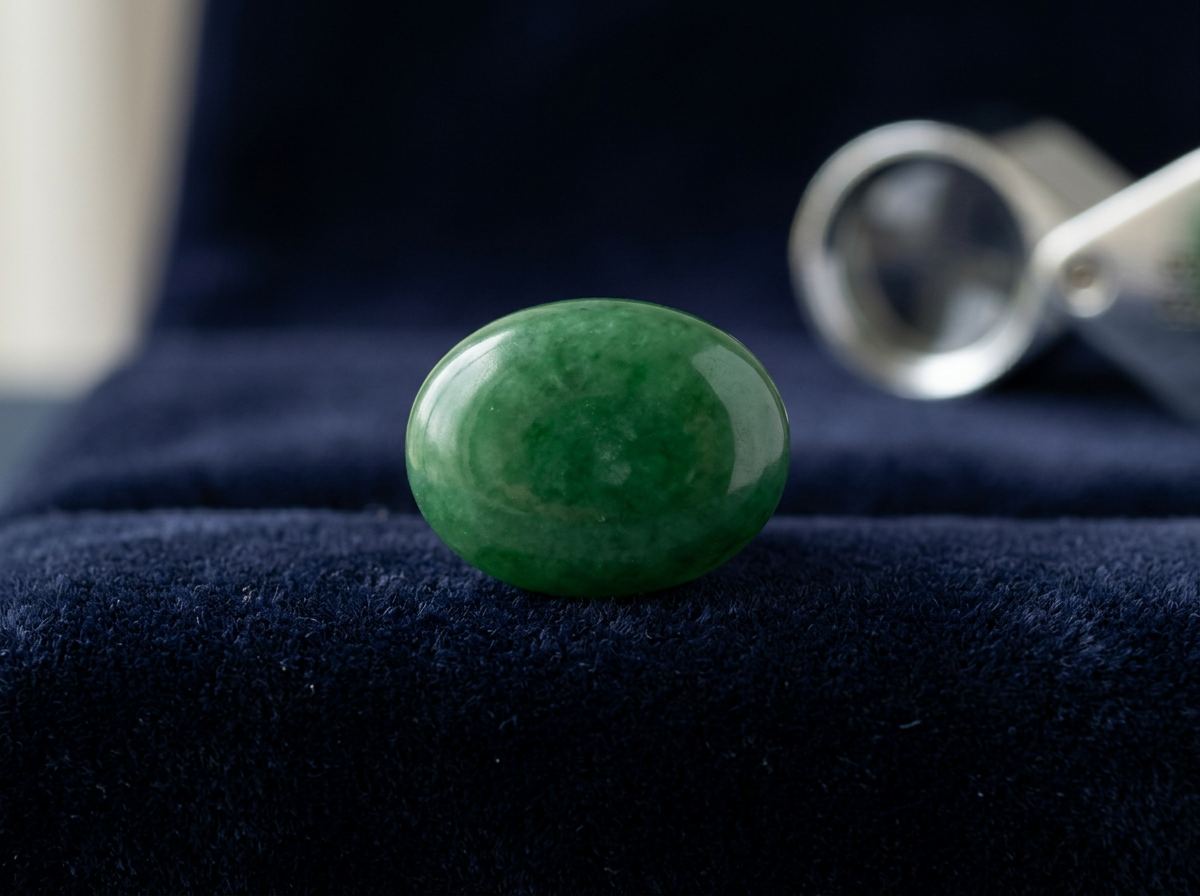
There are three questions hiding in that sentence, and they are answered in order:
- Is it jade at all? It could be serpentine, aventurine quartz, dyed chalcedony, garnet, or glass. A surprising amount of “jade” sold to tourists is not jade in any sense.
- If it is jade, is it jadeite or nephrite? Two different minerals, two different price structures, two different cultural histories.
- If it is jadeite, is it Type A, B or C? Natural, bleached-and-polymer-impregnated, or dyed — and the value difference between those three is enormous.
Only the first two can be narrowed down on the counter. The third is a laboratory question, and it is the one that actually decides the price. That is why jade is the species where “I think it’s real” is least useful and “here is the report” matters most.
It is also the species that carries the heaviest cultural weight of anything in this course. We will come back to that, because how you handle it is part of the job.
Two different rocks called jade
“Jade” is not a mineral. It is a trade name covering two distinct materials that were not distinguished from each other by Western science until 1863.
| Jadeite | Nephrite | |
|---|---|---|
| Mineral group | Pyroxene, NaAlSi₂O₆ | Amphibole (tremolite–actinolite series), Ca₂(Mg,Fe)₅Si₈O₂₂(OH)₂ |
| Mohs hardness | ~6.5–7 | ~6–6.5 |
| Specific gravity | ~3.30–3.38 | ~2.90–3.03 |
| Refractive index | ~1.66 (spot reading) | ~1.61 (spot reading) |
| Structure | Granular, interlocking grain | Fibrous, felted, interlocking fibres |
| Luster | Vitreous to greasy | Oily to waxy |
| Translucency | Can be high — fine jadeite glows | Usually lower; even, waxy translucency |
| Colors | Imperial green, apple green, lavender, white, yellow, orange, red, gray, black | White (“mutton fat”), gray-green, spinach green, brown, black |
| Finest green | Chromium-driven “imperial” green — vivid and pure | Not available in nephrite |
| Toughness | Very good | Exceptional — the toughest natural gem material |
That last row is the counter-intuitive one, and it is worth being precise about: jadeite is harder, but nephrite is tougher. Nephrite’s felted fibre structure resists fracture better than almost any natural material, which is why nephrite — not jadeite — was the prehistoric tool and weapon stone across China, New Zealand, the Pacific Northwest and Central Asia.
Colour causes in jadeite, which you can state simply and correctly:
- Chromium produces the finest, most saturated green — the “imperial” green that tops the market.
- Iron contributes to duller greens, blue-greens and the dark “spinach” tones.
- Manganese is associated with lavender and mauve.
- White jadeite is essentially pure jadeite with no chromophore; black jadeite gets its colour from graphite or other dark inclusions.
The practical consequence: the vivid, translucent, emerald-like green that commands the top of the jade market is a jadeite colour. A translucent green nephrite is a beautiful thing, but it is a different colour family and a different price structure.
Where jade comes from
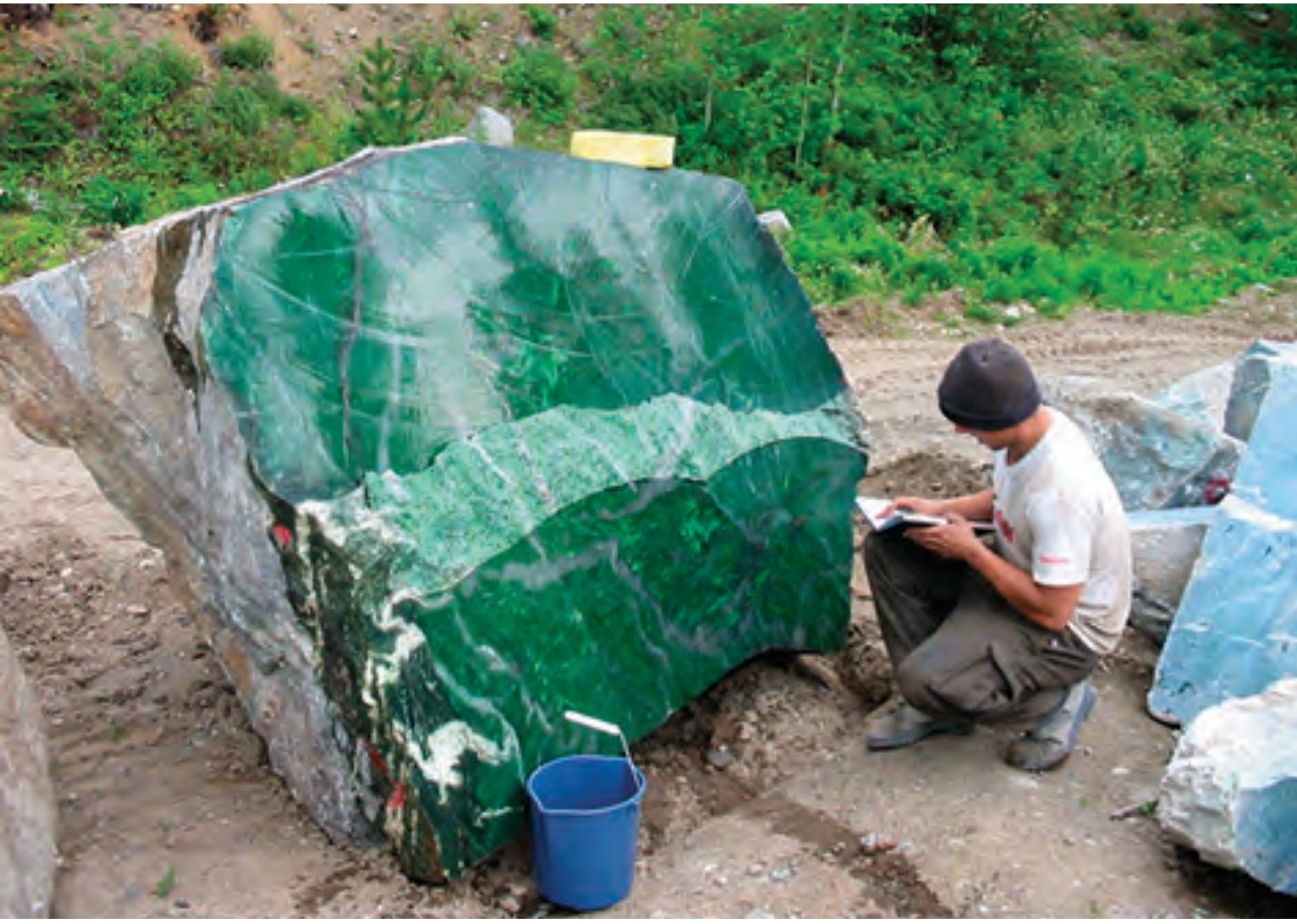
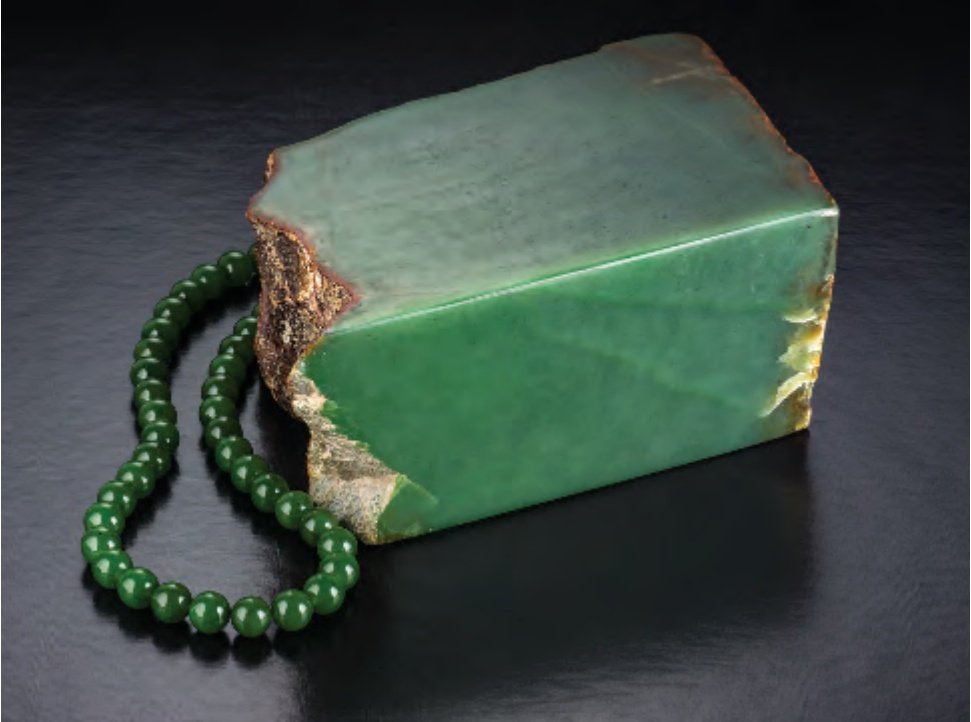
Jadeite:
| Source | Character |
|---|---|
| Hpakant, Kachin State, Myanmar | The world’s premier source, and effectively the only commercial source of top-quality imperial jadeite |
| Guatemala (Motagua Valley) | Rediscovered for the modern market in the 1970s; blue-green, green, and other colours; historically important for Mesoamerican cultures |
| Japan, California, Russia, Kazakhstan | Minor occurrences |
Nephrite:
| Source | Character |
|---|---|
| Hetian (Hotan), Xinjiang, China | Historically the most prized white nephrite, recovered as river boulders; “mutton fat” at its best. The imperial jade of China before jadeite |
| New Zealand — pounamu (greenstone) | Nephrite with deep Māori cultural, spiritual and legal standing |
| British Columbia, Canada | Large deposits; much of it sold into the Chinese carving market |
| Australia (Cowell, South Australia) | Commercial white-to-green nephrite |
| Russia (Lake Baikal), Taiwan (Fengtian), USA (Wyoming), Poland | Additional sources |
Note where jadeite and nephrite dominate commercially: fine jadeite is overwhelmingly a Myanmar story, and its market is overwhelmingly a Chinese-speaking one. That is why the jadeite market reacts to events in Kachin State and to Chinese collector demand in a way no other colored-stone market does.
Value factors for jadeite
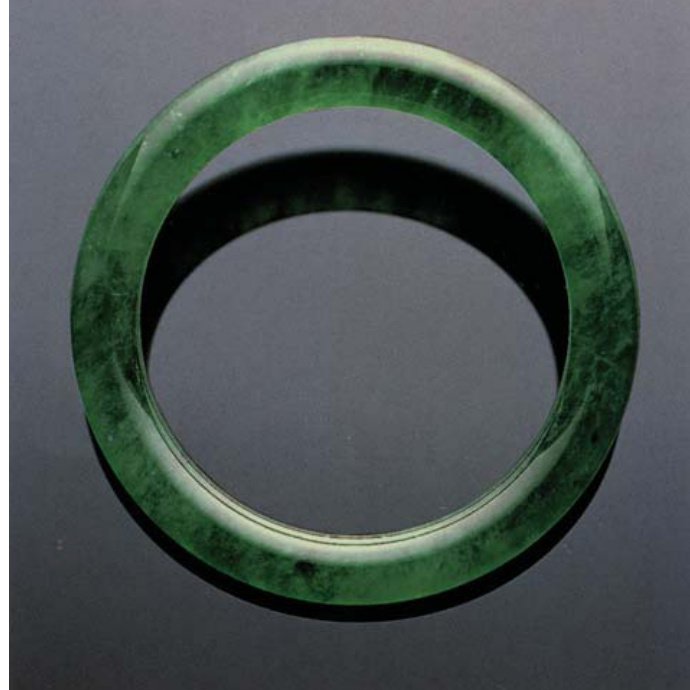
Color first — and the target is specific. Imperial green is a pure, slightly bluish-to-emerald green, evenly distributed, with fine texture and good translucency. Evenness matters enormously: a bangle with patchy color is worth a fraction of one with the same color running evenly all the way round.
Then, in rough order:
- Translucency. Fine jadeite glows; poor jadeite looks like stone.
- Texture. Jade is a rock, not a single crystal, so the grain is the beauty. Fine, even, tight grain is the mark of quality, and it is what allows light to travel.
- Clarity of the piece. Freedom from cracks, black spots, dull patches and white “cotton” clouds.
- Carving quality. In jade, the carving is a major part of the value in a way it is not for a faceted stone.
- Size and form. Matched pairs, large cabochons and full-round bangles carry premiums.
That second point deserves emphasis, because it is what makes jade different from everything else in this course. Texture and translucency matter more in jade than in any other gem species. A client who understands “look at how the light travels through it, and how even the grain is” understands jade.
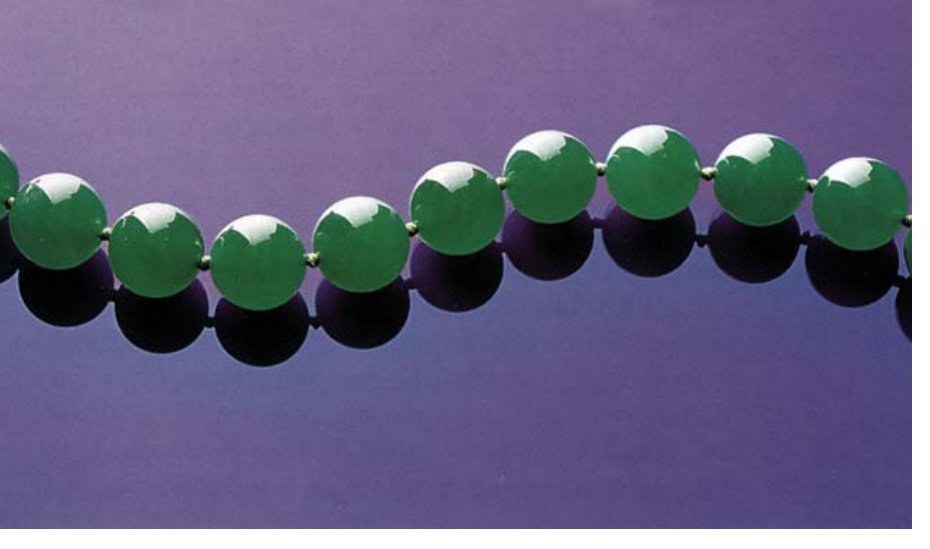
Type A, Type B, Type C
This is the single most important vocabulary in jade, and it is a treatment language specific to jadeite.
| Type | What it is | What to know |
|---|---|---|
| Type A | Natural jadeite, no chemical treatment | A traditional surface waxing finish is accepted and generally considered within Type A. Nothing has been done to the body of the stone. |
| Type B | Bleached and polymer-impregnated | Acid removes brown/gray iron staining, leaving the stone porous and chalky; a polymer resin is injected to restore translucency and hold the structure together. It degrades. |
| Type C | Dyed | Color has been added. Often concentrated along grain boundaries and in surface cracks. |
| B + C | Both bleaching/impregnation and dyeing | Common in commercial goods |
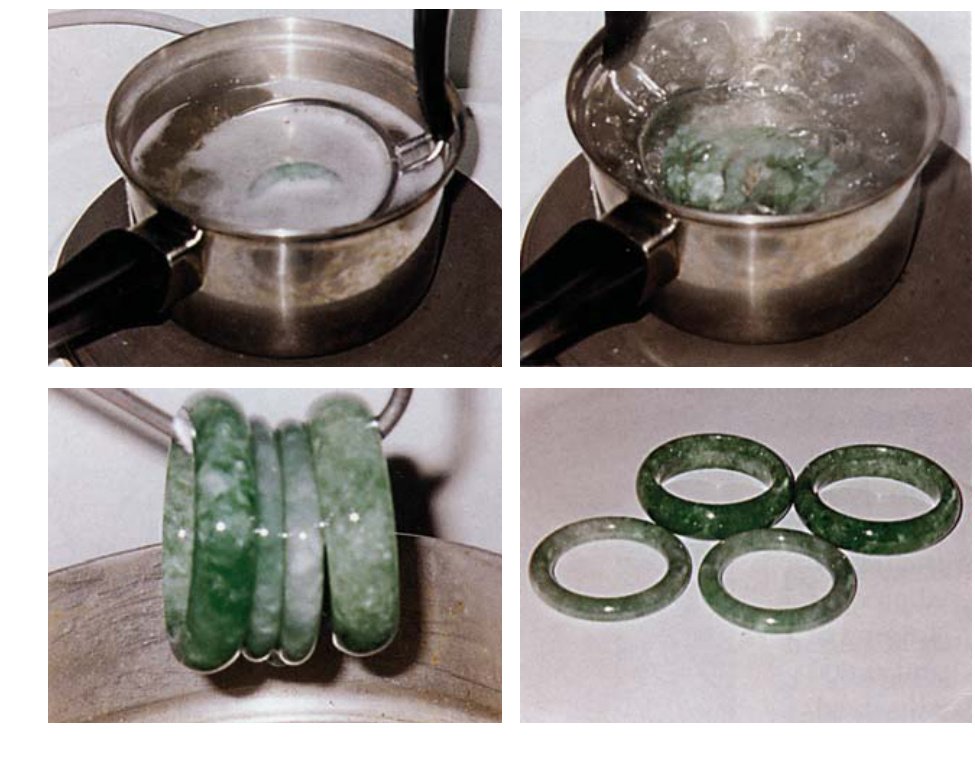
How Type B is actually detected. The definitive test is infrared spectroscopy, which shows the absorption peaks of the polymer resin — this is a laboratory test, not a loupe test. What you can suspect at the counter:
- A luster that is duller, waxier or more “plasticky” than natural jadeite.
- Under magnification, a pitted or orange-peel surface, because the acid attacks the grain boundaries.
- Resin that yellows, crazes and clouds with age. A piece that has gone hazy and yellow after a few years is behaving exactly as Type B is expected to behave.
How Type C is detected. Dye concentrates along grain boundaries, in cracks and in surface pits. Magnification is usually enough to raise the suspicion; a spectroscope or Raman/UV-Vis work confirms it. A chromium-bearing natural green and a dye will not behave the same way.
Fritsch et al. (1992) is the anchor paper for bleached and polymer-impregnated jadeite, and the finding that matters commercially is the durability one: Type B is not permanently stable. It is a legitimate, disclosed, lower-priced product — but it is not an heirloom material, and it must never be presented as one.
Disclosure is mandatory. The price gap between Type A and Type B/C of otherwise similar appearance is not a discount; it is a different product.
[MEDIA: video | C17-M16-V1]
Watch (selected section): A Gemstone’s Journey through the GIA Laboratory — GIA (GIA-CS-01), 57:21
Why here: The lab workflow explicitly covers jade impregnation and dye testing as an add-on service, alongside origin reporting for untreated jadeite and omphacite jade from Myanmar and Guatemala.
https://www.youtube.com/watch?v=P5J1a3_JcTM
Simulants and neighbours
| Material | Sold as | Key differences |
|---|---|---|
| Serpentine / bowenite | “New jade,” “Korean jade” | Softer (Mohs ~2.5–5.5), lower SG, often greasy feel, frequently mottled |
| Maw-sit-sit | Sometimes sold as jade | A rock from Myanmar containing kosmochlor, albite and jadeite, usually with black chromite spots; closely related to jadeite but not jadeite |
| Aventurine quartz | “Indian jade” | Granular green quartz with mica sparkle; much lower RI, granular sugar-like texture |
| Hydrogrossular garnet | “Transvaal jade,” “African jade” | A garnet; different constants and texture |
| Vesuvianite / californite | “California jade” | Different mineral; different constants |
| Dyed chalcedony / agate, dyed quartzite | “Jade” in tourist and online markets | Dyed color concentrated in cracks; wrong constants |
| Glass and plastic | “Jade” | Glass may show bubbles and swirl; plastic is warm and very light |
| Nephrite sold as jadeite (or the reverse) | “Jade” | Not a simulant — a misnaming, with the same disclosure problem |
The general rule is the one from M08: if the constants do not fit, stop and test, do not rationalize. A piece that is too light in the hand, too soft to scratch-test safely, or too cheap for its apparent quality is a simulant until proven otherwise.
Bangles: sizing, and the cultural weight
How to size a bangle. A bangle has to pass over the widest part of the hand, so you are not measuring the wrist — you are measuring the hand.
- Tuck the thumb across the palm, toward the base of the little finger.
- Measure across the hand at its widest point — usually across the knuckles — with a tape measure or calipers.
- Match that measurement to the bangle’s inner diameter, not its outer diameter.
Use a sizing set or a set of sample bangles rather than doing it from a tape measure alone, and never force a bangle on. A bangle that has to be forced is the wrong size, and forcing one with lubricant is how hands get hurt and how bangles get broken. A snug bangle is traditional and desirable; a painful one is not.
Shapes to know: full round (traditional, the most material), flattened or “D” section (sits closer to the wrist), oval (follows the wrist’s natural shape), and the donut/pi disc.
The cultural context, which is part of your job. In Chinese tradition a jade bangle is more than jewellery. It is often given by an elder, it is worn as a protective object, and it is commonly said that a bangle which breaks has taken the blow that was meant for its wearer. Families frequently keep the broken pieces rather than throw them away, and some choose to bury them.
Handle that seriously. The right response to a client who brings in a broken bangle is not amusement and not dismissal:
“It’s worth keeping the pieces. A lot of families do — the belief is that the bangle took the knock for you. Let’s look at whether it can be repaired or whether the pieces could be re-cut into something smaller, and you can decide what feels right.”
Comparable weight attaches elsewhere: pounamu is a taonga in Māori culture with genuine legal and custodial standing in New Zealand, and nephrite carries thousands of years of Chinese carving and ceremonial history. None of this is a sales technique. It is context, and clients notice whether you have it.
Care
- Type A: warm soapy water and a soft cloth; dry thoroughly. No harsh chemicals, no prolonged heat.
- Type B and C: avoid solvents, heat and ultrasonic cleaning entirely — the polymer and the dye are the fragile parts, and both will degrade faster if you are rough with them.
- Remove bangles for manual work and sport. Jade is tough, but a hard knock on a hard surface can break a bangle, and a ring or a bangle that breaks is exactly what the cultural tradition above is about.
- Store pieces separately so they do not abrade each other.
On the floor: applying it this week
- Monday (10 minutes): Find two green pieces in your inventory (or borrow two) and say which is jadeite and which is nephrite — then check yourself with SG or a report. Notice the luster difference: waxy/oily versus vitreous.
- Tuesday (10 minutes): Build or locate a bangle sizing set. Practise the thumb-across-the-palm measurement on a colleague.
- Wednesday (practice): The next time someone says “jade,” ask “jadeite or nephrite?” out loud. Model the distinction for the client.
- Thursday (15 minutes): Read the abstract of Fritsch et al. (1992). You should be able to say in one sentence why Type B is not an heirloom material.
- Friday (10 minutes): Practise the broken-bangle response until it comes out naturally and respectfully.
Objections, mistakes and edge cases
| Situation | The trap | Better move |
|---|---|---|
| “Is this real jade?” | Answering yes or no | Break it into the three questions: is it jade at all; jadeite or nephrite; Type A, B or C. Only the lab settles the last one. |
| A green bangle at a tourist-market price | Confirming it as jade | Check constants, weight in the hand and surface texture. Serpentine, quartz and dyed chalcedony are all common at that price point. |
| Client calls any green stone “jade” | Correcting her sharply | “A lot of green stones get called jade in the trade — this one is [serpentine / aventurine / nephrite], which is a different material at a different price.” |
| Type B presented as “natural jade, just polished” | Repeating it | Type B is bleached and polymer-impregnated. It must be disclosed, and it degrades. |
| A bangle that has gone cloudy and yellow after a few years | Blaming the client | That is what Type B does. Disclose it at sale, and say so plainly here. |
| Client wants a bangle forced on | Using lubricant and pressure | Never force it. Measure the hand, use the sizing set, and offer the next size up. |
| Broken bangle brought in | Laughing, or offering to throw the pieces away | Take it seriously. Offer repair or re-cut options, and let the client decide what to do with the pieces. |
| Nephrite described as jadeite to raise the price | Letting it pass | Different mineral, different constants, different price structure. Say which it is. |
| “Imperial jade” used loosely for any green | Repeating the term | Imperial green is a specific chromium-driven, evenly distributed, translucent green. Descriptive use needs the qualifier “green jadeite.” |
| Pounamu treated as an ordinary carving material | Ignoring its standing | It is a taonga with cultural and legal standing. Handle and describe it accordingly. |
| Client wants a Type B piece resized or repaired with heat | Promising it | Heat damages the polymer. Work cold, and tell whoever does the work that the piece is impregnated. |
Self-check
- What is the mineral difference between jadeite and nephrite?
- Which is harder, and which is tougher?
- What causes imperial green in jadeite, and what does manganese produce?
- Name the two commercially important jadeite sources and four nephrite sources.
- What are Type A, B and C, and which is the one that degrades?
- What is the definitive test for Type B, and what can you suspect at the counter?
- Name three simulants and the trade names they are sold under.
- How do you measure a bangle?
- How should you respond when a client brings in a broken bangle?
- What is the care difference between Type A and Type B/C jadeite?
Go deeper
- ★ Fritsch E. et al. (1992) Identification of Bleached and Polymer-Impregnated Jadeite. G&G 28:3 — https://www.gia.edu/gems-gemology/fall-1992-bleaching-jadeite-fritsch — the Type B anchor; 25 minutes.
- Hargett D. (1990) Jade of Guatemala. G&G 26:2 — the Motagua Valley material.
- GIA Gem Encyclopedia — Jadeite and Nephrite — https://www.gia.edu/jadeite and https://www.gia.edu/nephrite
- GIA Colored Stone Reports — https://www.gia.edu/colored-stone-reports — jade testing services, including impregnation and dye detection and origin reporting for untreated jadeite and omphacite jade from Myanmar and Guatemala (expanded 1 January 2026).
- Hughes R.W. — writing on the jade trade, the Myanmar supply chain and the Chinese market.
- Video: A Gemstone’s Journey through the GIA Laboratory (GIA-CS-01) — 57:21, linked above.