Emerald: Black Shale, Jardin, and the Treatment You Must Disclose
The ultrasonic that ruined a good stone
A client inherits her grandmother’s emerald ring. She takes it to a jeweler for a complimentary cleaning, and it comes back dull, cloudy, and — to her eye — ruined. The stone has not been destroyed. What happened is that the ultrasonic cleaner stripped the oil out of the fissures that run through it, and the fissures are now visible again.
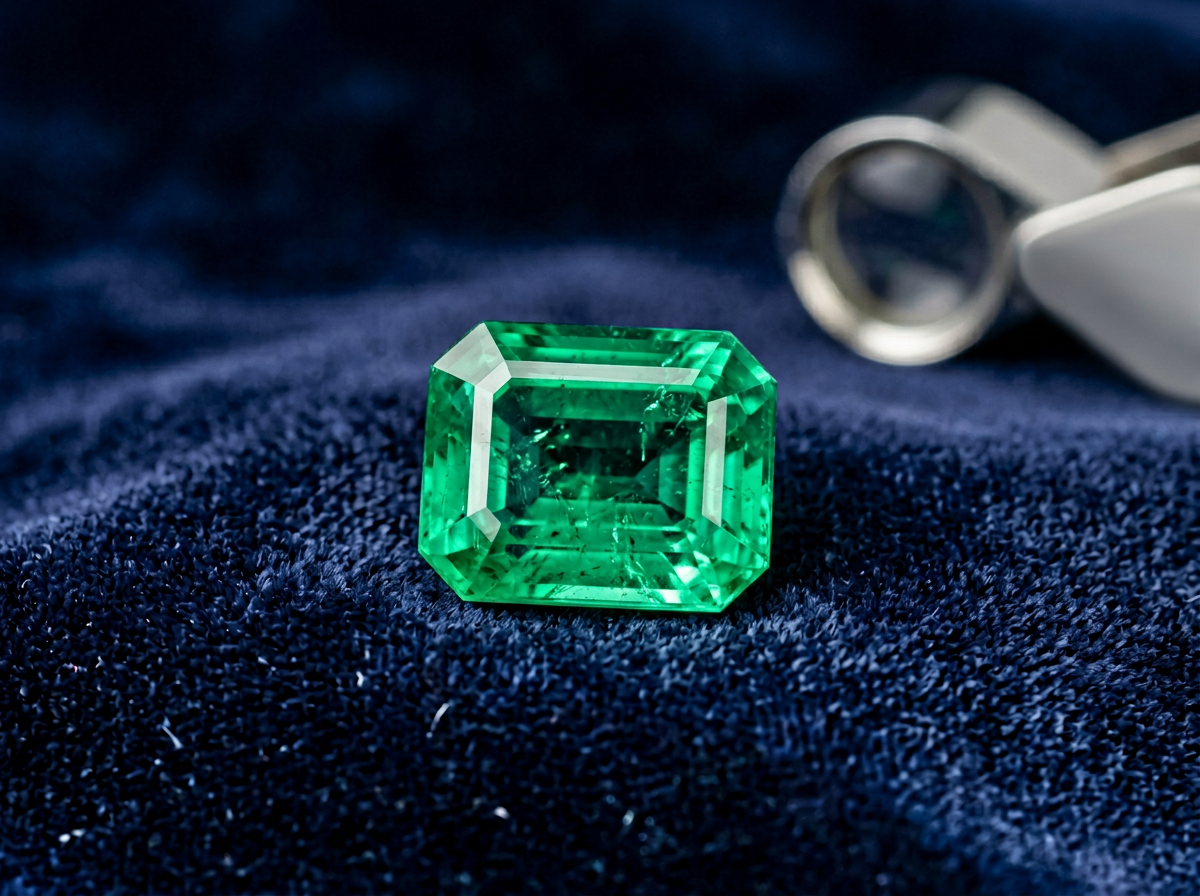
This is the single most common emerald complaint in the jewelry trade, and it is entirely preventable. Emerald is the one major gem species where “put it in the ultrasonic” is always the wrong answer — not usually, not “check first,” but always. The reason is also the reason this module is organized the way it is: emerald is characteristically fractured, that fracturing is routinely treated with a filler, and the filler is the least durable part of the stone.
Learn that sentence and you have already prevented the most expensive mistake most associates make with emerald.
Beryl, chromium and vanadium
Emerald is the green variety of beryl, Be₃Al₂Si₆O₁₈ — the same species as aquamarine (blue, from iron) and morganite (pink, from manganese). What makes it green is chromium and/or vanadium substituting into the aluminium site.
That “and/or” matters. Some emeralds are chromium-dominant, some vanadium-dominant, and the difference shows up under the lamp:
- Chromium-dominant emerald fluoresces red under long-wave UV, and often weakly under short-wave.
- Vanadium-dominant emerald is typically inert.
- Iron, where present, adds a blue component to the color and quenches fluorescence — the same quenching effect you met in ruby.
Which means the Colombian-vs-Zambian difference is partly a chemistry difference and partly a fluorescence difference. Colombian material is low-iron and chromium-bearing: it glows red under UV. Zambian material carries more iron: cooler bluish-green, and largely inert.
| Property | Value | What it tells you |
|---|---|---|
| Species | Beryl, Be₃Al₂Si₆O₁₈ | Same species as aquamarine and morganite |
| Cause of green | Cr³⁺ and/or V³⁺ | Chromium gives red fluorescence; iron quenches it |
| Mohs hardness | 7.5–8 | Hard enough to wear; not the problem |
| Toughness | Poor to fair — brittle, almost always fractured | This is the problem |
| RI | ~1.577–1.583 | Hydrothermal synthetics read lower — your fastest screen |
| Birefringence | ~0.006 | |
| SG | ~2.72 | Hydrothermal synthetics read ~2.65 — second screen |
| Optic character | Uniaxial (–) | |
| Dichroism | Blue-green / yellow-green | Visible in a dichroscope on most material |
| Typical clarity | Included — “jardin” is the norm | Loupe-clean emerald is a red flag, not a find |
Colombia: the black-shale anomaly
Here is the fact that makes Colombian emerald genuinely different, and it is not marketing.
Almost every emerald in the world forms in igneous or metamorphic rock — pegmatites, or schists where beryllium-bearing fluids met chromium-bearing host rock. Colombia is the exception: its emeralds are hosted by sedimentary rock. Specifically, Cretaceous black shale, with the emerald crystallizing in calcite–fluorite–pyrite–albite veins that cut through it. It is the only major emerald deposit of its type on earth.
That is why Colombian emerald looks the way it does: low iron (the shale is not iron-rich), warm saturated green with a slight yellowish cast, and strong red fluorescence from chromium.
| Colombian mine | Character |
|---|---|
| Muzo | The benchmark. A warm, slightly yellowish saturated green — “Muzo green” is the trade reference point |
| Coscuez | Also top-tier; historically enormous production; fine saturated green |
| Chivor / Somondoco | Lighter, brighter, sometimes a slightly bluish green; historically the oldest Colombian workings |
| La Pita, Peñas Blancas, Yacopí | Additional Colombian producers of variable quality |
Two Colombian specialties are worth knowing by name, because clients read about them and because both are genuinely Colombian indicators:
- Trapiche emerald. A rare hexagonal pattern: six dark rays of carbonaceous impurity radiating from the centre, separated by growth sectors. It looks like a wheel or a star, and it is unique to a handful of Colombian localities (and, rarely, to Brazil). Trapiche is a growth phenomenon, not an inclusion pattern in the usual sense, and it is cut as a slice or a cabochon to show it.
- Gota de aceite — “drop of oil.” A roiled, swirling internal structure that looks like oil dispersed in water, seen in some fine Colombian material (classically Muzo). It is an irregular growth structure rather than an inclusion, and it has been prized as a Colombian fingerprint.
Neither is a grade. Both are conversation pieces that support a genuine Colombian attribution, and neither replaces a report.
Beyond Colombia
| Source | Host / type | Character | Market position |
|---|---|---|---|
| Zambia (Kagem, Musakashi) | Schist-hosted | Cooler, bluish-green; more iron; usually inert under UV | The largest producer in the world by volume; Gemfields runs formal auctions at Kagem |
| Brazil (Belmont, Nova Era, Itabira, Goiás, Bahia) | Schist/pegmatite-related | Medium-to-light green, often slightly yellowish or bluish | Large commercial volume; Belmont is the standout as an integrated, mine-to-market operation |
| Ethiopia (Shakiso/Kenticha, Oromia) | Metamorphic | Reached the market around 2016–2017; chromium-dominant, low iron, and can look markedly Colombian | Newer premium-quality entrant — which is exactly why origin reporting matters here |
| Afghanistan (Panjshir) | Vein-type | Fine small stones; famously difficult logistics and artisanal mining | Small, high-quality niche |
| Zimbabwe (Sandawana) | Pegmatite/schist | Small but intensely colored stones | Rare, collector interest |
| Pakistan (Swat/Mingora), Russia (Ural Mountains), Madagascar (Mananjary), Tanzania, Nigeria | Various | Variable | Secondary to minor |
Two notes that prevent real errors at the counter.
Ethiopia is the newest thing in this table and the easiest to misdescribe. Material from the Shakiso area is chromium-dominant with low iron, so it can look Colombian to the eye and behave Colombian under UV. It is Ethiopian. Do not let a “looks Colombian” stone become a “is Colombian” statement.
Hpakant is in Myanmar, and it is a jadeite locality — not an emerald locality. The two names get tangled because both are famous Myanmar gem sites. If you hear “Hpakant,” you are talking about jadeite, which is M16.
[MEDIA: video | C17-M14-V1]
Watch: Emerald Adventures in Afghanistan (Panjshir Valley) — GIA (GIA-CS-05), 3:12
Why here: Andy Lucas in the Panjshir — artisanal tunnel mining at altitude, and the kind of field conditions that explain why fine small emeralds cost what they cost.
https://www.youtube.com/watch?v=QUSnLD2cr-M[MEDIA: video | C17-M14-V2]
Watch: An Overview of Emerald Mining in Brazil — GIA (GIA-CS-04), 1:42
Why here: Sergio Martins across Bahia, Nova Era/Itabira and Goiás — the Brazilian end of the source table in under two minutes.
https://www.youtube.com/watch?v=07m5fFqyZIc
Clarity enhancement: from cedarwood oil to polymer
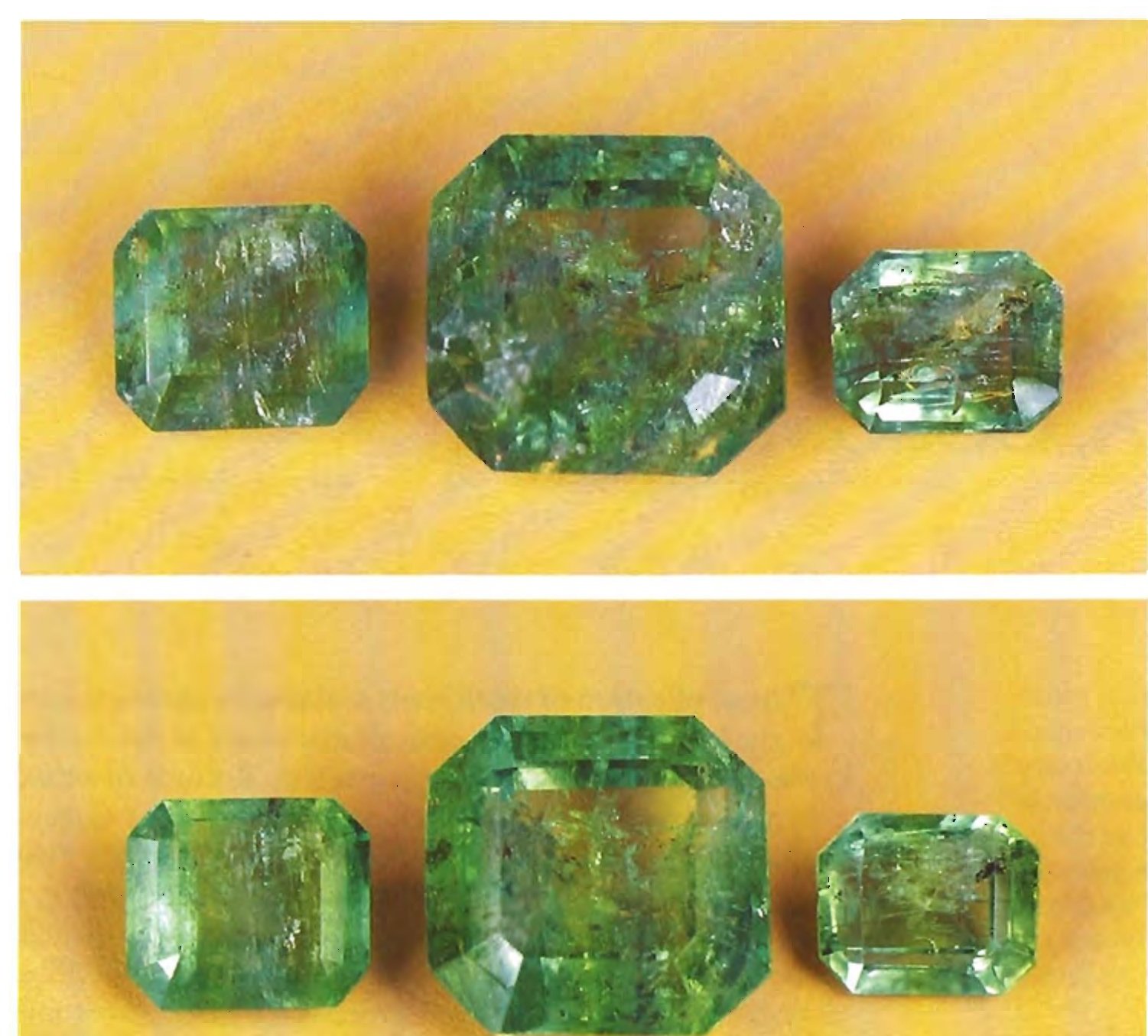
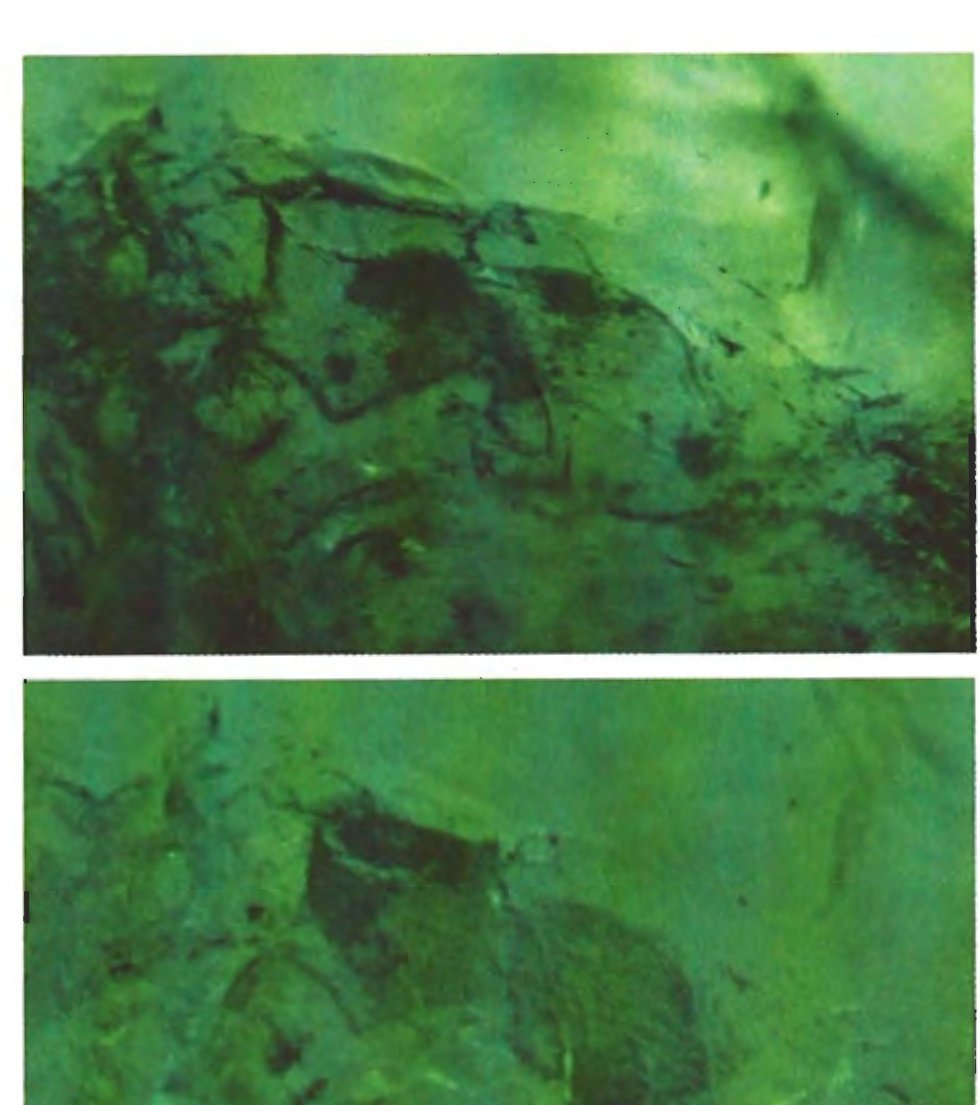
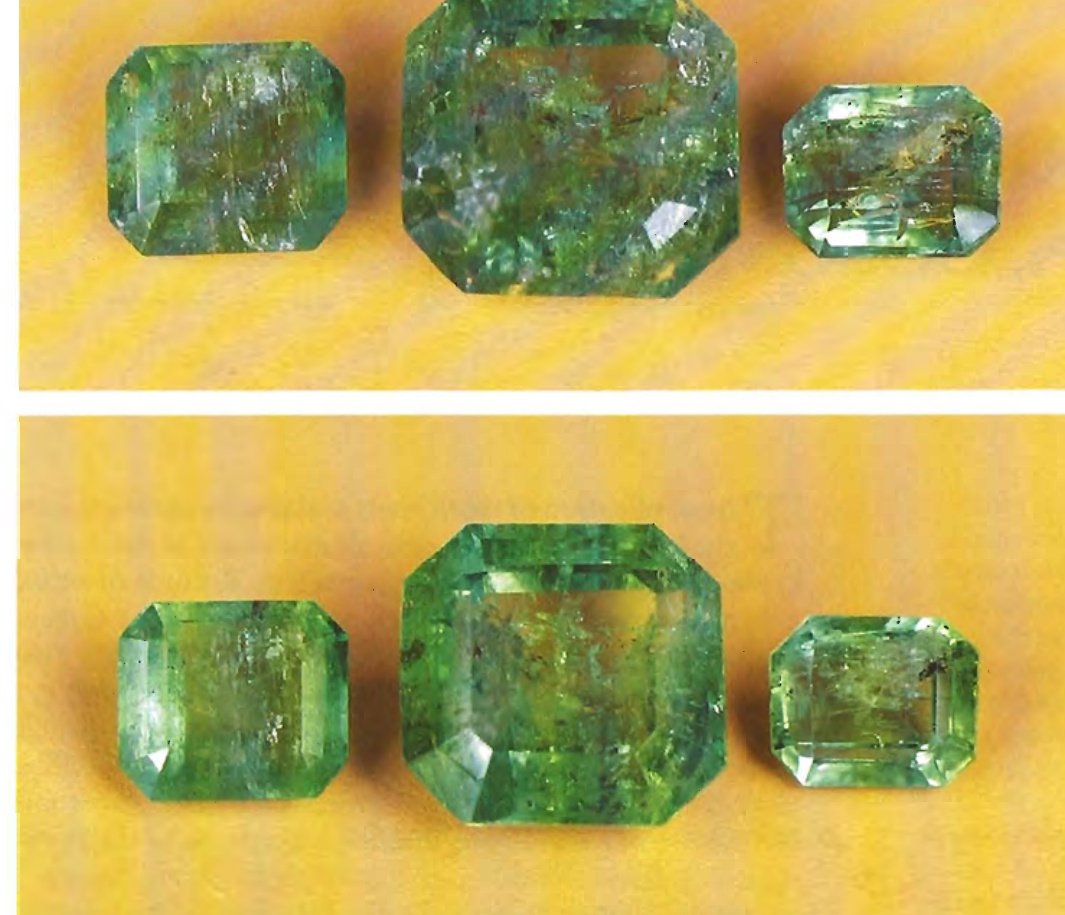
Almost all emerald is fractured. That is not a defect in the way it is in sapphire — it is the nature of the material, and the trade has responded with a treatment that is ancient, standard, and legitimate: clarity enhancement, meaning filling the surface-reaching fissures with something whose refractive index is close to beryl’s, so the fissures become much harder to see.
| Enhancer | What it is | How it behaves |
|---|---|---|
| Cedarwood oil | The traditional filler; RI close enough to beryl to hide fissures well | Looks excellent at first; dries out over time — this is why emerald needs periodic re-oiling |
| Synthetic resin / polymer (epoxy, and trade products such as Opticon, ExCel, PermaSafe) | More durable, longer-lasting fillers | Last longer, but can yellow or craze with age and are harder to remove and re-treat |
| Colored (dyed) oils/resins | Filler carrying green dye, used to improve apparent color as well as clarity | A dyeing treatment on top of filling — a separate and more serious disclosure |
GIA classifies the degree of clarity enhancement on a four-step scale, and this is the single most useful emerald number you can learn:
| Grade | Meaning |
|---|---|
| F0 | No clarity enhancement detected |
| F1 | Minor clarity enhancement |
| F2 | Moderate clarity enhancement |
| F3 | Significant clarity enhancement |
(McClure et al., 1999, is the anchor paper.)
Two things about that scale that salespeople get wrong. First, F1 is normal — a substantial majority of commercial emerald carries at least minor enhancement, and presenting F1 as a defect is inaccurate. Second, F0 and F1 command real premiums over F2 and F3, so the grade belongs on the invoice, in the description, and in your conversation.
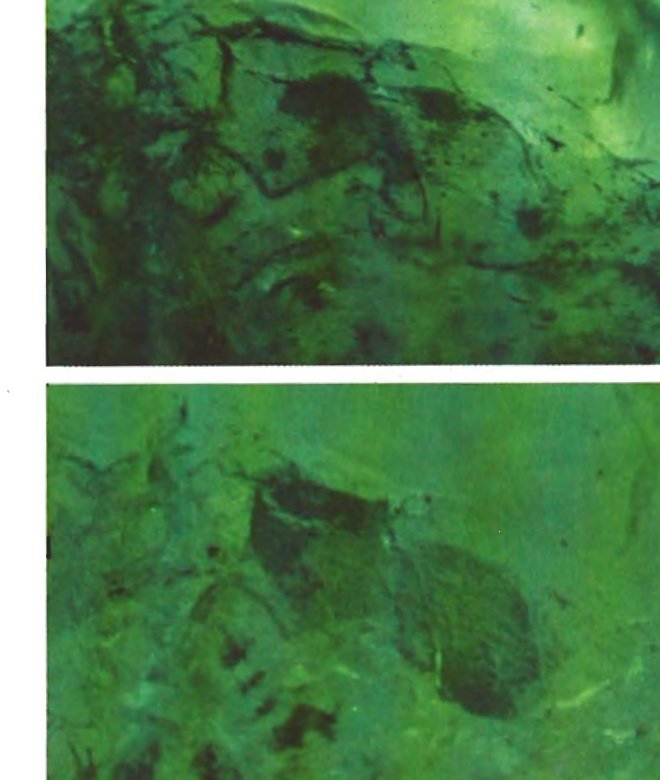
At the microscope, filled fissures can show a slightly different luster from the beryl, a faint iridescent or “flash” along the fracture in reflected light, and — where oil has begun to dry — a whitish, hazy appearance in the fissures.
Disclosure is mandatory at every level of this scale. Under the FTC Jewelry Guides, an undisclosed clarity enhancement is a material misrepresentation, and the practical rule is simple: state the F-grade before the client asks.
Synthetics: flux and hydrothermal
Emerald has been synthesized commercially since the mid-twentieth century, and both major production methods produce convincing material.
Flux-grown emerald (Chatham, Gilson, Lennix, Biron, Seiko and others) grows from a molten flux. Look for flux fingerprints and veils — wispy, veil-like residues that sometimes look like a fingerprint in oil — along with phenakite crystals and occasionally metallic platinum flakes from the crucible. RI and SG generally overlap natural emerald, so constants will not separate them.
Hydrothermal emerald (Lechleitner, Linde, Regency, Tairus, Malossi) grows in an autoclave on a seed plate. Detection: seed plates, growth zoning, and nail-head or chevron spicules of phenakite. And the useful part — RI and SG read noticeably lower than natural:
| Natural emerald | Hydrothermal synthetic | |
|---|---|---|
| RI | ~1.577–1.583 | ~1.560–1.570 |
| SG | ~2.72 | ~2.65 |
Those two readings are the fastest screening test available on the bench. They are not conclusive on their own, but a stone reading 1.565 and 2.65 is not going to turn out to be natural Colombian material.
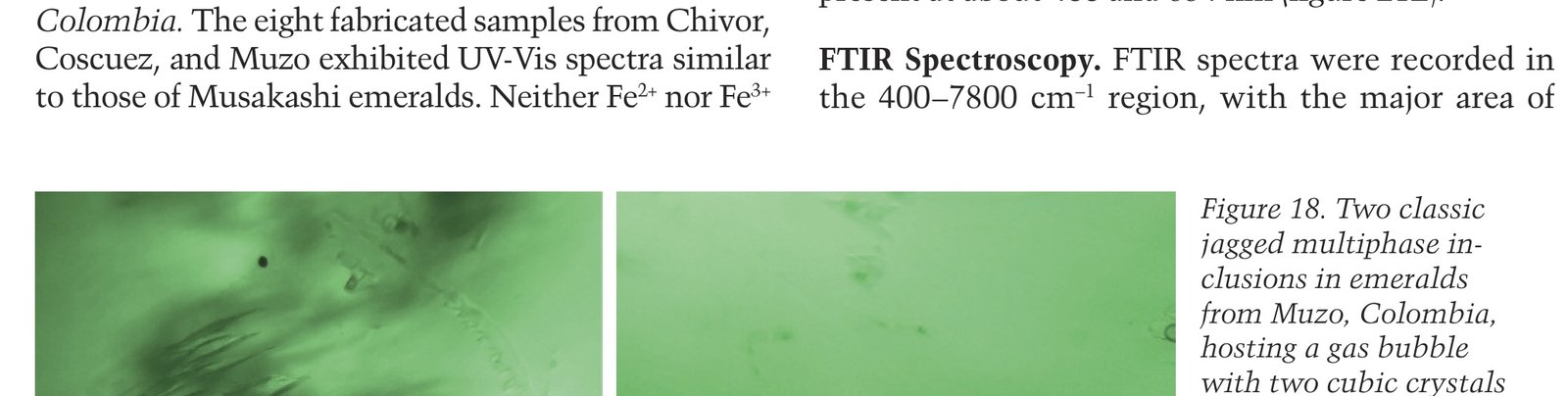
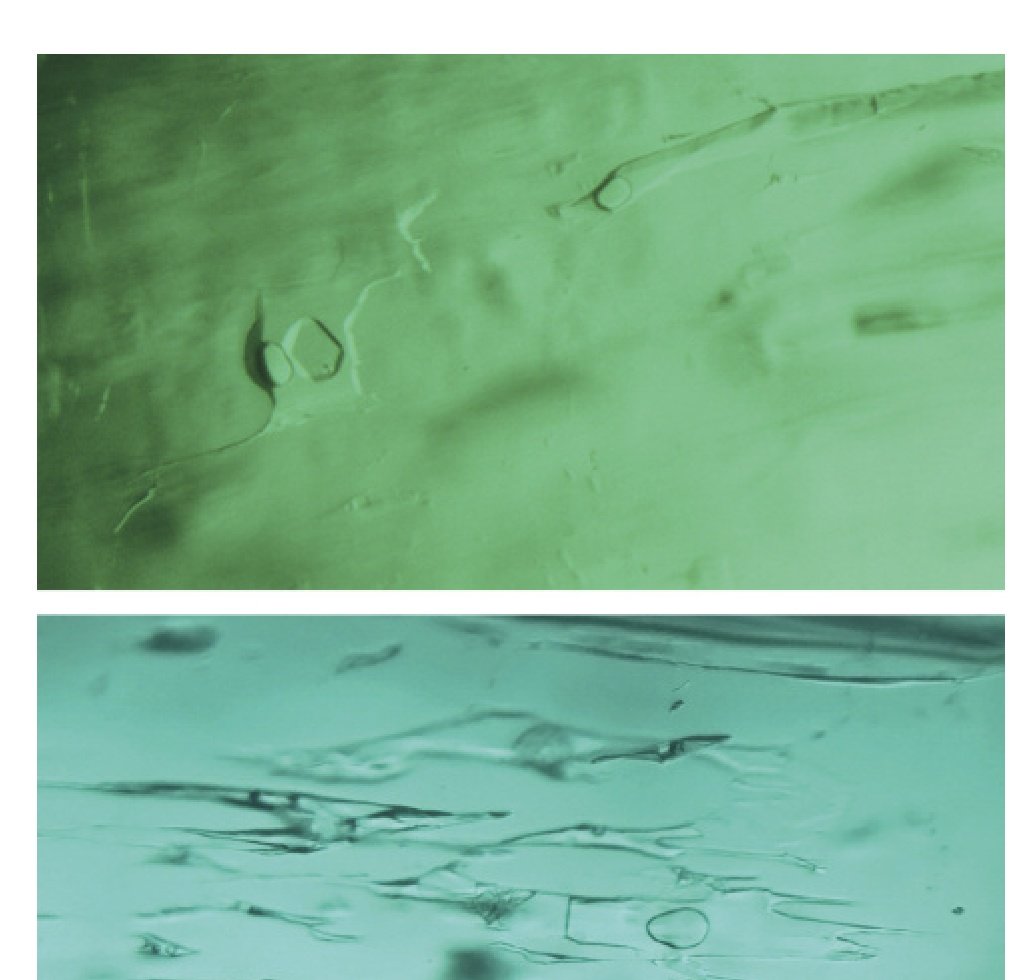
The deeper principle from M06 applies here with force: synthetic emerald does not contain the natural inclusion scenes you would expect — mica plates, actinolite or tremolite needles, pyrite, calcite, and in Colombian material, three-phase inclusions containing a gas bubble, liquid and a solid crystal. An emerald with no natural inclusions at all is suspicious, because clean natural emerald is extraordinarily rare. Absence of inclusions is itself a finding.
Soudé emerald is a different thing again: an assembled stone, usually a doublet (sometimes a triplet), with a green cement or glue layer sandwiched in the middle. It must be disclosed as assembled, and it must never be immersed, ultrasonically cleaned or steamed — the layers can separate.
Care: the absolute rule
State this to every client who buys an emerald, and put it on the care card:
- No ultrasonic. No steam. Ever. Not “rarely.” Not “check first.”
- Warm soapy water and a soft brush only. Dry immediately with a soft cloth.
- No solvents, no alcohol, no acetone, no household cleaners, no acids.
- No sudden temperature changes and no heat.
- Remove before any bench work that involves a torch — the stone should come out before sizing, retipping or prong work.
- Re-oiling: a reasonable client-facing rule is an annual check for a ring, and the jeweler doing it should be told the stone is enhanced.
- Never promise that a stripped emerald will look “as good as new” after re-oiling. It will usually look better; it may not go all the way back.
The reason behind all six lines is the same: emerald’s weakness is toughness, not hardness. At Mohs 7.5–8 it resists scratches well. It is brittle, it is fissured, and the filler that makes it look good is the most fragile thing in it.
Value factors
Color first, and in emerald the trade’s reference point is a slightly bluish-green to pure green of medium-to-medium-dark tone with strong saturation — not too dark (which reads as black in low light), not too light (which reads as green beryl rather than emerald). “Muzo green” is the descriptor clients will have read; use it as a description and let the report carry any authoritative claim.
Then clarity — with the emerald exception fully in force.
Inclusions in emerald are expected and forgiven. What you are paying for is transparency and liveliness, not loupe-cleanliness. A stone that has obvious jardin but is bright, open and lively is worth more than a sleepy, heavily included stone that happens to have fewer visible marks. And a genuinely clean emerald should send you to a laboratory before it sends you to the sales pad.
Then origin (Colombia commands the largest premium; Zambia and Brazil anchor the commercial market; Ethiopia is the newer premium entrant), then cut — note that the emerald cut exists precisely because it protects a brittle stone and shows off color, with cut corners and a large table — then size, and finally treatment, where F0 and F1 carry real premiums over F2 and F3.
On the floor: applying it this week
- Monday (5 minutes): Find the F-grade on the report or invoice for every emerald in your case. If you cannot find it, flag the stone for the buyer.
- Tuesday (10 minutes): Watch GIA-CS-05 (Panjshir, 3:12) and GIA-CS-04 (Brazil, 1:42). Two minutes each and you will stop mispronouncing the sources.
- Wednesday (practice): Say the enhancement as part of the description on the next emerald you show: “This is an F1 — minor clarity enhancement, which is normal and disclosed on the report.”
- Thursday (10 minutes): Check your care sheets. If they do not say “no ultrasonic, no steam” for emerald in bold, they are wrong.
- Friday (15 minutes): With a loupe, compare an F1 stone with an F2 or F3 stone in reflected light. Find the luster difference in the fissures.
Objections, mistakes and edge cases
| Situation | The trap | Better move |
|---|---|---|
| Client asks “can I clean it in the ultrasonic?” | Saying “it’s 7.5 on Mohs so it’s fine” | No ultrasonic, no steam, ever. Hardness is not toughness, and the treatment is the fragile part. |
| Client wants a loupe-clean emerald | Promising one | Clean natural emerald is extraordinarily rare; a “clean” stone at a normal price is a synthetic or an assembled stone. |
| Client heard that emeralds are “always oiled” | Using that to skip disclosure | Disclose the actual grade. “Always oiled” is a reason to state it, not a reason to omit it. |
| Ethiopian emerald that looks Colombian | Describing it as Colombian | Ethiopia is chromium-dominant and genuinely Colombian-looking. Origin comes from the report. |
| “Hpakant emerald” | Repeating it | Hpakant is a jadeite locality in Myanmar. Different stone, different module. |
| An emerald with no visible inclusions at a good price | Calling it a find | Suspicious. Check RI/SG — hydrothermal synthetics read about 1.560–1.570 and ~2.65 versus natural ~1.577–1.583 and ~2.72. |
| Client wants the stone re-oiled before a special occasion | Promising it will look brand new | It will usually improve. Do not promise a full recovery. |
| Old estate emerald with a decades-old report | Pricing off it | Treatment detection has advanced; recommend a fresh report for anything significant. |
| Trapiche or gota de aceite cited as proof of Colombian origin | Treating either as a certificate | Both are strong Colombian indicators, and both are descriptive, not diagnostic. Report. |
| Client wants to size an emerald ring | Leaving the stone in | Remove it first. No torch near an enhanced emerald. |
| “Is this a real emerald or a lab-grown one?” | Guessing from the color | Flux and hydrothermal synthetics both look right. The screens are inclusions plus RI/SG — then a report. |
Self-check
- Why is Colombian emerald geologically unusual?
- What two elements make emerald green, and how does iron change the appearance?
- What is the difference between F0, F1, F2 and F3?
- Why does emerald need re-oiling?
- Which two readings screen hydrothermal synthetic emerald from natural, and in which direction?
- What are trapiche and gota de aceite?
- Which country is the largest emerald producer by volume?
- Why is Ethiopian emerald easy to misidentify?
- State the emerald cleaning rule in full.
- Why is a loupe-clean emerald suspicious rather than desirable at a normal price?
Go deeper
- ★ McClure S.F. et al. (1999) Classifying Emerald Clarity Enhancement at the GIA Gem Trade Laboratory. G&G 35:4 — https://www.gia.edu/gems-gemology/winter-1999-classifying-emerald-clarity-mcclure — the F0–F3 scale; 20 minutes.
- Keller P.C. (1981) Emeralds of Colombia. G&G 17:2 — Colombian geology and the black-shale host.
- Lucas A. et al. (2015) The Belmont Mine and an Emerald’s Journey from Mine to Market. GIA Research & News — https://www.gia.edu/gia-news-research — traceability.
- Lucas A. et al. (2016) Jaipur, India: The Emerald Cutting and Trading Powerhouse. — https://www.gia.edu/gems-gemology/winter-2016-jaipur-india
- GIA Research & News — Ethiopian emerald (Shakiso/Kenticha). — https://www.gia.edu/gia-news-research
- ★ Overton T.W. (2004) Gem Treatment Disclosure and U.S. Law. G&G 40:2 — https://www.gia.edu/gems-gemology/summer-2004-gem-treatment-disclosure-us-law-overton
- Video: Emerald Adventures in Afghanistan (GIA-CS-05) — 3:12, embedded above.
- Video: An Overview of Emerald Mining in Brazil (GIA-CS-04) — 1:42, embedded above.