Synthetics, Simulants, and Assembled Stones: What Is (and Is Not) What It Looks Like
The vintage-market ruby
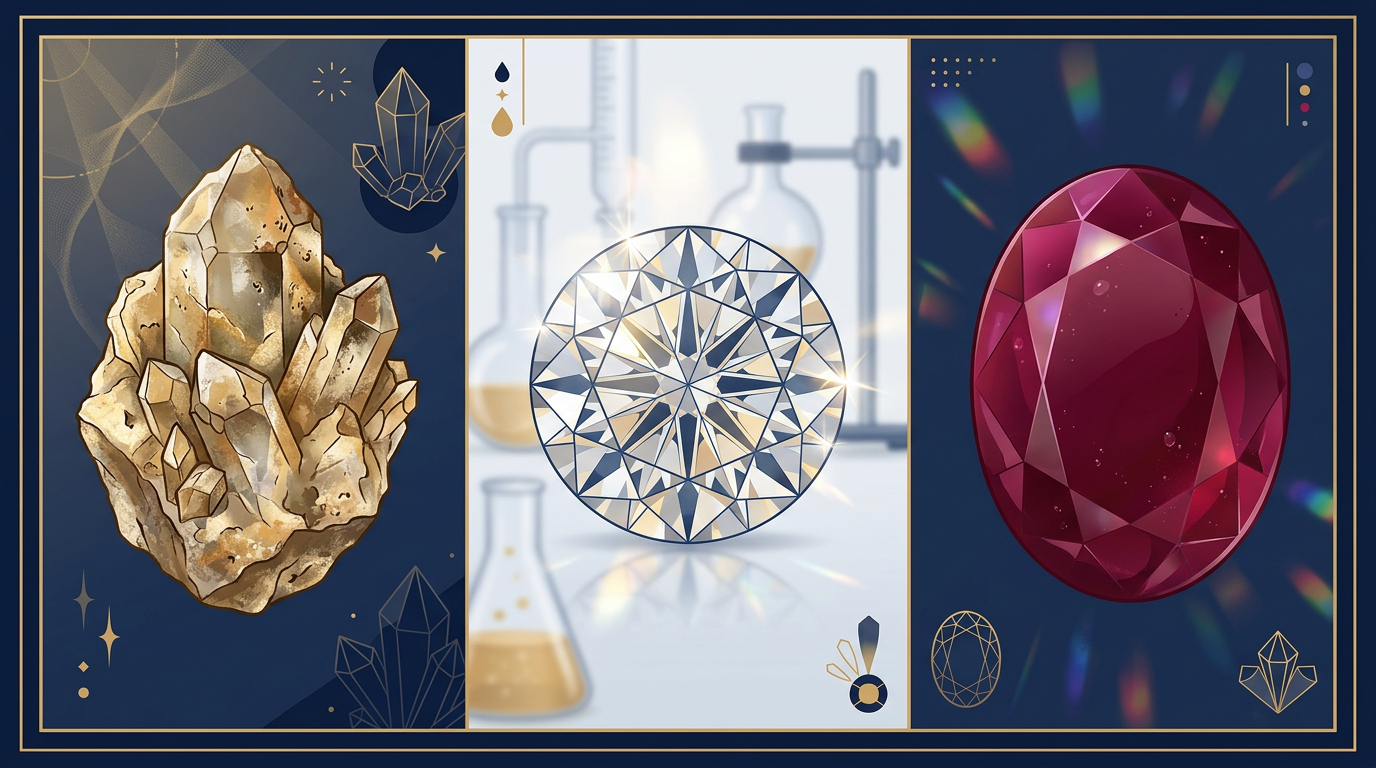
A customer comes in with a 5 ct oval “ruby” she bought for $400 at a flea market, set in a worn yellow-gold mounting. She is convinced she has found a hidden Mogok. Under your 10× loupe you see something the seller apparently did not: faint curved color bands sweeping across the stone in gentle arcs, and two spherical gas bubbles near a facet junction. Those two features — curved striae and spherical bubbles — mean this is a Verneuil flame-fusion synthetic ruby, grown in a lab in a few hours by melting aluminum oxide powder through an oxyhydrogen flame. It is genuine corundum (same chemistry, same hardness, same refractive index as natural ruby), but it is not natural ruby. The stone is worth perhaps $20 to $50 as a synthetic, not the thousands a natural 5 ct ruby would bring.
Telling her this is a disappointing conversation. Failing to tell her would be dishonest. Misidentifying her synthetic as natural and making an offer on that basis would cost you money or, worse, resell a synthetic as natural and damage your store’s reputation.
This module covers the three categories of non-natural colored stones you will encounter at the counter: synthetics (man-made crystals with the same chemistry and structure as the natural gem), simulants/imitations (different materials that only look similar), and assembled stones (doublets and triplets — two or three pieces glued together). The anchor references are J. Stone-Sundberg’s 2013 four-part Sapphire Series, N. Renfro et al.’s 2010 decade-in-review of synthetics, and a long list of G&G Lab Notes and Gem News reports documenting each newly detected simulant as it appeared. T.W. Overton’s 2004 paper on FTC disclosure law governs the language you use.
Three categories: synthetic, simulant, assembled
The three categories are often confused by clients and (unfortunately) by some salespeople. The distinction matters legally and commercially.
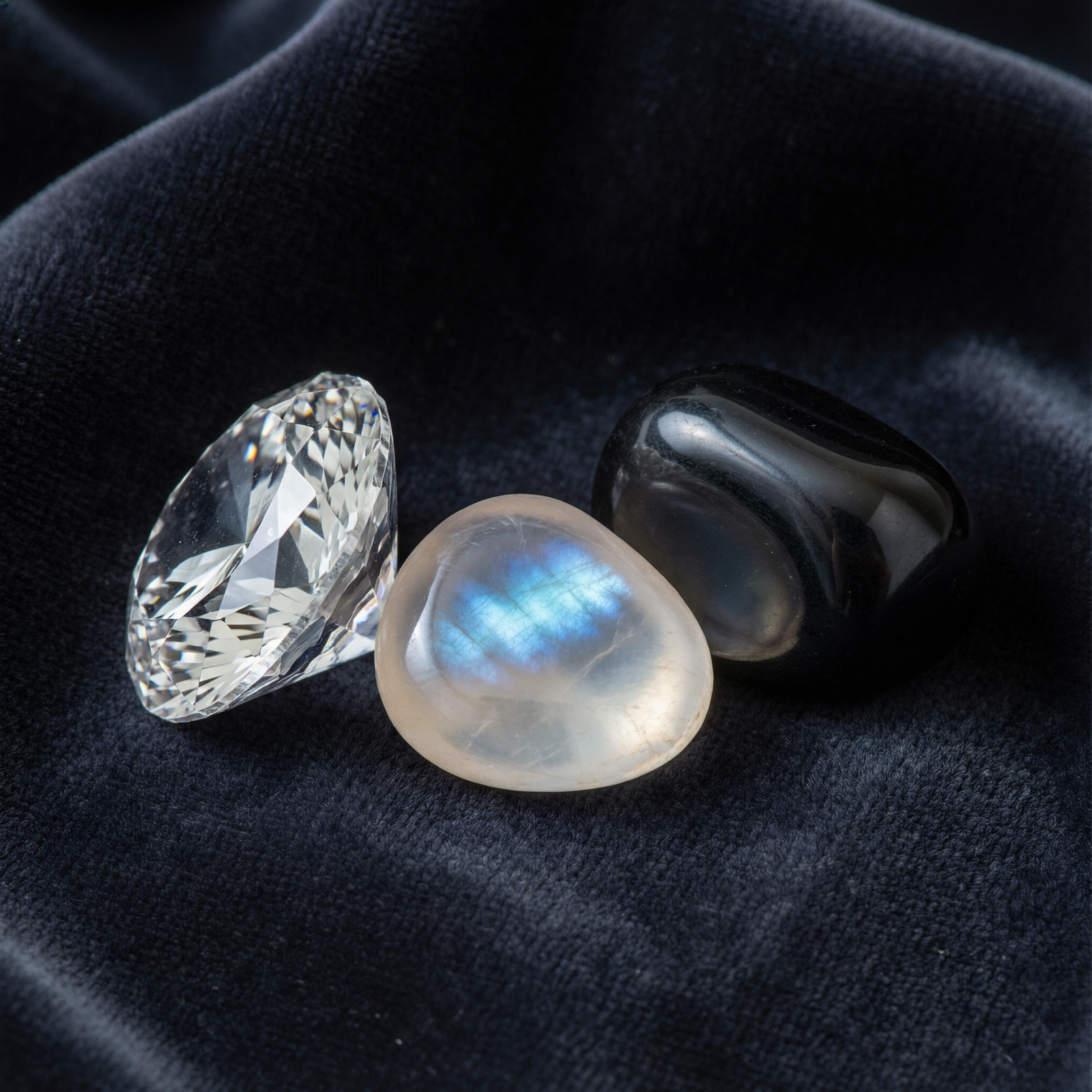
1. Synthetic (lab-created, lab-grown). A synthetic gem has the same chemical composition, crystal structure, and physical/optical properties as its natural counterpart. A synthetic ruby is still corundum — Al₂O₃ — with chromium for color; it is 9 Mohs, RI 1.76–1.77, SG 4.0, and it scratches the same things a natural ruby scratches. It is not “fake” — it is man-made, typically grown in days to months in a laboratory rather than formed over geological time in the ground. The major synthetic growth methods are described in the next section. FTC Jewelry Guides (Overton 2004) require disclosure: if a colored stone is synthetic, the seller must say so clearly before sale. Acceptable terms: “synthetic ruby,” “lab-created ruby,” “lab-grown ruby.” A brand name alone (“Chatham emerald,” “Kyocera opal,” “Inamori alexandrite”) is not sufficient disclosure — “synthetic” or “created” must accompany it.
2. Simulant (imitation). A simulant is a different material that merely looks like the gem it imitates. Red glass is a ruby simulant; blue glass is a sapphire simulant; cobalt glass is a lapis simulant; cubic zirconia is a diamond simulant (C16). A simulant is not the same chemical species and typically has different hardness, RI and SG, which makes identification straightforward with instruments. Some simulants are themselves natural gems — red garnet, red spinel, red tourmaline and pink topaz can all be (and historically have been) misrepresented as ruby; they are real gems but they are not ruby. “Simulant” is descriptive; “fake” is unhelpful because the simulant may be a perfectly legitimate material in its own right (a garnet-and-glass doublet is not a “fake ruby” — it is a garnet-and-glass doublet, a specific product).
3. Assembled stones (doublets, triplets). These are composite gems made of two or three pieces bonded together:
– Opal doublet: a thin slice of precious opal glued to a backing (potch/common opal, dark glass, ironstone epoxy or basalt), which adds durability and a dark background to intensify play-of-color.
– Opal triplet: same two layers plus a clear quartz or glass cap on top to protect the soft opal and magnify the play-of-color.
– Garnet-topped doublet (GTD): a thin slice of almandine garnet (natural, red) fused to a colored-glass pavilion; common 19th-century ruby simulant.
– Emerald triplets (soude emerald, beryl-and-glass triplet): two layers of near-colorless beryl (or synthetic spinel/quartz) joined by green cement, or a beryl top + green-glass pavilion; imitates emerald at a fraction of the price.
– Sapphire/spinel doublets and other composites appear regularly in GIA Lab Notes.
A note on terminology: the word “cultured” is reserved by convention for pearls (M15) — natural vs cultured pearl is the standard industry split, because cultured pearls are grown by a mollusk with human assistance, not in a laboratory. Avoid “cultured emerald,” “cultured ruby,” etc., even though the logic seems parallel — industry practice is “synthetic” or “lab-created” for lab-grown colored stones.
| Category | Same chemistry/structure as natural? | Example |
|---|---|---|
| Natural gemstone | yes (found in the ground) | Natural Mogok ruby |
| Synthetic / lab-created | yes (grown in lab) | Verneuil synthetic ruby, Chatham flux emerald, Biron hydrothermal emerald |
| Simulant / imitation | no — different material, similar appearance | Red glass, red garnet, red spinel (when sold as ruby) |
| Assembled (doublet/triplet) | partially — composite | Opal doublet (natural opal + backing), garnet-topped doublet, beryl-glass emerald triplet |
Synthetic growth methods and their detection features
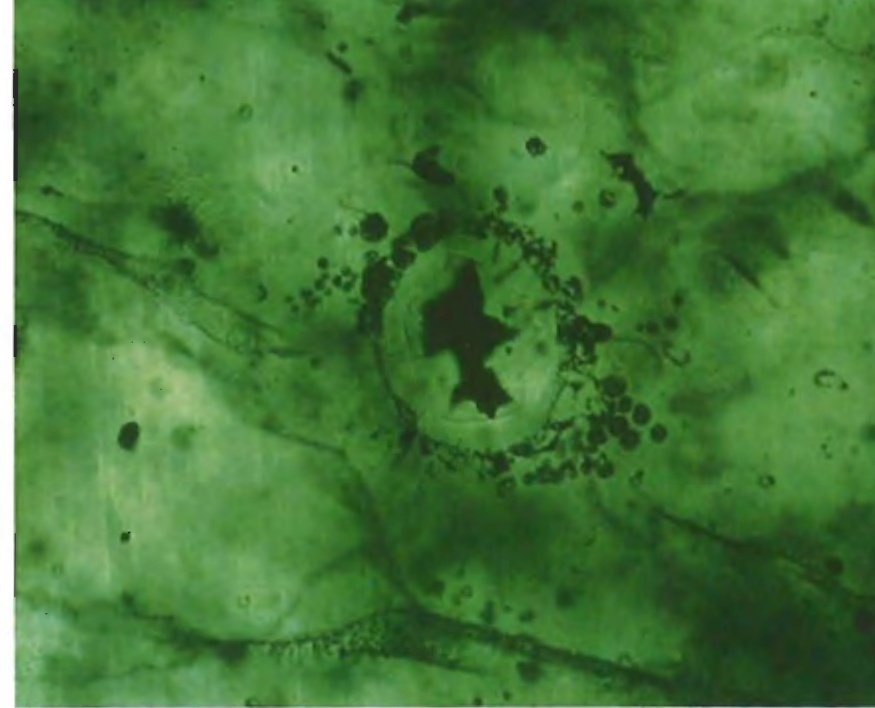
The four major commercial synthetic growth methods for colored stones each leave diagnostic fingerprints. Knowing these signatures is what lets a gemologist separate natural from synthetic under the microscope. The features overlap with M06’s synthetic-inclusion table and are expanded here.
| Method | How it works | Species grown | Key 10× / microscopic detection features | Brands / producers |
|---|---|---|---|---|
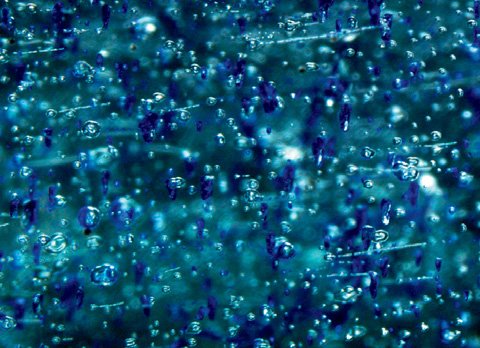
| Verneuil (flame-fusion) | Powder (e.g., Al₂O₃) falls through an oxyhydrogen flame, melting onto a rotating boule. Fast and cheap (boules grown in hours), this is the oldest commercial synthetic process (Auguste Verneuil, 1902) and still the source of most inexpensive synthetic ruby/sapphire. | Ruby, sapphire (all colors including colorless), blue/red/other synthetic spinel, rutile, strontium titanate; also synthetic star corundum (with titanium doping). | Curved growth striae (curved color bands) — the single most-cited feature; natural corundum has straight/angular color bands. Spherical gas bubbles (often dark, round, isolated, not fingerprint-like). Clouds of tiny bubbles; no natural host-rock mineral inclusions (no calcite/biotite/actinolite). | Produced by many manufacturers worldwide; inexpensive watch-jewel and jewelry-grade synthetics. |
| Czochralski (pulled) | A seed crystal is dipped into a melt and slowly pulled upward while rotating, growing a cylindrical crystal. | Ruby, sapphire, alexandrite, YAG, GGG (garnet simulants), some laser materials. (Synthetic moissanite is grown by a related physical-vapor process, C16.) | Curved striae can be present; spherical gas bubbles; generally very clean internally; higher optical clarity than Verneuil. | Various producers; many commercial synthetic alexandrites are Czochralski. |
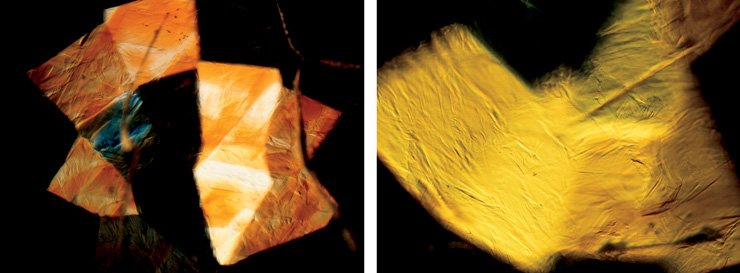
| Flux-melt | Nutrient (e.g., Al₂O₃ + Cr, or beryl components) is dissolved in a molten flux (lithium molybdate, lead oxide, etc.) at temperatures well below the melting point of corundum/beryl; crystals grow slowly over weeks to months as the flux cools. This produces crystals that mimic natural growth closely — flux synthetics are harder to detect than Verneuil. | Ruby, sapphire, emerald, alexandrite, spinel. | Wispy/veil-like flux inclusions (often chevron, lace, or fingerprint-shaped, with a uniform/golden/whitish appearance unlike natural fluid fingerprints); platinum crystals (tiny reflective platelets from the platinum crucibles many flux processes use); no natural host-rock inclusions (no calcite, biotite, actinolite). | Chatham, Kashan, Ramaura, Knischka, Gilson (early producers), Douros, others. |
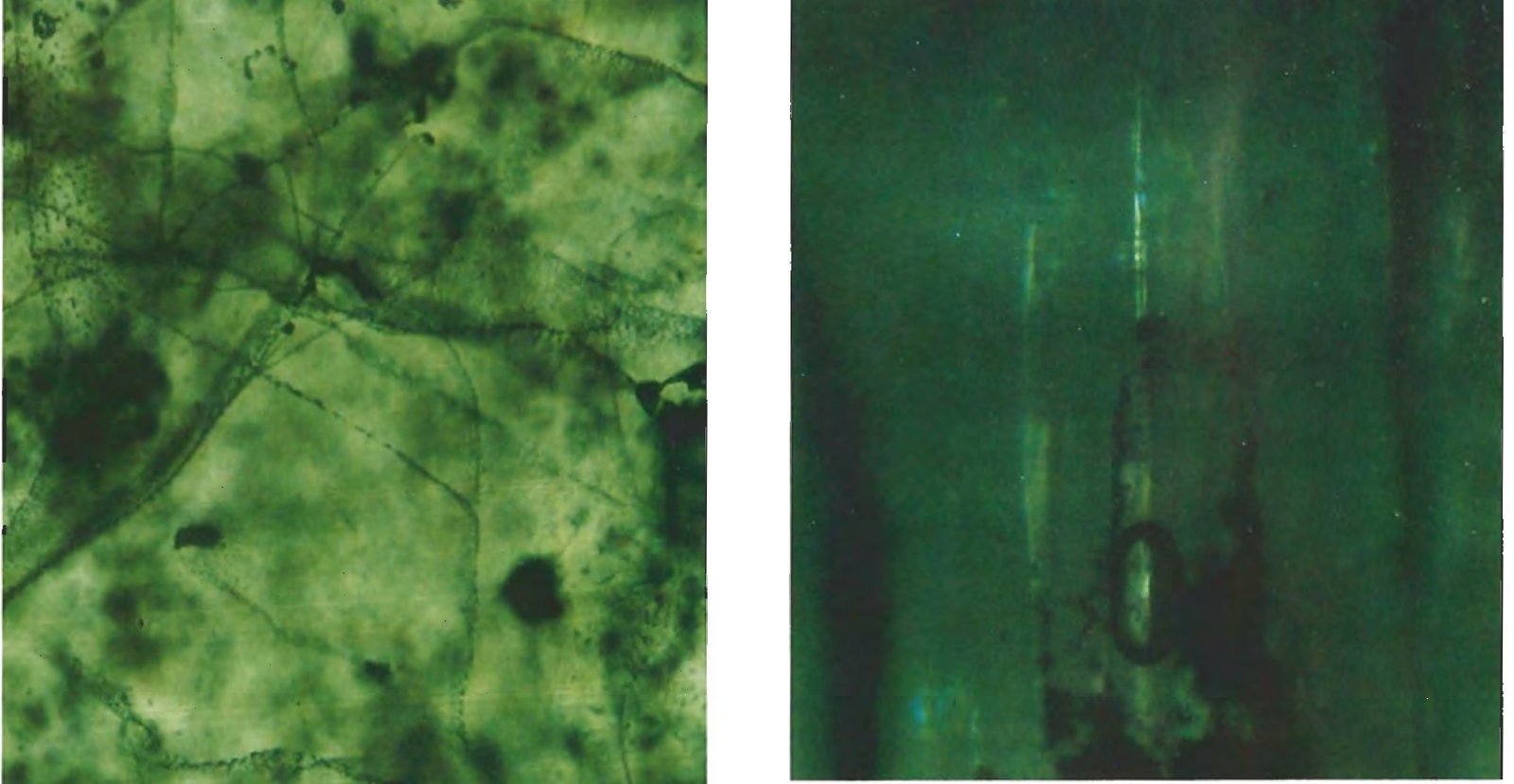
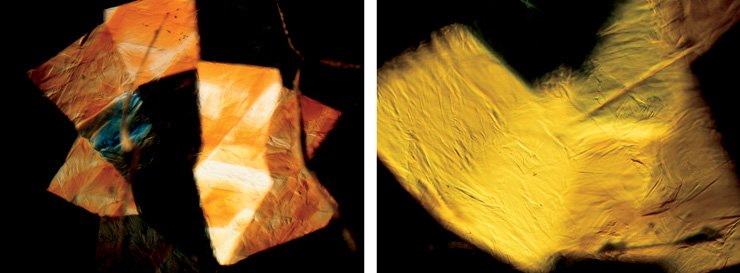
| Hydrothermal | Crystals grow in a high-pressure steel autoclave filled with a water-based nutrient solution at high temperature/pressure, over weeks to months — this is how nature grows hydrothermal emerald and quartz, and the lab method closely mimics it. | Emerald (Biron/Pool hydrothermal from Australia, Russian/Tairus, Chinese hydrothermals, etc.), synthetic quartz (almost all commercial synthetic amethyst, citrine, prasiolite, ametrine is hydrothermal), some hydrothermal ruby/sapphire. | Chevron / zig-zag growth patterns (the most quoted feature for hydrothermal synthetics — stepped growth features not found in natural emerald); nail-head spicules (in hydrothermal emerald); phenakite crystals; metal platelets (copper/gold) from the autoclave; tapered two-phase fluid inclusions; a visible seed plate (flat line marking the original seed crystal). | Biron (formerly Australian), Tairus (Russia/Thailand), various Chinese producers; large-scale synthetic quartz production in multiple countries. |
Other synthetics worth recognizing:
– Synthetic opal (Gilson, Kyocera and successors) is produced by precipitating silica spheres in a laboratory, producing a play-of-color effect structurally analogous to natural opal. The classic detection feature is a columnar (lizard-skin) structure viewed perpendicular to the surface (Schmetzer & Henn 1987) — the regular columns are visible at magnification and are unlike natural opal’s more random sphere arrangement. Some synthetic opal is polymer-impregnated.
– Kyocera/Inamori synthetic star rubies and synthetic cat’s-eye alexandrite (Koivula/Kammerling 1988; Kane 1987) — flux-grown or Czochralski with oriented rutile inclusions, or produced with diffusion-induced stars. Unnaturally perfect stars that do not move naturally are a red flag (see M06).
– Lechleitner overgrowth synthetics (Kane 1985) and more recent synthetic ruby overgrowth on corundum (Saeseaw 2015) place a thin synthetic layer onto a natural seed; detection: boundary at the overgrowth layer, seed plate visible.
– GE synthetic jadeite (Nassau & Shigley 1987) — General Electric produced small experimental quantities of synthetic jadeite in the 1980s; it has never been a commercial jewelry threat but is known in the gemological literature. Not something you will see in a retail case.
– Skull-melt cubic zirconia (CZ) and synthetic moissanite (SiC) are diamond simulants covered in C16; they are not colored-stone synthetics in this course’s scope.
Common simulants by species
| Natural gem | Common simulants | How to separate (at the counter / with basic tools) |
|---|---|---|
| Ruby / pink sapphire | Red/pink glass; synthetic Verneuil red spinel; red garnet (pyrope/almandine, rhodolite); garnet-topped doublets (GTD); composite sapphire/spinel doublets; doublets; rubellite tourmaline; dyed corundum. | Glass is softer (5–6 Mohs), warmer to the touch, shows gas bubbles and swirl marks; red spinel is singly refractive (ruby is doubly refractive) and shows different RIs; red garnet is also singly refractive and typically has lower SG and no fluorescence; GTD shows a join line at the girdle in profile and a “red ring” around the table edge when viewed face-down on a white surface. Doublets show the join. Chelsea filter: many natural rubies (especially Cr-rich) show red; glass and garnet typically don’t (some Thai basalt rubies don’t either; Chelsea is screening only). |
| Blue sapphire | Blue glass, synthetic blue spinel, blue CZ, tanzanite misidentified as sapphire, iolite, blue tourmaline, kyanite, cobalt-colored synthetic spinel, beryllium-diffused synthetics. | Glass has bubbles/swirls and is softer; spinel is SR vs sapphire DR; tanzanite is 6–6.5 Mohs (much softer) and strongly trichroic; iolite shows strong trichroism (brown/blue/yellow) and lower RI; kyanite shows extreme hardness anisotropy (4–5 on one direction, 6–7 on another); cobalt-colored synthetic spinel shows a diagnostic cobalt spectrum and strong red through Chelsea filter. |
| Emerald | Green glass, green CZ, green synthetic spinel, green YAG, beryl/glass triplets (soude emerald), large beryl triplets (Singbamroong 2007), plastic-coated beryl, green tourmaline, peridot misidentified as emerald, dyed quartzite (“African emerald” misnomer). | Glass shows bubbles/swirls; green CZ is much higher dispersion and is DR; green spinel is SR (emerald DR) and RI too low; beryl triplets show a join/girdle line in immersion; coated stones show bubbles in coating; green tourmaline has higher birefringence and is more saturated green; peridot is a yellower green with strong birefringence doubling; emerald triplets have two-color top/bottom luster. |
| Alexandrite | Vanadium-doped synthetic Verneuil corundum (“alexandrium” etc. — color-change synthetic sapphire, NOT chrysoberyl), color-change CZ, color-change garnet (genuine but different species), color-change glass, synthetic flux/Czochralski alexandrite. | True alexandrite is chrysoberyl (RI ~1.746–1.755, SR, SG 3.73). Color-change synthetic corundum has RI 1.76–1.77, DR. Color-change garnet is singly refractive and has garnet RI (varies by type). CZ is much higher dispersion and lower SG. |
| Lapis lazuli | Cobalt blue glass (Bosshart 1983 — classic), dyed howlite, dyed jasper, dyed calcite rock (“Swiss lapis,” usually dyed jasper), sodalite (natural but cheaper, lacks pyrite), rarely synthetic lapis. | Cobalt glass shows vivid red through Chelsea filter and has no pyrite; dyed materials show dye in fractures/grain boundaries and are softer; howlite is much softer (3.5 Mohs) than lapis (5–5.5); natural lapis has visible pyrite flecks and a non-homogeneous blue. |
| Turquoise | Dyed howlite, dyed magnesite, “block turquoise” (plastic- or resin-bonded turquoise powder), glass, ceramic, reconstructed turquoise, rarely plastic. | Dyed howlite shows dye in cracks and is softer (3.5 vs. 5–6); magnesite is white/gray before dyeing and shows typical magnesite texture; stabilized natural turquoise is still real turquoise (stabilization is a treatment, not a simulant — disclose stabilization); glass is cold to the touch, shows bubbles; the hot-point test damages plastic (do not perform on customer stones). |
| Pearl | Majorica imitation pearls (glass bead with essence d’orient coating — fish-scale extract), shell pearls (calcite bead coated with ground nacre), plastic beads, glass beads, coated glass, rarely “Mallorca pearls” (same family as Majorica). | Natural/cultured pearls feel gritty when rubbed gently against the tooth (nacre is slightly rough); imitations are smooth. Majorica/coated beads show a seam, a smooth surface, and coating wear at the drill hole. X-ray is definitive for natural-vs-cultured (M15). |
| Amber | Copal (young, undisturbed resin — younger geologically, often from Colombia or Madagascar; softens with ether/acetone), pressed amber (ambroid, heat-fused amber pieces), plastic (bakelite, celluloid, polyester, polystyrene), glass. | Copal melts/drips at lower heat than amber and is tacky with acetone; plastic floats in salt water differently and produces a plastic smell when touched with a hot point (do not test on customer pieces); amber floats in saturated salt water (glass/plastic usually sink but some plastics float); UV fluorescence patterns differ. |
| Opal | Slocum Stone (glass opal simulant with metallic flakes), plastic “opalite” (Koivula/Kammerling 1989), Gilson/Kyocera synthetic opal (which is a true synthetic, not merely a simulant — see above), opalite glass (common decorative glass), doublets/triplets. | Glass simulants show bubbles/swirls and no true sphere-array diffraction; plastic opal is much softer, shows molded patterns; synthetic opal shows columnar lizard-skin structure; doublets/triplets show a join line. |
| Peridot | Peridot-colored glass (McClure/Reinitz 1999), green CZ, green tourmaline, green sapphire, moldavite (tektite). | Glass shows bubbles and 5–6 Mohs hardness; green tourmaline shows stronger pleochroism; green sapphire is 9 Mohs (much harder); peridot’s strong birefringent doubling of pavilion facets is a quick ID under 10×. |
| Tanzanite | Violet-blue glass, synthetic forsterite (rare), coated tanzanite/coated topaz (McClure/Shen 2008), iolite, color-change sapphire. | Glass is softer (5–6 Mohs) with bubbles/swirls; coated tanzanite shows coating bubbles and color on the surface; iolite is strongly trichroic and less saturated. |
A quick triage note on the Chelsea color filter: the Chelsea filter transmits deep red and near-infrared light only. Stones that transmit red (many natural Cr-colored emeralds, Cr-colored rubies, cobalt-colored glass/synthetic spinel) appear pinkish-red through the filter; stones that absorb red (most green pastes, many synthetic emeralds, some iron-rich basalt rubies) appear green. This is a screening tool, not a verdict: Colombian emeralds typically show red through Chelsea; some Zambian/Brazilian and hydrothermal synthetic emeralds also do; some Thai rubies do not. Never call an origin or natural/synthetic determination from the Chelsea filter alone.
Assembled stones: doublets and triplets
Assembled stones are legitimate products when sold honestly. A well-made opal triplet is an affordable way to wear opal — the quartz cap protects the precious opal layer and the dark backing intensifies color; an opal doublet gives durability. The legal problem arises when assembled stones are sold as whole natural stones without disclosure.
Detection principles:
– Look at the girdle in profile, preferably immersed in water or refractive-index fluid. A doublet/triplet almost always shows a join line (a flat plane where two layers meet) at or near the girdle.
– Bubbles in the glue layer are often visible — they are confined to a flat plane, not scattered as in bulk glass.
– Differences in luster, hardness, or surface wear between top and bottom can reveal a composite. In a GTD, the top is hard, vitreous garnet; the pavilion is softer glass.
– In opal triplets the top cap is transparent quartz (no play-of-color) while the thin opal layer is beneath it; viewed from the side you see the color confined to a thin plane.
– Beryl-and-glass emerald triplets show near-colorless beryl top and bottom with a green layer in the middle; when immersed the green cement stands out.
– Garnet-topped doublets often show a “red ring” — if you lay the stone table-down on a white surface and look at the pavilion, the red garnet top creates a faint red rim at the edge of the table.
| Assembled type | Composition | Detection at 10× / immersion |
|---|---|---|
| Opal doublet | Thin precious opal slice + backing (potch, glass, ironstone epoxy, basalt) | Join line visible from side; opal color confined to thin top layer; backing often dark glass/potch without play-of-color. Boulder opal (natural ironstone host) is NOT a doublet. |
| Opal triplet | Opal doublet + clear quartz/glass cap (domed) | Transparent cap, thin opal layer, backing; domed cap may show some magnification; join lines visible from side. |
| Garnet-topped doublet (GTD) | Thin almandine garnet top + colored-glass pavilion | Join line at girdle; red “rim” when table-down on white; garnet top is hard (7–7.5 Mohs) while glass pavilion is soft (~5.5); bubbles in glass pavilion. |
| Beryl/glass emerald triplet (soude-style) | Two near-colorless beryl/quartz/spinel layers joined by green cement; or beryl top + green-glass pavilion | Join line visible; green concentrated in a middle plane; immersed view shows two-color structure. |
| Sapphire/synthetic-spinel doublet | Synthetic sapphire crown + synthetic spinel pavilion (or vice versa) (Anjomani 2016) | Join line at girdle; RIs differ across the join; bubbles in adhesive. |
Counter discipline and disclosure
The FTC Jewelry Guides, summarized by Overton (2004), set the rule for U.S. sales: any treatment that is not permanent, or that creates a material difference in value, must be disclosed to the consumer before sale. The same logic applies to synthetic origin and to assembled stones: “ruby” by itself means natural ruby; “emerald” by itself means natural emerald; “opal” by itself means whole opal (solid precious opal), not a doublet or triplet.
Counter rules:
1. Use the words. “This is a synthetic (lab-created) ruby”; “this is a doublet, with a thin layer of natural opal on a backing”; “this emerald has been clarity-enhanced with oil/resin.” Do not bury the disclosure in small print or rely on a report the client never sees.
2. Brand names are not disclosure. “Chatham emerald” requires “Chatham synthetic/created emerald”; “Gilson opal” requires “Gilson synthetic opal”; “Inamori” requires “Inamori synthetic alexandrite.”
3. Never guess identity at the counter. If you see curved striae, you can say “this has the features of a Verneuil synthetic, which I’d want confirmed by the lab.” If you see a join line at the girdle, say “this appears to be a doublet.” If you don’t see anything but the price is too good to be true, refer.
4. When in doubt, refer to a gemologist/lab. A GIA identification report is a fraction of the cost of a wrong call on an expensive stone. The single biggest counter mistake in colored stones is identifying by color. A red stone that looks like ruby can be ruby, synthetic ruby, garnet, spinel, tourmaline, glass, a doublet, plastic, or composite. The first step is not the client’s credit card — it is confirming what the stone is.
5. Treat synthetics and simulants with respect as products. Synthetic ruby is not “bad”; it is a real product with a real price point and real uses (class rings, fashion jewelry, industrial bearings, watch crystals). Disclose honestly and let the client choose.
[MEDIA: link-out | C17-M08-L1]
Legal reference: Overton T.W. (2004) Gem Treatment Disclosure and U.S. Law. G&G 40:2 — https://www.gia.edu/gems-gemology/summer-2004-gem-treatment-disclosure-us-law-overton
Required reading for any associate who sells colored stones.
On the floor: applying it this week
- Monday (10 minutes): Take a loupe to any synthetic stones your store sells (most stores carry synthetic birthstone jewelry, e.g., synthetic ruby class rings). Look for curved striae and gas bubbles. Train your eye on known material.
- Tuesday (10 minutes): If you have access to a Chelsea filter, look at a known natural Colombian emerald, a known synthetic emerald (if you have one), and a cobalt glass lapis simulant. Note the red/pink reaction in Colombian emerald and cobalt glass; green in pastes. Then note that the filter does not give a verdict on its own.
- Wednesday (practice): Disclose material correctly every time this week: “synthetic ruby” for synthetic, “emerald doublet” for assembled, “natural ruby” for natural. Drop the word “real” — it’s not the opposite of synthetic.
- Thursday: If a client brings in a “bargain ruby/emerald/sapphire,” train yourself to say “let me look at this properly — some of these features deserve a second look under the microscope” rather than declaring natural or synthetic instantly.
- Friday (5 minutes): Re-read M06 on inclusion features for synthetic detection. Curved striae and flux veils are the two features you are most likely to spot at the counter.
Objections, mistakes and edge cases
| Situation | The trap | Better move |
|---|---|---|
| Client says “is this a real emerald?” | Saying “yes” because it contains beryl | Clarify: natural vs synthetic/assembled. If it is a synthetic emerald, say so — “it’s a real beryl, but it was grown in a lab.” If it is a doublet, say so. The word “real” confuses the conversation. |
| Client has a “ruby” with a gas bubble and curved striae | Calling it a “fake ruby” | Call it what it is: “This is a Verneuil synthetic ruby — genuine corundum, grown in a lab rather than mined. It’s not fake; it’s synthetic, and it’s a different product from natural ruby.” |
| A vendor offers you “Chatham emeralds” | Assuming “Chatham” is a disclosure by itself | Chatham is a brand of flux-grown synthetic emerald. Sell it as “Chatham created/synthetic emerald” and price accordingly. |
| Client wants a large red stone for low budget | Steering her to red glass without disclosing | Offer composite/doublet/created ruby as legitimate alternatives at the right price point, and disclose what each is. Glass is fine as a fashion product; the problem is when it’s sold as ruby. |
| Inherited “opal” triplet the client thinks is solid black opal | Dismissing it as worthless | An opal triplet is wearable and attractive — but it is worth a fraction of solid black opal. Explain the construction honestly; don’t tell her it’s “nothing.” |
| An estate stone has no obvious inclusions at 10× | Declaring it synthetic because it’s clean | Some natural stones (fine aquamarine, morganite, garnet, tanzanite, some corundum) can be loupe-clean. Absence of inclusions is not proof of synthesis. Refer to a lab for a formal determination. |
| Client hears “lab-grown” and assumes it is identical to natural (as lab-grown diamonds are marketed) | Overstating parity for colored stones | Lab-grown colored stones (especially flux and hydrothermal) can be chemically and optically identical to their natural counterparts, and are real corundum/beryl — but origin reports still distinguish them, and price is different. Use the same language lab reports use: “natural” vs “laboratory-grown” or “synthetic.” |
| Edge case: a stone labeled “created ruby” turns out to be pink paste glass | Assuming any red “created” item is synthetic corundum | Always verify. “Created ruby” should mean synthetic corundum, but mislabeled glass appears. |
Self-check
- What is the difference between a synthetic gem and a simulant?
- What two 10× features are the classic indicators of a Verneuil (flame-fusion) synthetic ruby or sapphire?
- What type of inclusions are characteristic of flux-grown synthetics, and what metallic platelets are common from the crucible?
- What chevron/zig-zag growth feature plus nail-head spicules and a seed plate suggest a hydrothermal synthetic emerald?
- What columnar/lizard-skin structure viewed from the side distinguishes most synthetic opal from natural?
- How do you detect an opal doublet/triplet at 10×?
- What classic simulant is made by fusing a thin slice of garnet to colored glass?
- What does FTC disclosure law (per Overton 2004) require regarding the word “ruby” or “emerald” used alone?
- Why can’t the Chelsea filter alone identify a stone as natural emerald or natural ruby?
- If you don’t see definitive synthetic features but the price seems too good to be true, what is the professional move?
Go deeper
- ★ Stone-Sundberg J. (2013) Sapphire Series Parts 1–4. GIA Research & News — https://www.gia.edu/gia-news-research-Sapphire-Series-Introduction-to-Sapphire-and-Synthetic-Sapphire — anchor: Verneuil, Czochralski, flux, hydrothermal synthetic sapphire in four parts, 30 minutes total.
- ★ Renfro N. et al. (2010) Synthetic Gem Materials in the 2000s. G&G 46:4 — https://www.gia.edu/gems-gemology/winter-2010-synthetic-diamonds-renfro — decade review, 25 minutes.
- ★ Overton T.W. (2004) Gem Treatment Disclosure and U.S. Law. G&G 40:2 — https://www.gia.edu/gems-gemology/summer-2004-gem-treatment-disclosure-us-law-overton — legal anchor, 25 minutes.
- Schmetzer K., Henn U. (1987) Synthetic opal Kyocera — G&G 23:3.
- Bosshart G. (1983) Cobalt glass lapis imitation — G&G 19:4.
- Koivula J.I., Kammerling R.C. (1989) “Opalite” plastic imitation opal — G&G 25:1.
- Mayerson W.M. (2001) Beryl-and-glass emerald triplet — G&G 37:1.
- Anjomani N. (2016) Synthetic sapphire/spinel doublets — G&G 52:4.
- Koivula J.I. et al. (1996) Tairus hydrothermal synthetic emerald — G&G 32:1.
- Kane R.E., Liddicoat R.T. (1985) Biron hydrothermal synthetic emerald — G&G 21:3.
- Hanano J. et al. (1990) Majorica imitation pearls — G&G 26:3.