Module 1: The Modern Bridal Buyer’s Journey
For decades, jewelry retail clung to a comforting script. A solitary suitor walked into a store, looked into a glass case with zero diamond knowledge, spent two months of salary on whatever round brilliant solitaire the jeweler recommended, and tucked the ring box into a sock drawer until proposal night.
That script is dead.
Today’s bridal journey begins months before anyone touches a showroom door handle. It starts on phones late at night. Couples spend between three and six months studying facet patterns, ring profiles, and metal alloys. They save hundreds of images to shared boards, watch macro videos of oval diamonds moving under natural sunlight, compare lab-grown diamond price drops on Reddit, and scrutinize cut proportions on specialist forums.
The romantic dynamic has shifted with equal force. More than seventy-five percent of couples now shop together. Even when the proposal retains an element of surprise, the person wearing the ring has almost certainly specified the diamond shape, the prong style, and the gold color.
Walking up to today’s client with a memorized 4Cs lecture is the fastest way to lose the room. They already know what color grades look like on a certificate. What they lack is tactile reality. They need a knowledgeable guide who can translate digital inspiration into sound bench mechanics, validate their research, and create a calm space where emotion and craft align.
—
—
1. What Modern Pre-Shopping Really Looks Like
Clients do not enter your salon to find out what an engagement ring is. They enter to test what they have already spent months looking at on screens.
The research happens in distinct layers:
First, visual mood boards. More than eighty percent of future brides curate image folders long before ring shopping turns serious. These folders gather specific aesthetic preferences: compass-set prongs, hidden halos, elongated proportions, and bezel collars.
Second, short-form video. Feeds deliver endless clips of diamonds rotating in different lights, comparing the crisp fire of a round brilliant to the crushed-ice look of a radiant cut.
Third, specialized forums. On communities like Reddit’s engagement ring boards, shoppers debate depth percentages, bow-tie shadows in ovals, laboratory certificates, and wholesale markups.
This independent research creates a specific counter dynamic. Clients arrive armed with technical terms, yet they remain vulnerable to decision paralysis. They know what a 2.5-carat oval looks like on a phone screen. They do not know how it balances on a size 5 finger, or whether an ultra-thin 1.4mm band can endure years of daily door handles and steering wheels.
Our task is to ground that digital knowledge in physical reality.
—
—
2. Three Counter Archetypes and How to Guide Them
When welcoming a couple or a solitary shopper, identify their decision archetype within the first three minutes of conversation.
Archetype 1: Collaborative Co-Shoppers (Roughly 45% of Appointments)
Both partners sit at the counter together. They share notes openly and treat the appointment as a joint project.
The wearer focuses on daily comfort, finger coverage, and how the setting pairs with existing bracelets or rings. The purchaser looks at diamond cut grades, warranty terms, and financing options.
The floor discipline here is balance. Divide your attention equally. Never speak exclusively to the person holding the payment card while treating the wearer like a passive observer. Ask the wearer how the gallery height feels when she closes her hand. Ask the purchaser if the diamond’s table reflection meets their expectations. Keep both partners engaged in every step of the decision.
Archetype 2: The Hybrid Shopper (Roughly 35% of Appointments)
The purchaser comes in alone, but pulls out a phone immediately: “She sent me three specific links and said she wears a size 6.”
This client feels relieved to have guardrails, but nervous about making mistakes. They wonder whether an F color is white enough in yellow gold, or if a four-prong basket is secure.
Step in as a technical translator. Validate the partner’s selections right away: “Your partner has an eye for clean proportion. That is an elongated oval in a low-profile cathedral mount.” Then walk them through the structural details, assuring them that sizing and post-proposal adjustments are part of your service.
Archetype 3: The Complete Surprise (Roughly 20% of Appointments)
The purchaser arrives with zero direct guidance. Sometimes they bring a sister or close friend; often they stand at the counter alone.
Their anxiety is palpable. They worry about spending thousands of dollars on a piece their partner might secretly dislike.
Lower the emotional stakes early. Remind them of your exchange and remounting privileges: “The priority today is selecting an exceptional center diamond. If your partner wants to adjust the setting after the proposal, our workshop credits the mounting fully toward any custom design she prefers.” That single policy removes their fear of making an irrevocable error.
—
—
3. The Digital Image Translation Protocol
When a customer holds out a phone showing an Instagram reel or Pinterest pin, inexperienced associates often make a costly mistake. They criticize the design: “That ring was rendered in CAD; nobody can wear prongs that thin without losing stones.”
The customer hears condescension. They pull their phone back, thank the associate, and leave.
A seasoned consultant handles the moment with respect. They break the image down into its structural components:
1. Acknowledge the aesthetic choice. “The floating look on this gallery is clean and minimal. It highlights the diamond beautifully.”
2. Translate the silhouette into bench reality. “Notice how low this basket sits against the finger. In rendered photos, rings float in empty space. In real life, a ring needs enough under-gallery clearance so a wedding band can slide flush against it without grinding prongs.”
3. Offer practical alternatives. “To give you that featherweight look without risking loose diamonds, we cast our shanks with a slight knife-edge taper. The band looks like 1.5mm from above, but maintains 1.8mm of solid gold underneath for everyday durability.”
This approach respects the client’s research while steering them toward an heirloom that lasts fifty years.
—
—
4. Hospitality and Showroom Staging
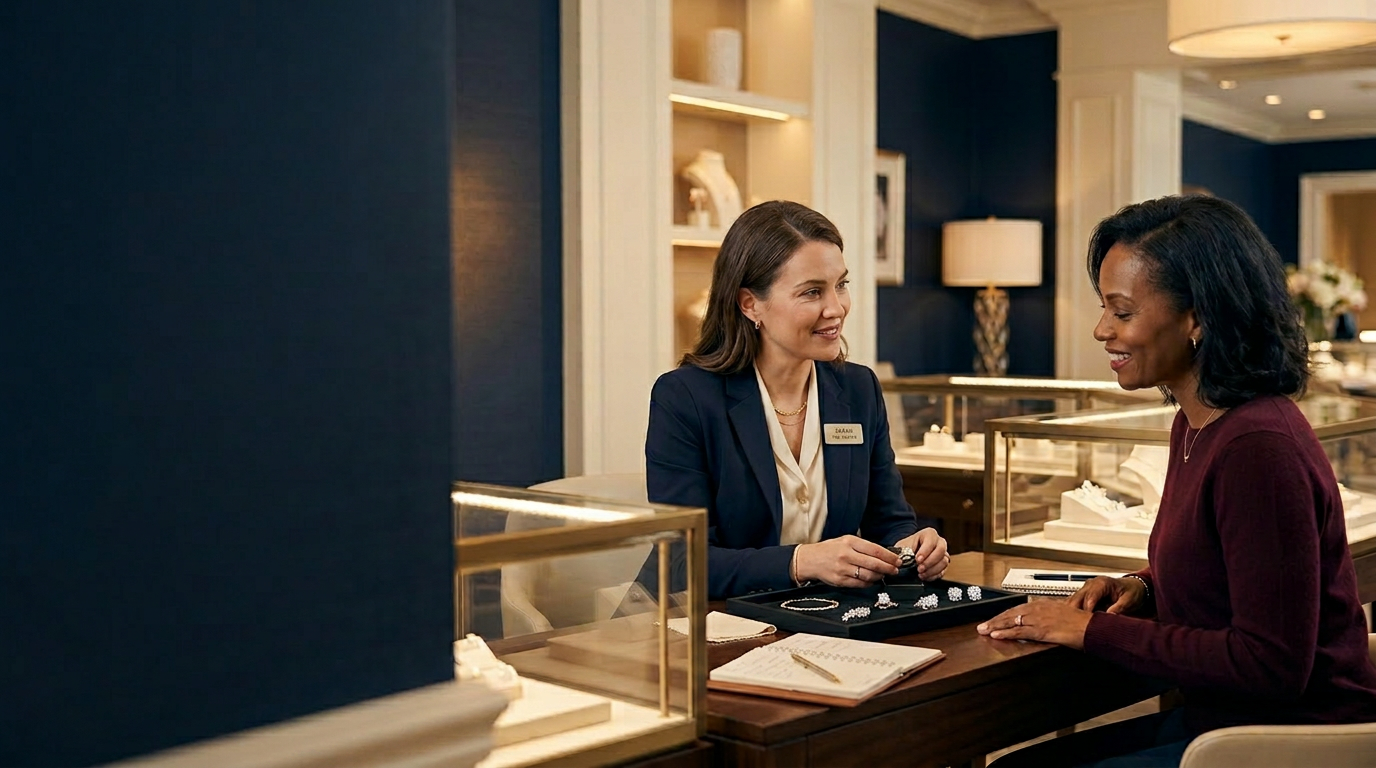
Fine jewelry transactions succeed when the physical environment slows the customer down. A hurried customer stays guarded. An unhurried customer opens up.
Excellence in showroom hospitality relies on small, deliberate habits:
1. The beverage ritual. Offer still water, espresso, or a dry sparkling wine before pulling a single ring tray. Seating clients with a glass in hand changes their heart rate and signals that their visit will not be a high-pressure pitch.
2. The velvet tray standard. Never leave loose diamonds or mountings scattered across bare glass. Every piece sits upright on a plush velvet pad. Hold tweezers with deliberate control. Hand the 10x loupe to the client gently, adjusting the focal distance for them.
3. Lighting management. Showroom halogen spots make every diamond sparkle artificially. After viewing stones under showcase spots, walk the client toward natural daylight near a window or skylight. Demonstrating how a diamond performs in indirect daylight builds instant credibility.
—
—
5. Daily Floor Summary
Modern bridal clients are not looking for an order-taker or an aggressive closer. They are looking for a trusted jeweler who knows more about diamond proportions and metal fatigue than they do, yet treats their ideas with genuine warmth.
When you master the art of decoding digital inspiration, balancing couple dynamics, and staging an unhurried presentation, you turn an anxious transaction into the start of a multi-decade relationship.
—
6. Morning Team Briefing
– Validate Online Research: When a client shows an Instagram ring, praise the silhouette before explaining any bench considerations. Never make them feel naive.
– Spot the Archetype: Distinguish between co-shoppers, hybrid hint-droppers, and surprise buyers in the opening three minutes.
– Rule of Three on the Pad: Never clutter the presentation tray with more than three rings at once. Remove rejected designs right away.
– Test in Natural Light: Walk stones to a window to demonstrate honest daylight performance.
– Keep Notes Clean: Log finger measurements, partner names, and design favorites into the client record before closing the appointment.
—
7. Fact-Check Verification
| Standard / Observation | Industry Benchmark | Floor Execution Guideline |
| :— | :— | :— |
| Research Horizon | 3 to 4 months prior to purchase | Assume deep familiarity with 4Cs terminology; focus on tactile fit. |
| Co-Shopping Rate | >75% of modern couples | Engage both partners equally throughout the consultation. |
| Fancy Shape Dominance | ~65% of center diamond demand | Maintain broad selection of ovals, emeralds, and radiants on hand. |
| Showroom Tray Limit | 3 rings maximum on display pad | Clear rejected pieces promptly to prevent visual fatigue. |
| Daylight Verification | Standard gemological practice | Demonstrate stone fire under natural light to verify color grades. |
Module Knowledge Assessment
Module 1 Assessment: The Modern Bridal Buyer’s Journey
10-Question Comprehensive Examination with Rationales
Q1: According to contemporary industry research from The Knot and De Beers, what percentage of modern bridal couples engage in collaborative co-shopping or style pre-selection?
– A) Less than 10%
– B) Approximately 25%
– C) Over 70% to 75%
– D) Exactly 100%
Correct Answer: C
Rationale: Industry studies consistently show that over 70% of couples shop together or collaborate directly on ring design prior to the proposal.
Q2: How long does the average modern bridal buyer spend researching engagement rings prior to making a final purchase?
– A) Less than 48 hours
– B) Between 3 and 6 months
– C) Exactly five years
– D) Only on the day of the proposal
Correct Answer: B
Rationale: The typical omnichannel bridal journey involves 3 to 6 months of passive social discovery, technical study, and showroom validation.
Q3: When a customer pulls out a smartphone and shows the associate a Pinterest screenshot of a ring, what is the first step of the “Pinterest Decoding Protocol”?
– A) Tell the customer that rings on the internet are fake
– B) Validate and compliment their aesthetic taste warmly
– C) Immediately quote the highest price in the store
– D) Refuse to look at competitor photos
Correct Answer: B
Rationale: Validating the client’s aesthetic choices builds instant rapport, while criticizing their saved images creates defensiveness and kills the consultation.
Q4: Why do many online CAD renderings of engagement rings pose durability problems when worn in everyday life?
– A) CAD cannot render platinum
– B) Digital renderings often depict ultra-thin shanks (e.g., 1.2mm) to maximize diamond visual impact, which easily warp, bend, or lose pavé stones under real-world mechanical stress
– C) Digital rings are illegal under FTC guidelines
– D) CAD designs can only use lab-grown diamonds
Correct Answer: B
Rationale: Renderings often sacrifice structural integrity for aesthetics; physical fine jewelry requires sufficient metal thickness (typically 1.7mm–2.0mm) for lifetime durability.
Q5: How should a sales professional handle a “Pure Surprise” bridal buyer (Archetype C) who has zero direct input from their partner and exhibits extreme anxiety?
– A) Pressure them to buy the most expensive solitaire in the showcase immediately
– B) Offer complete psychological safety by explaining the store’s complimentary post-proposal sizing, inspection, and setting exchange guarantees
– C) Tell them to go home until they find out their partner’s exact ring size
– D) Warn them that 50% of surprise proposals fail
Correct Answer: B
Rationale: Highlighting flexible exchange and sizing policies lowers the stakes, eliminates decision panic, and gives the nervous buyer confidence to proceed.
Q6: Which diamond shape has experienced the most dramatic surge in modern bridal popularity, rivaling the traditional round brilliant?
– A) Triangular Trilliant
– B) Oval Cut
– C) Old Mine Cut
– D) Baguette
Correct Answer: B
Rationale: Oval diamonds have surged in modern bridal demand, favored for their elongated finger-flattering proportions and large apparent face-up surface area.
Q7: When a couple visits the showroom together to co-shop (Archetype A), how should the consultant direct the conversation?
– A) Talk exclusively to the male partner about money and ignore the female partner
– B) Address both partners as equal collaborators, engaging the recipient on aesthetic feel and daily comfort, and the purchaser on craftsmanship, quality, and payment flexibility
– C) Ask the couple why they aren’t married yet
– D) Separate the couple into two different rooms
Correct Answer: B
Rationale: Successful co-shopping consultations treat both partners with equal respect, balancing emotional design choices with analytical purchasing criteria.
Q8: What is the primary psychological driver of “analysis paralysis” among modern diamond buyers?
– A) Diamonds are too cheap
– B) Information overload from conflicting online forums, video reels, and diamond pricing platforms without physical context
– C) Stores have too many chairs
– D) Customers don’t like looking at diamonds
Correct Answer: B
Rationale: Modern buyers consume massive amounts of technical data online; without physical diamond comparison under expert guidance, this data creates confusion rather than clarity.
Q9: What is the recommended minimum shank width for an everyday diamond engagement ring set with micro-pavé diamonds?
– A) 0.5 mm
– B) 0.8 mm
– C) 1.7 mm to 2.0 mm
– D) 6.0 mm
Correct Answer: C
Rationale: Fine jewelry bench standards recommend at least 1.7mm to 2.0mm of metal width to securely seat pavé diamonds and resist bending during daily activities.
Q10: What role should the modern fine jewelry sales consultant embrace at the bridal counter?
– A) A high-pressure transaction closer who demands immediate cash deposits
– B) A trusted milestone Sherpa and consultative curator who guides couples through complex decisions with technical transparency and romantic empathy
– C) A quiet order-taker who only answers yes or no
– D) An anonymous retail clerk
Correct Answer: B
Rationale: The modern bridal specialist succeeds by acting as an expert, empathetic guide who removes friction and curates an unforgettable milestone experience.