Module 3: Showing High-Value Goods: Floor Discipline
In the theatre of luxury fine jewelry sales, the counter is where commerce, art, and high-ticket emotion converge. When a client requests to see a 3.50-carat round brilliant diamond solitaire or a hand-fabricated platinum eternity band, the retail sales professional transitions into a trusted advisor. Yet, this exact moment of intimate luxury presentation is where the commercial enterprise faces its most severe vulnerability to asset loss.
Loss-prevention investigations conducted by Jewelers Mutual and the Jewelers’ Security Alliance (JSA) demonstrate that over 75% of daytime retail shrinkage occurs directly during active customer consultations. These losses are rarely the result of armed assaults; rather, they stem from minor, cumulative lapses in counter discipline:
– An associate leaves a showcase key inserted in the lock cylinder while turning to fetch a polishing cloth.
– An associate brings out four diamond rings onto an open counter to satisfy an enthusiastic shopper.
– An associate leaves a sliding glass case door cracked open by two inches while answering a phone call.
– An associate fails to loupe a returned diamond ring, discovering hours later that the genuine natural diamond was substituted with a $50 cubic zirconia.
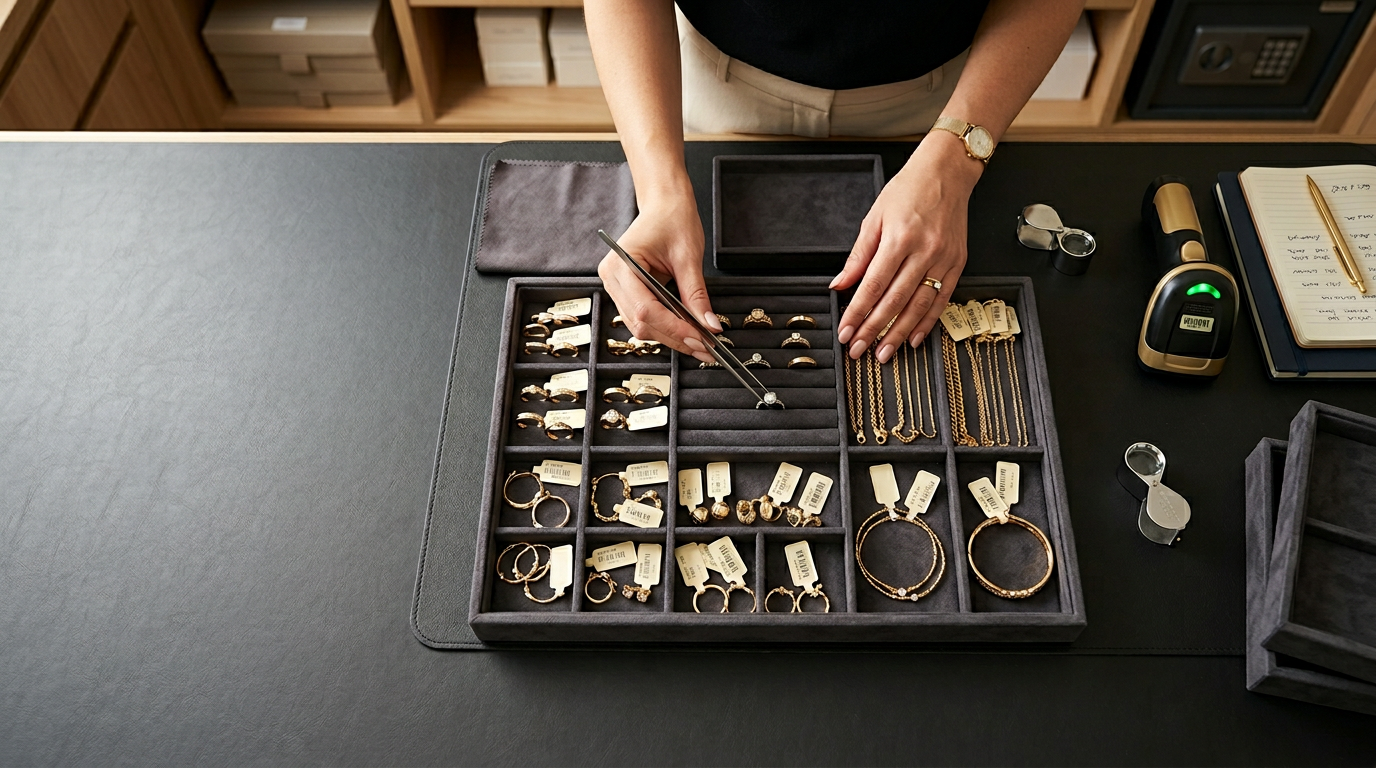
Professional jewelers understand that white-glove luxury presentation and rigorous loss prevention are not opposing forces. In fact, they are identical disciplines. The precise physical behaviors that protect high-value merchandise, handling pieces exclusively with lint-free cloths, presenting items on weighted velvet trays, verifying facet integrity under 10x magnification, and maintaining focused custody, are the exact behaviors that signal prestige, connoisseurship, and reverence to high-net-worth buyers.
This module details the foundational counter disciplines required to present high-value fine jewelry with absolute security and supreme luxury polish.
—
1. The Three Cardinal Showcase Disciplines
Every fine jewelry showroom operates under three non-negotiable physical rules governing showcase access. Violating any of these three rules compromises the entire security perimeter of the boutique.
1. The Wrist Keyholder Mandate
The physical key to a jewelry showcase is the master gateway to hundreds of thousands of dollars in inventory. Leaving a showcase key in a lock cylinder, even for five seconds, is the single most common procedural failure cited in retail distraction theft insurance claims.
– The Mechanism: Every associate must wear their showcase keys secured to a durable elastic wrist coil, a leather wrist strap, or a reinforced retractable belt lanyard.
– The Rule: If the associate lets go of the key, it must automatically retract to their wrist or hip.
– The Prohibitions:
– Never leave a key in the lock: When an associate unlocks a case, the key stays in their hand. Once the door is opened, the key is removed from the cylinder immediately.
– Never place keys on counter glass: Placing keys on the countertop allows a distraction confederate to slide a newspaper, brochure, or handbag over the keys, quietly palming them while the associate is occupied.
– Never hang keys on under-counter hooks: Under-counter hooks are well-known to professional thieves, who reach over the counter to swipe keys while an associate bends down to retrieve gift wrap.
2. The Plunger Lock Relocking Protocol
Showcase glass sliding doors must never remain unlocked while an associate is presenting merchandise.
– The Reflex: The moment an associate’s hand clears the showcase with the selected piece, the sliding door must be slid shut and the plunger lock pushed inward until it clicks.
– The Rationale: In a classic distraction theft, Accomplice A asks the associate to explain the 4Cs of a diamond. While the associate turns toward Accomplice A, Accomplice B quietly slides open the unlocked case door from the front corner, reaches an arm inside, and scoops three full presentation trays into an open shopping bag. Locking the showcase immediately eliminates this vulnerability.
3. The One-Item-Out Rule
The most foundational doctrine of fine jewelry asset protection is the One-Item-Out Rule:
Only one high-value piece of jewelry is removed from the showcase and shown to a customer at any given time.
– The Comparative Exception (Maximum Two Items): If a client is actively deciding between two competing diamond shapes (e.g., comparing an oval cut against a radiant cut), the associate may remove a second piece onto a velvet presentation tray.
– The Absolute Ceiling: Under no circumstance are three high-value pieces ever permitted on the counter simultaneously. If the client asks to see a third stone:
> “I would love to show you that emerald cut! Let me just place this oval back in the showcase so we can focus our attention clearly on comparing these two.”
– The Psychological Advantage: Enforcing this rule not only prevents loss; it focuses the client’s decision-making process, eliminating cognitive choice overload and accelerating the closing sequence.
—
—
2. Counter Topography & Spatial Custody Geometry
A jewelry counter is not merely a piece of showroom furniture; it is a tactical barrier. The physical geometry of where an associate stands, where the velvet tray is placed, and how merchandise is handed over determines whether an opportunistic thief can execute a grab-and-run.
The 45-Degree Consultative Stance
Never stand squared-off directly facing the client with locked knees and forearms leaning on the glass.
– The Posture: Stand at a 45-degree angle to the counter. Your dominant foot is slightly back, your weight is balanced evenly, and your torso is oriented toward the client while your head maintains peripheral sightlines across the showroom floor.
– The Tactical Benefits:
– If a customer makes a sudden grab for merchandise or attempts to vault the counter, you cannot be knocked backward or trapped against the display wall.
– You maintain an unbroken field of vision toward the primary showroom entrance, immediately noticing when new visitors or suspicious groups enter the boutique.
Show Tray Positioning: The Tactical Centerline
All merchandise must be presented on a weighted, non-slip velvet presentation tray.
– The Centerline Barrier: Imagine an invisible line running down the exact center of the countertop from left to right.
– Zone A (Associate Zone): The rear half of the counter belongs exclusively to the associate. The velvet show tray must remain firmly anchored inside Zone A, resting under the associate’s immediate physical custody.
– Zone B (Client Zone): The front half of the counter is for the client’s hands, elbows, or handbag.
– The Hand-Off: Never push an open tray across the centerline into Zone B. When the client wishes to try on a ring:
1. Pick up the individual ring from the tray with your thumb and forefinger.
2. Extend your hand across the centerline to gently hand the piece to the client or invite them to extend their finger.
3. Keep the velvet tray anchored in Zone A under your direct custody.
—
—
3. The 5-Point Anti-Switch Loupe Protocol
Diamond switching is one of the most lucrative and undetectable crimes facing fine jewelry retailers. In a switch operation, a professional thief poses as an affluent client interested in a 2.00 to 5.00-carat certified loose diamond or diamond engagement ring. The suspect carries a counterfeit replica, typically a cubic zirconia (CZ) or synthetic moissanite stone mounted in a matching silver or brass setting. The replica has been pre-selected to match the millimeter dimensions, carat weight, and head design of genuine inventory.
Through sleight-of-hand (often using a palmed stone, a fake cough, dropping an item, or a double-ring palm), the thief substitutes the counterfeit for the genuine article, returning the fake to the associate while slipping the real diamond into their pocket. If the associate simply glances at the stone with the naked eye and returns it to the showcase, the theft will not be discovered until the piece is sold to another client weeks later, creating catastrophic financial and reputational damage.
The 5-Point Anti-Switch Loupe Protocol completely eliminates this threat:
The Twin Loupe Sequence: Before & After
An associate must examine the piece under a 10x optical triplet loupe at two non-negotiable moments:
1. Immediately BEFORE handing the item to the client.
2. Immediately AFTER receiving the item back from the client, BEFORE returning it to the showcase.
The 5 Diagnostic Inspection Points
When looking through the 10x loupe, the associate systematically checks five physical markers:
1. GIA/AGS Micro-Laser Inscription: Examine the girdle facet. Confirm the presence of the laboratory report number micro-laser inscribed on the stone. Counterfeit stones and quick-switch replicas almost never feature matching microscopic laser inscriptions.
2. Natural Inclusions & Clarity Fingerprint: Check the characteristic internal clarity features mapped on the GIA plotting diagram (e.g., a tiny black crystal under the table facet, or a feather near the bezel). Synthetic moissanite or CZ will appear either unnaturally flawless or exhibit characteristic double-refraction facet doubling.
3. Prong Seating & Tool Marks: Examine the metal claws. Genuine factory mountings feature crisp, polished, undisturbed prongs. A hastily swapped stone in an imitation mount often shows rough tool marks, uneven prong heights, or visible adhesive residue.
4. Assay Hallmarks & Maker’s Marks: Loupe the inside of the ring shank. Confirm the presence of crisp, micro-stamped purity hallmarks (`PT950`, `750`, `18K`), brand trademarks, and serial numbers.
5. Thermal Density & Specific Gravity Feel: As you hold the piece in your palm, assess its heft and thermal conductivity. Genuine platinum has an unmistakable density (specific gravity ~21.4) and feels cold to the touch; base-metal replicas feel noticeably light and warm.
White-Glove Connoisseurship Scripting
Many new associates feel awkward louping an item in front of a client, fearing the client will feel suspected or insulted. The secret lies in reframing the inspection as white-glove luxury service:
– When Louping BEFORE Hand-Off:
> “Allow me to clean the table facet with our microfiber cloth and check the prong tension under our 10x loupe before you try this on. We ensure every mounting is in immaculate, secure condition for our clients.”
– When Louping AFTER Return:
> “Thank you so much! Let me just wipe away any natural skin oils and verify the GIA laser inscription on the girdle for you. It’s such a magnificent stone, that VS1 feather right near the upper girdle is its authentic natural birthmark.”
When executed with warmth and poise, this ritual does not insult the client; it elevates their perception of the diamond’s extraordinary value while sending an unambiguous signal to any potential thief that this boutique cannot be deceived.
—


—
4. Private Salon Protocols for Exceptional High Jewelry
When merchandise values exceed standard retail thresholds, typically $25,000 to $50,000+, sales floor display cases are no longer the appropriate presentation environment. High-ticket diamond suites, museum-grade colored gemstones, and rare horological grand complications must be presented exclusively within a Private Viewing Salon.
The Private Salon Security Envelope
1. Physical Isolation: Private salons are enclosed architectural spaces separated from the main showroom floor. They feature solid-core lockable doors, acoustic dampening, and reinforced glass. Showing high-value goods inside an enclosed salon eliminates the risk of an opportunistic grab-and-run runner darting out the front door.
2. Client Identification Verification: Jewelers Mutual guidelines strongly recommend requiring a valid, government-issued photo ID (driver’s license or passport) prior to presenting loose diamonds or high jewelry exceeding $50,000 in a private salon.
– The Luxury Framing:
> “As part of our standard private salon registration for exceptional high jewelry collections, may I please verify your photo identification for our concierge guest registry?”
3. Escort Protocol: Clients are escorted into the private salon before merchandise is brought into the room. The associate never walks through the open showroom carrying loose diamond parcels or high-jewelry trays while escorting an unfamiliar client.
4. Under-Counter Duress Traps: Private salons must be equipped with concealed silent duress buttons beneath the presentation desk, allowing an associate to trigger a silent police dispatch without taking their hands off the desk.
By mastering these floor disciplines, luxury jewelry sales associates establish an impenetrable operational shield that protects millions of dollars in enterprise assets while delivering a seamless, world-class client experience.