Pearls: Nacre, Seven Value Factors, and the Word the FTC Requires
“Are they real?”
A client brings in her mother’s strand, puts it on the counter, and asks two questions: “Are these real?” and “Are they worth anything?”
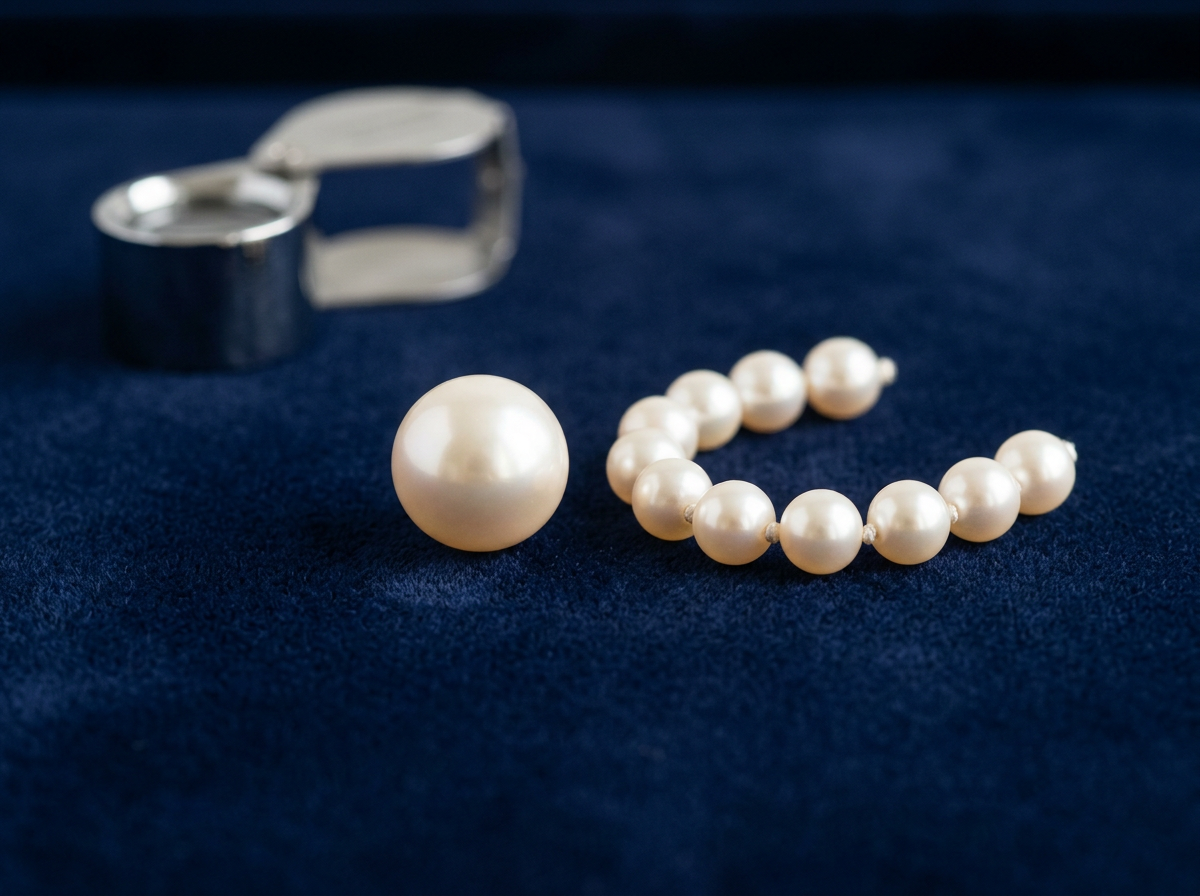
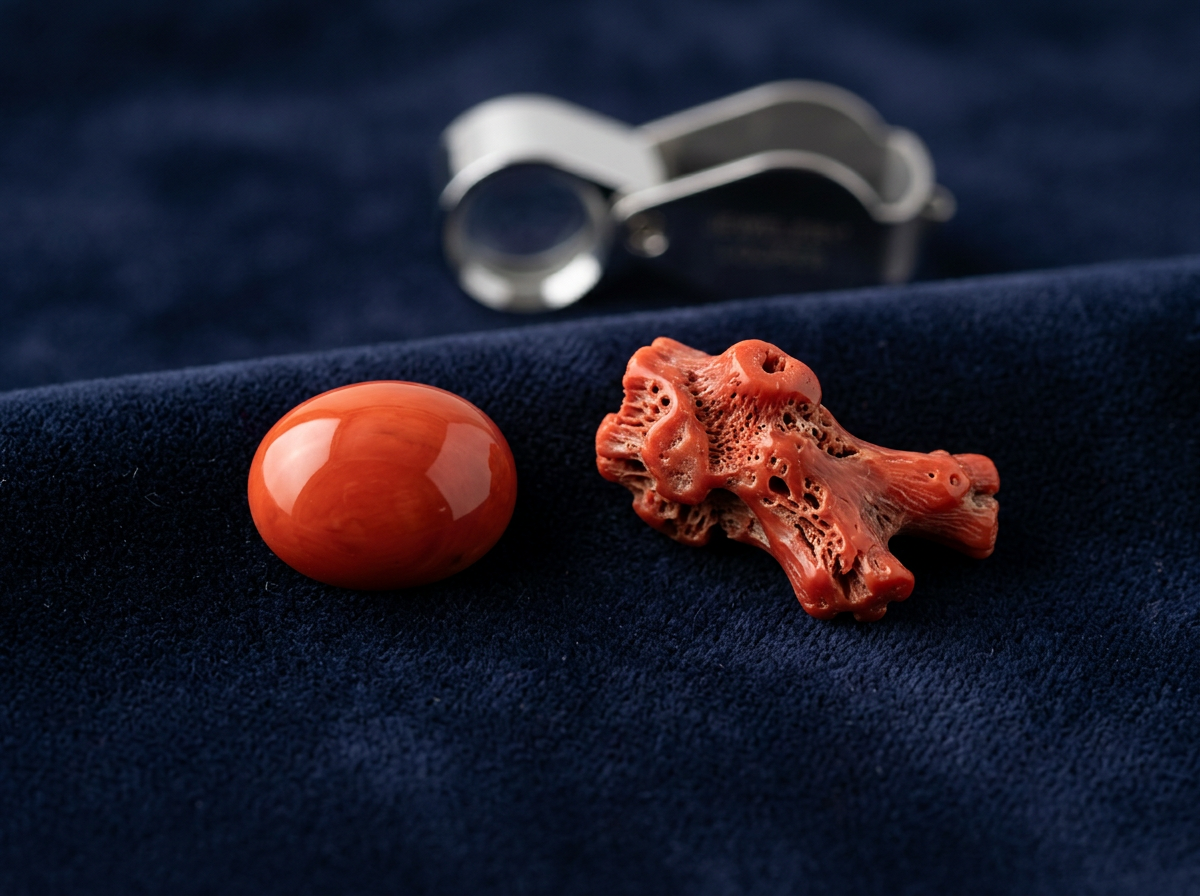
Both are harder than they sound. “Real” splits three ways — natural, cultured or imitation — and the answer moves the value by a large factor. “Worth anything” depends on luster, nacre thickness, matching and condition, none of which the client can judge from her side of the counter.
Here is the sentence that starts the conversation properly:
“They’re real pearls — cultured pearls, which means a pearl farmer helped the oyster start, but the oyster made the pearl. Almost every pearl sold today is cultured. Let me look at the luster and the nacre, and then we’ll talk about what you have.”
That answer is honest, it is accurate, and it uses the word the law requires. Pearls are the one major gem category where the vocabulary itself is regulated, so we start there.
How a pearl forms
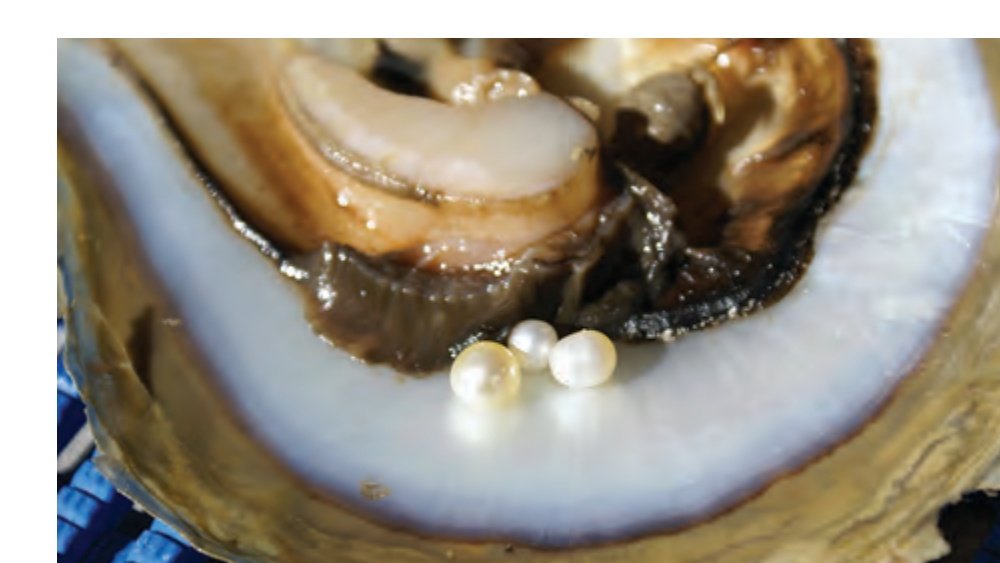
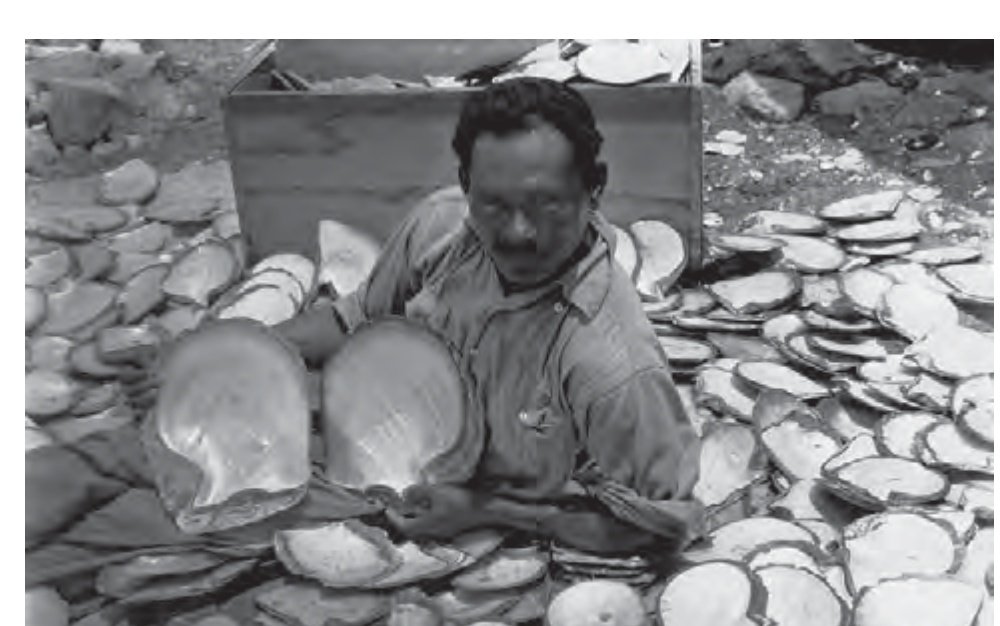
A pearl forms when a mollusk cannot expel an irritant, and instead coats it. What it coats it with is nacre: platelets of the calcium-carbonate mineral aragonite, stacked like brickwork and bound by an organic protein called conchiolin.
That structure is the whole story of how a pearl looks. Light entering the nacre is reflected from many successive aragonite layers at once, and the interference and diffraction between those reflections produce:
- Luster — the sharpness and brightness of the surface reflection.
- Orient — an iridescent sheen that appears to sit just below the surface and shift as the pearl moves.
- Iridescence — rainbow play of color across the surface.
Thin, well-ordered, closely stacked platelets give sharp reflections. Thick, disordered or sparse layering gives a chalky, dull look. Everything the trade values in a pearl comes back to the quality of that stacking.
Nacreous vs non-nacreous. Nacreous pearls are built from those aragonite platelets — Akoya, South Sea, Tahitian, freshwater and abalone pearls are all nacreous. Non-nacreous pearls are porcelaneous concretions without platelet layering: conch, melo, clam (Tridacna) and cassis. They can be beautiful and valuable, but they do not show nacreous luster and orient, and they “read” completely differently on the counter — conch, for instance, has a characteristic flame structure visible under magnification, like light catching a moiré silk.
Natural vs cultured. A natural pearl forms entirely by accident, with no human intervention of any kind. A cultured pearl forms because a technician implanted a bead and/or a small piece of mantle tissue into the mollusk, and the mollusk then did exactly what it does naturally.
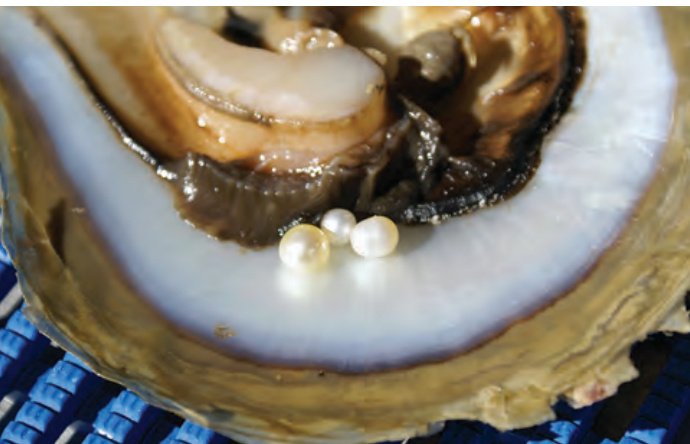
Both are real pearls. The distinction is origin, not authenticity — and it is the subject of one of the few hard vocabulary rules in the jewelry trade:
Under the FTC Jewelry Guides, the unqualified word “pearl” means a natural pearl. Cultured pearls must be identified as cultured pearls. This is a legal requirement about terminology, not a comment on quality.
The cultured-pearl industry is a little over a century old. The modern industry traces to Kokichi Mikimoto’s work in Japan in the 1890s, with commercially successful spherical cultured pearls reaching the market in the early 1900s. Before that, fine matched strands were effectively the preserve of the very wealthy, because natural pearls are rare by definition.
The types
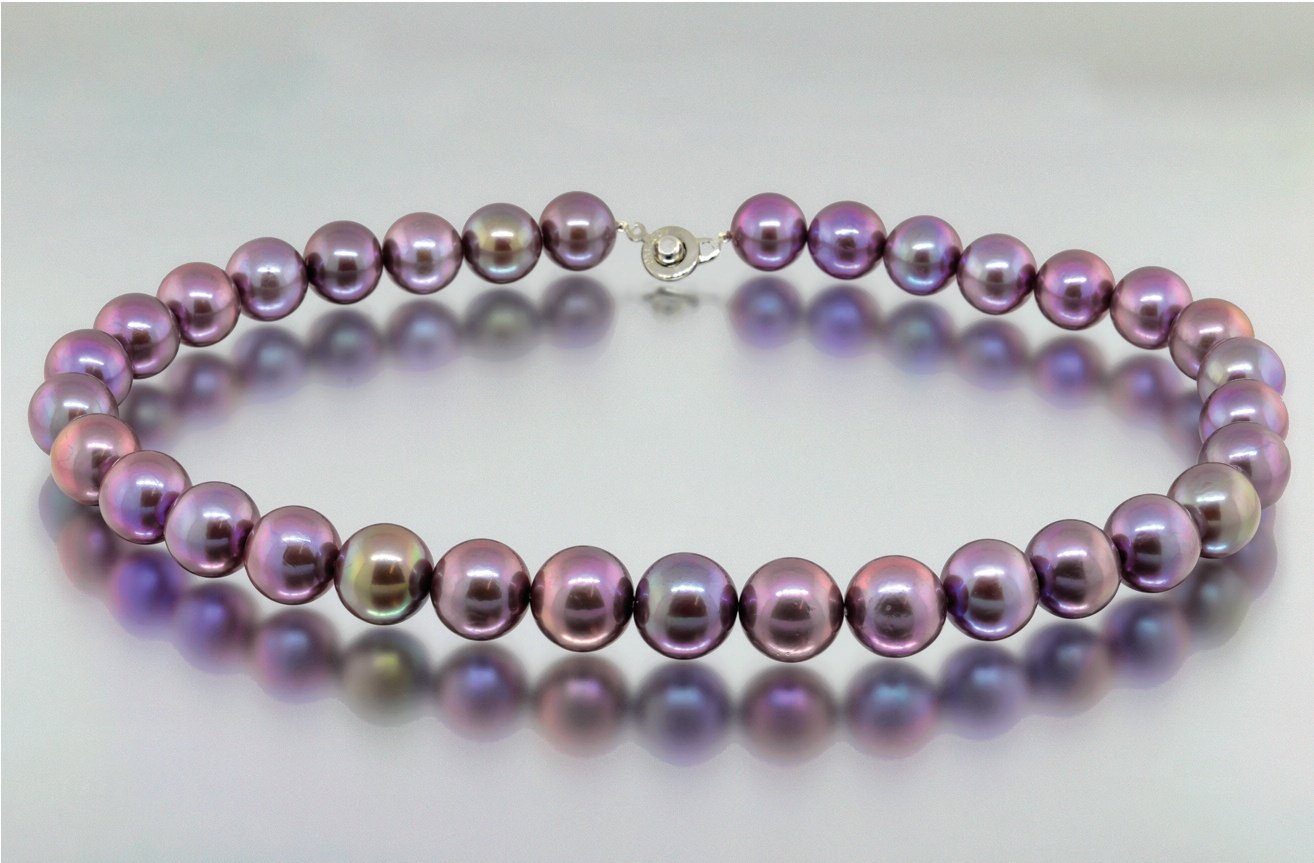
| Type | Mollusk / source | Size | Character | Notes |
|---|---|---|---|---|
| Akoya | Pinctada fucata/martensii — Japan, China, Vietnam, Australia | 2–10 mm | White to cream with rose, silver or green overtones; the classic round, high-luster strand | Bead-nucleated; nacre typically thin relative to South Sea (roughly 0.15–0.5 mm) |
| South Sea | Pinctada maxima — Australia, Indonesia, Philippines | 9–20 mm | White to silver, and golden (notably from the Philippines); thick nacre (roughly 2–6 mm) | The largest and generally most valuable cultured pearls |
| Tahitian | Pinctada margaritifera — French Polynesia | 8–18 mm | Naturally dark body color with peacock green, aubergine and silver overtones | “Black pearl” in the trade means dark, not literally black |
| Freshwater | Hyriopsis cumingii and related mussels — overwhelmingly China | 2–15 mm | Wide color range; historically off-round and pastel, now routinely round and large | Mostly tissue-nucleated — no bead — so mostly solid nacre; wears well |
| Mabé (blister pearl) | Grown against the shell | Variable | Hemispherical; backed and capped | Lower cost; excellent for earrings and rings |
| Keshi | By-product of culturing | Small to medium | All nacre, irregular, usually exceptional luster | Formed when a nucleus is rejected or a beadless sac forms |
| Natural pearl | Wild mollusks, accidental | Variable | Essentially antique and rare | Estate and auction market |
| Conch | Lobatus (Strombus) gigas | Small, often non-round | Pink to white, porcelaneous, with a flame structure | Non-nacreous; not commercially culturable; collected |
| Abalone / melo / clam | Various | Variable | Abalone is nacreous with intense iridescence; melo is non-nacreous orange | Specialist and rare |
Four points in that table are worth pulling out, because they are the ones that come up at the counter.
Freshwater is not “the cheap one” anymore. Because most freshwater pearls are tissue-nucleated rather than bead-nucleated, they are essentially solid nacre, which makes them durable and forgiving to drill. Modern Chinese production includes large, round, high-luster material and the bead-nucleated “Edison” type. Judging freshwater by a reputation it earned twenty years ago is a mistake.
South Sea nacre thickness is the durability story. Akoya nacre is thin by comparison; South Sea and Tahitian pearls are grown longer and laid down much thicker nacre. When a client asks why a South Sea strand costs several times an Akoya strand of the same size, nacre thickness is a large part of the honest answer — it is what makes the pearl last and what gives it depth of luster.
“Black” Tahitian is a dark pearl, not a black one. Natural Tahitian body colors run from silver-gray through charcoal, with overtones — peacock green, aubergine, eggplant, silver — that are where the real beauty and much of the value sit. A literally black pearl should make you think about dye.
La Peregrina is the anchor example for natural pearls. Recovered in the Gulf of Panama in the sixteenth century, it passed through the Spanish monarchy and Napoleon’s brother before Richard Burton bought it for Elizabeth Taylor in 1969. It weighs 202.24 grains (about 50.56 carats) and sold at Christie’s New York in December 2011 for $11,842,500 — a world record for a pearl jewel. It is a natural pearl, and that is why the number looks the way it does.
The GIA 7 Pearl Value Factors
GIA evaluates pearl quality on seven factors. Learn them in this order, because the order is a teaching tool: luster comes first in importance, even though it is fourth in the list.
| Factor | What good looks like | Why it matters |
|---|---|---|
| Size | Measured in millimetres; larger is rarer | Size in pearls is largely a function of mollusk species and years of growth |
| Shape | Round is rarest and most prized; then near-round, oval, button, drop, semi-baroque, baroque | Roundness is genuinely rare in nature |
| Color | Body color plus overtone (a translucent color over it) plus orient (iridescence) | A rose overtone on white Akoya, or deep golden South Sea, carries real premiums |
| Luster ★ | Sharp, bright, near-mirror reflections | The single most important factor. A moderate-sized pearl with superb luster beats a big chalky one every time |
| Surface | Clean, free of spots, bumps, wrinkles, scratches and chips | Some marking is normal and acceptable; heavy marking kills value |
| Nacre | Thick, even, well-ordered layering | Drives both beauty and longevity; thin nacre can let the bead show through |
| Matching | Uniformity across a strand or pair in all of the above | For strands and earrings, matching can matter more than any single pearl |
Two cautions that protect you at the counter.
The AAA / AA / A letter scale is trade shorthand, not a standard. No single authority polices it. One vendor’s AAA is another’s AA+. The letters are a summary layered on top of the seven factors, so when a client or a supplier says AAA, translate it back into luster, surface, shape and nacre before you accept it or repeat it.
Luster outranks everything, including size. This is the most useful single sentence in pearl selling. A 7 mm Akoya strand with mirror luster will look better and be worth more than a 9 mm strand with a chalky, dead surface. Clients fixate on size; teach them to look at reflections.
Treatments
Some pearl treatments are so routine they are part of normal processing: washing, light tumbling, and the traditional Japanese maeshori preparation, which polishes and improves luster. These do not add color and are generally accepted practice.
The treatments that must be disclosed are the ones that change color or conceal quality:
| Treatment | What it does | Detection |
|---|---|---|
| Bleaching | Lightens and evens the body color; near-universal in the trade | Subtle; often inferred rather than directly seen |
| Dyeing | Adds color — most commonly black dye on freshwater pearls | Color concentrated in drill holes, in surface irregularities, and uneven between pearls in a strand |
| Irradiation / coating | Less common; used to darken or alter color | Laboratory testing |
| Color treatment that does not add a colorant | Chemically modifies existing pigments | See the Ballerina case below |
The Ballerina case study: “chocolate pearls”
This is the most instructive pearl treatment in the modern literature, partly because it is so often described incorrectly.
“Chocolate pearls” are Tahitian cultured pearls — Pinctada margaritifera — treated by Ballerina Pearl Co. to convert less attractive or non-uniform dark material into an even, pleasing brown. They are not freshwater pearls, and the color is not added by dye: GIA’s studies (Wang et al. 2006; the color-durability study by Du Toit in 2008; and the 2016 study of “pistachio” colored pearls treated by the same company) describe a bleaching-type process using hydrogen peroxide, with polishing as part of the treatment. That distinguishes it from the older silver-nitrate (Ag) dyeing method used by other processors, which genuinely does deposit a foreign colorant.
What that means practically:
- Identification is instrumental, not visual. Natural-color Tahitian pearls typically show a strong bluish fluorescence under DiamondView imaging; treated stones are generally inert or weak. UV-Vis-NIR reflectance and Raman photoluminescence also show characteristic differences.
- The color is reasonably stable. GIA’s durability work found treated and untreated pearls behaved similarly when exposed to daylight, cosmetics and many chemicals. More change was observed under heat and with reactive household cleaning solutions — which is a good argument for the “last on, first off, wipe and put away” rule regardless of treatment.
- It still must be disclosed. A stable treatment is not an undisclosed treatment.
[MEDIA: video | C17-M15-V1]
Watch (selected section): A Gemstone’s Journey through the GIA Laboratory — GIA (GIA-CS-01), 57:21
Why here: The lab’s pearl workflow — including the imaging and X-ray work that separates natural from cultured and treated from natural-color material.
https://www.youtube.com/watch?v=P5J1a3_JcTM
How a laboratory tells natural from cultured
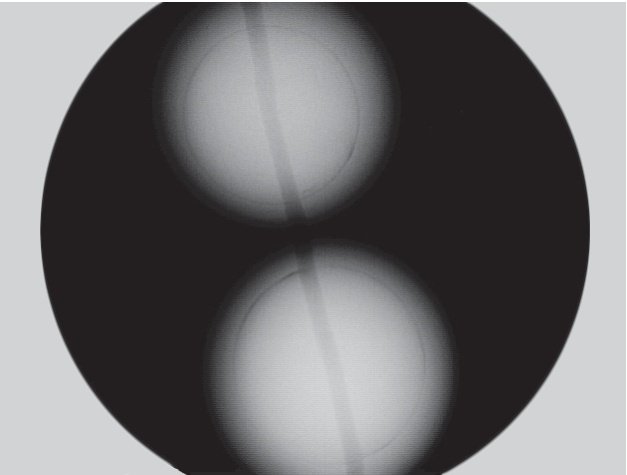
You cannot answer this with a loupe, and you should not try. X-radiation is the workhorse.
- Real-time microradiography (RTX) shows the internal structure at a glance. In a bead-nucleated cultured pearl you see the bead — a distinct sphere with a boundary between it and the nacre. In a natural pearl you see concentric growth structures and no bead.
- X-ray computed microtomography (μ-CT) maps the internal architecture in three dimensions. This is what handles the hard cases: beadless cultured pearls (keshi, tissue-nucleated freshwater) look superficially like naturals because there is no bead to find. μ-CT resolves it by revealing the internal cavities and growth architecture characteristic of a cultured sac.
- X-ray fluorescence (XRF) helps with the saltwater/freshwater question: freshwater pearls are generally manganese-rich and strontium-poor relative to saltwater pearls.
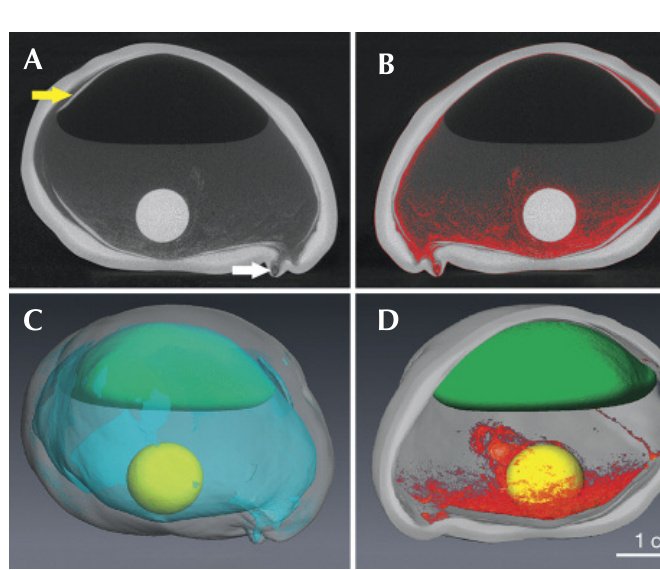
The practical rule is the same one that recurs throughout this course: anything presented to you as a natural pearl gets a laboratory report. The value difference between natural and cultured is far too large, and the appearance difference is far too small, for an opinion to be an acceptable substitute.
Care: last on, first off
Pearls rank about 2.5 to 4.5 on the Mohs scale. They are the softest thing in most jewelry cases, and that single fact generates every rule below.
- Last on, first off. Pearls go on after makeup, perfume and hairspray, and come off first at the end of the day.
- Wipe after wearing with a soft, slightly damp cloth. This removes the cosmetics and skin acids that dull nacre.
- No ultrasonic, no steam, no soaking, no solvents, no heat. All of them attack the nacre or the string.
- Restring periodically. Silk stretches, soils and weakens — annually for a frequently worn strand is a sensible rule. Knot between pearls so a break does not lose the strand.
- Store flat in a soft pouch, not hanging, and not in a sealed dry vault for long periods. Pearls contain a little water and organic material, and prolonged desiccation is unkind to them.
- Wear them. Pearls dull far more from years in a box than from careful wear.
On the floor: applying it this week
- Monday (10 minutes): Take two strands and sort on luster first — hold them under the same light and look at the sharpness of the reflection. Say which wins and why before you look at size.
- Tuesday (10 minutes): Check your own language. Say “cultured pearl” out loud ten times until it is automatic. The FTC requires it.
- Wednesday (practice): On the next pearl you sell, give the care card and say the two rules: last on first off, and wipe after wearing.
- Thursday (10 minutes): Look at a dyed black freshwater strand under magnification and find the dye concentration in the drill holes. Once you have seen it, you will not miss it.
- Friday (15 minutes): Practice the estate-strand conversation: “They’re real cultured pearls — let me check luster, nacre and condition, and whether the string is sound.”
Objections, mistakes and edge cases
| Situation | The trap | Better move |
|---|---|---|
| “Are these real pearls?” | Answering “yes” to a cultured strand | “Yes — real cultured pearls. Almost every pearl sold today is cultured; a natural pearl is rare and I’d want a lab report before I called one that.” |
| Client fixates on size | Selling into the size argument alone | Redirect to luster: “Look at the reflection rather than the millimetres. This 7 mm strand is brighter than that 9 mm one.” |
| Supplier says “AAA” | Repeating the letters as if they were a standard | Translate into the seven factors. No authority polices AA/AAA; confirm it yourself. |
| Chocolate or pistachio Tahitian pearls | Assuming “chocolate” means freshwater, or assuming it is dyed | It is a treated-color Tahitian cultured pearl, treated by a bleaching-type process rather than by dye — and it still requires disclosure. |
| A literally black pearl | Selling it as a rare natural black Tahitian | Check for dye concentration in drill holes and surface irregularities. |
| Client wants to clean pearls in the ultrasonic | Saying yes | Never. Nacre is soft, the string is fragile, and heat and solvents attack both. |
| Estate strand with the original string | Assuming it is sound | Silk degrades with age. Check and recommend restringing before regular wear. |
| “Pearls are too delicate to wear” | Agreeing, and losing the sale | They are soft, yes — but they dull far more from neglect than from careful wear. Last on, first off, wipe, restring. |
| A very cheap “perfectly matched” strand | Accepting it as a fine buy | Uniform perfection at a low price often means imitation. Check for the evenness of the surface and the temperature feel; send it if you are unsure. |
| Keshi described as natural pearls | Repeating it | Keshi are an all-nacre by-product of culturing. They are cultured pearls. |
| “Conch pearl is just a pink pearl” | Treating it as nacreous | Conch is non-nacreous and porcelaneous with a flame structure. Different material, different look, different value logic. |
Self-check
- What is nacre made of, and what produces luster and orient?
- What is the legal difference between “pearl” and “cultured pearl”?
- Name the four main cultured pearl types with their mollusk and typical size range.
- Which pearl type is mostly tissue-nucleated, and what does that mean for durability?
- What are the GIA 7 Pearl Value Factors, and which is the most important?
- Why is a big chalky pearl worth less than a smaller bright one?
- What are “chocolate pearls” actually made of, and how is the color produced?
- Why does a lab use μ-CT rather than a loupe for beadless pearls?
- State the pearl care rules.
- What is the Mohs hardness of pearl, and what single rule follows from it?
Go deeper
- ★ GIA 7 Pearl Value Factors — How GIA Analyzes Pearls from Start to Finish. — https://www.gia.edu/gia-news-research/guide-how-gia-analyzes-pearls — the seven factors from GIA directly; 15 minutes.
- ★ Wang W. et al. (2006) Identification of “Chocolate Pearls” Treated by Ballerina Pearl Co. G&G 42:4 — the treatment identification.
- ★ Du Toit (2008) The Color Durability of “Chocolate Pearls” by Ballerina Pearl Co. G&G 44:3 — https://www.gia.edu/gems-gemology/fall-2008-color-durability-chocolate-pearls-du-toit — durability under real wear conditions.
- G&G Spring 2016 — Identification of “Pistachio” Colored Pearls Treated by Ballerina Pearl Co. — https://www.gia.edu/gems-gemology/spring-2016-identification-pistachio-colored-pearls-treated-ballerina-pearl-company
- ★ Overton T.W. (2004) Gem Treatment Disclosure and U.S. Law. G&G 40:2 — https://www.gia.edu/gems-gemology/summer-2004-gem-treatment-disclosure-us-law-overton — the “pearl” vs “cultured pearl” vocabulary rule.
- GIA pearl identification and treatment reports — https://www.gia.edu/pearl-identification-report
- Video: A Gemstone’s Journey through the GIA Laboratory (GIA-CS-01) — 57:21, linked above.