Ruby: Pigeon’s Blood, Marble and Basalt — and the Filled Stone You Must Disclose
Two rubies, fifteen times the price
A client sits down with her phone open. She has found a 3 ct “pigeon’s blood Burmese ruby,” certified, for $900 — and she has just been quoted $14,000 for the 1.2 ct unheated Mozambique ruby in your case. She is not being difficult; she is being reasonable. Both stones are called ruby, and one costs roughly fifteen times more per carat than the other.
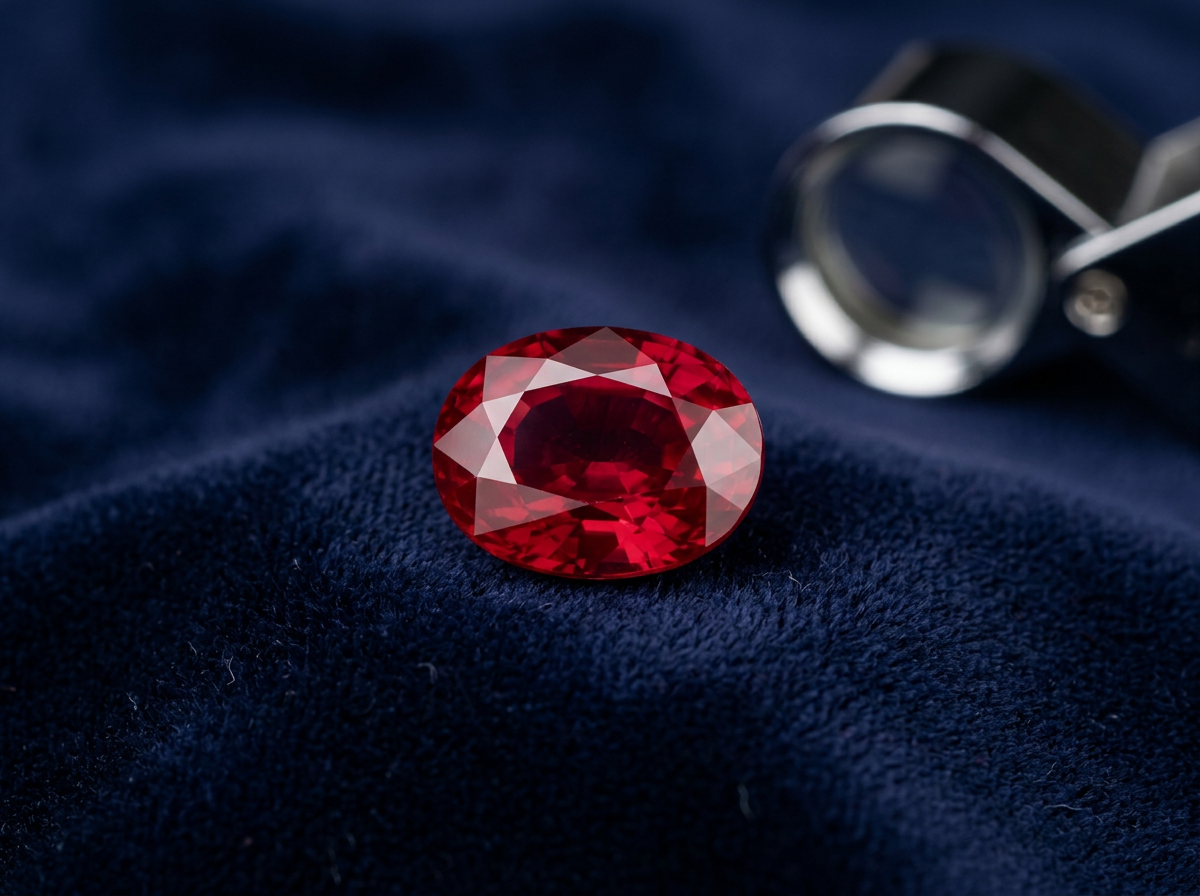
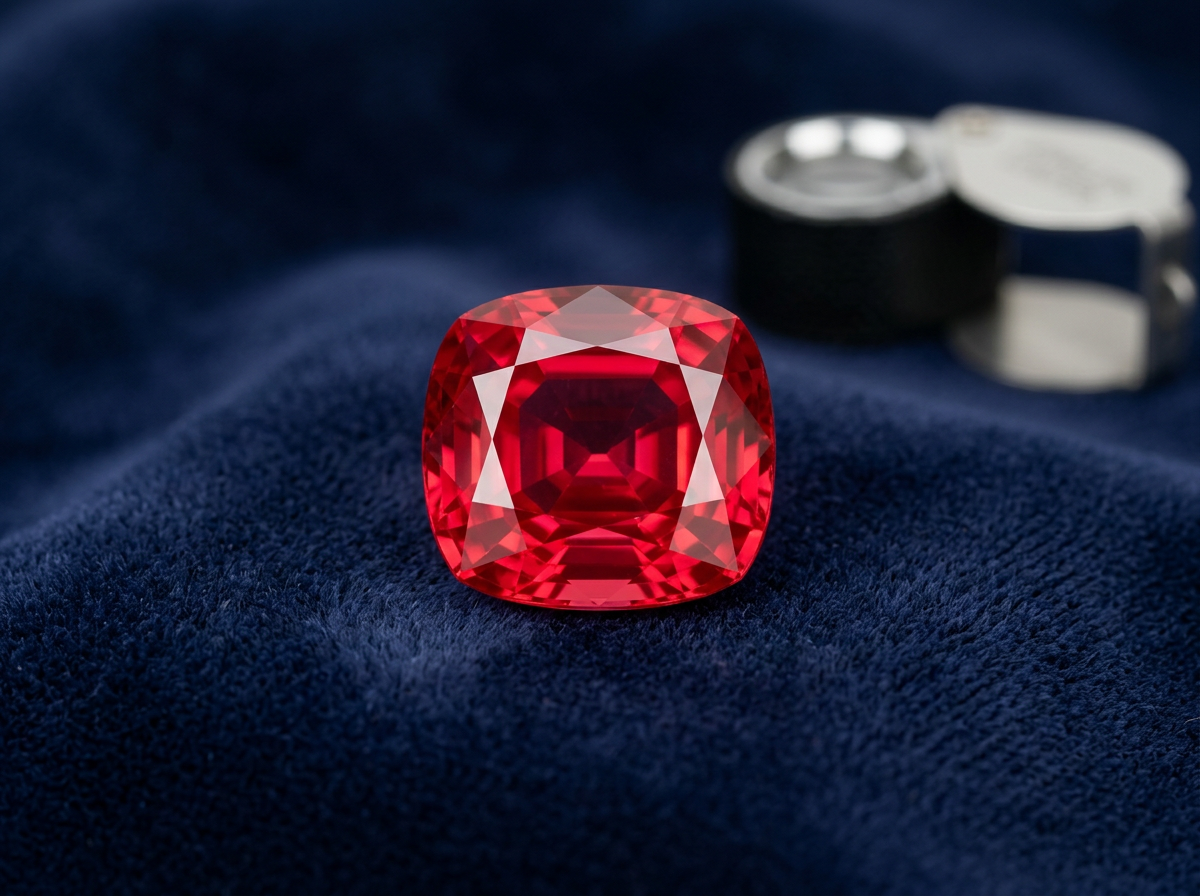
Here is the answer, and it is the organizing idea of this entire module: “ruby” is the gem trade’s widest price band. At one end sits untreated marble-hosted material from Mogok, where a 25.59 ct stone sold at Sotheby’s Geneva in May 2015 for CHF 28.25 million (about $30.3 million — over $1.1 million per carat). At the other sits a heavily fractured piece of low-grade rough that has been injected with lead glass so it looks transparent: a manufactured composite that trades for tens of dollars per carat, dissolves in jewelry dip, and must never be sold without disclosure.
The $900 stone is not a bargain. It is a different product wearing the same name. Your job in the next ten minutes is to understand that gap well enough to explain it without condescension — because the client who came in with a screenshot is the client most likely to become a serious collector client if you handle her honestly.
Why ruby is red: chromium in corundum
Ruby is corundum — aluminium oxide, Al₂O₃ — the same species as sapphire. What makes it red is chromium: Cr³⁺ ions substituting for aluminium in the lattice, typically in the range of roughly 0.1–3 wt% Cr₂O₃. Chromium absorbs light in the yellow-green and violet-blue parts of the spectrum and transmits red, and the same ion is responsible for the strong red fluorescence that makes the finest material look lit from within.
The second half of the story is iron. Where ferrous/ferric iron is present alongside chromium, it both quenches the fluorescence and adds brown or blue modifiers to the body color. Every ruby locality story is, at bottom, a story about how much chromium got in and how much iron came along with it.
| Property | Value | Why you care |
|---|---|---|
| Species | Corundum, Al₂O₃ | Ruby and sapphire are one species; color is the only difference |
| Color cause | Cr³⁺ (chromium) | Same ion gives the red color and the red fluorescence |
| Mohs hardness | 9 | Excellent for rings; second only to diamond among natural gems |
| Toughness | Good (no cleavage) | But heavily included or filled stones are not — see below |
| Refractive index | 1.762–1.770 | Single number on a refractometer; separates ruby from red spinel (~1.718) and garnet |
| Birefringence | 0.008 | Weak doubling — visible with a loupe in larger stones |
| Optic character | Uniaxial (–) | |
| Specific gravity | ~4.00 | Noticeably heavier than spinel (~3.60) or quartz |
| Pleochroism | Purplish-red / orangy-red | The cutter orients the table for the purer direction — this is why two stones from the same rough can differ |
| Typical clarity | Included — rutile “silk” is normal | A loupe-clean ruby at a low price is a warning, not a find |
Note the last row. Ruby is an included species. Fine rutile silk is not merely tolerated, it is part of the classic Mogok look: it scatters light across the stone and softens the red into the glow collectors pay for. A large, clean, inexpensive ruby should make you reach for the loupe, not for the sales pad.
The marble/basalt split: the most useful idea in ruby
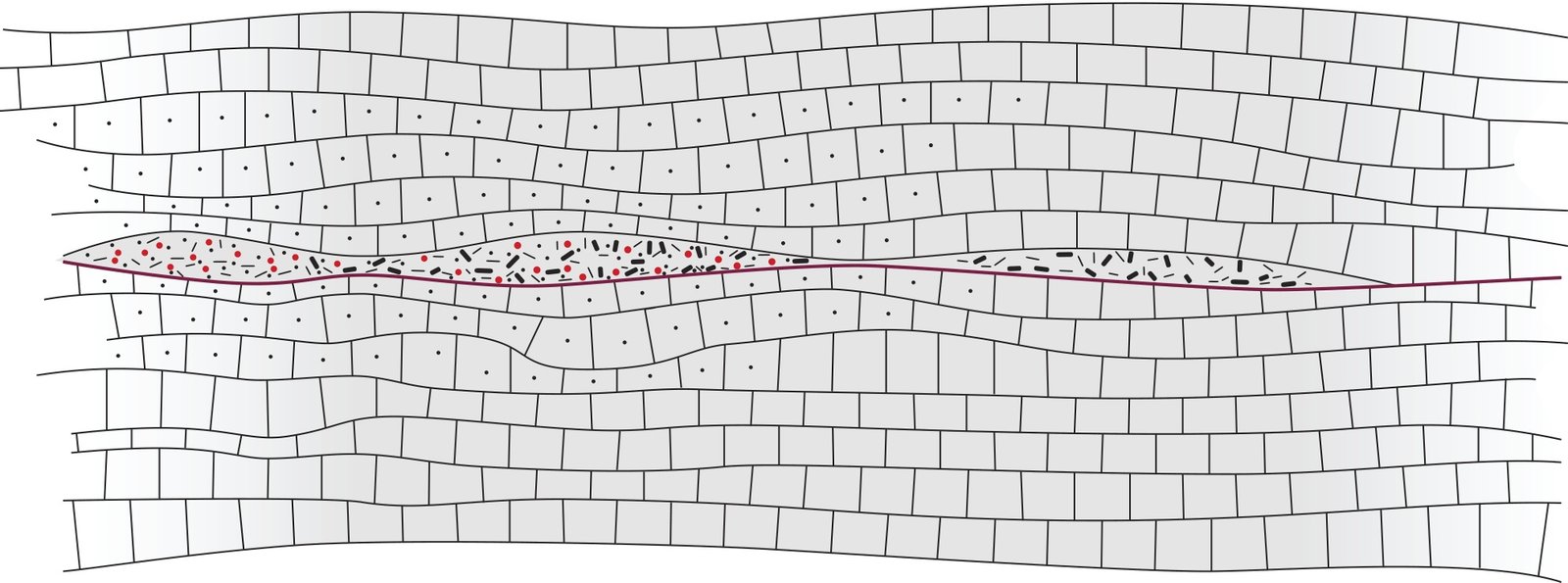
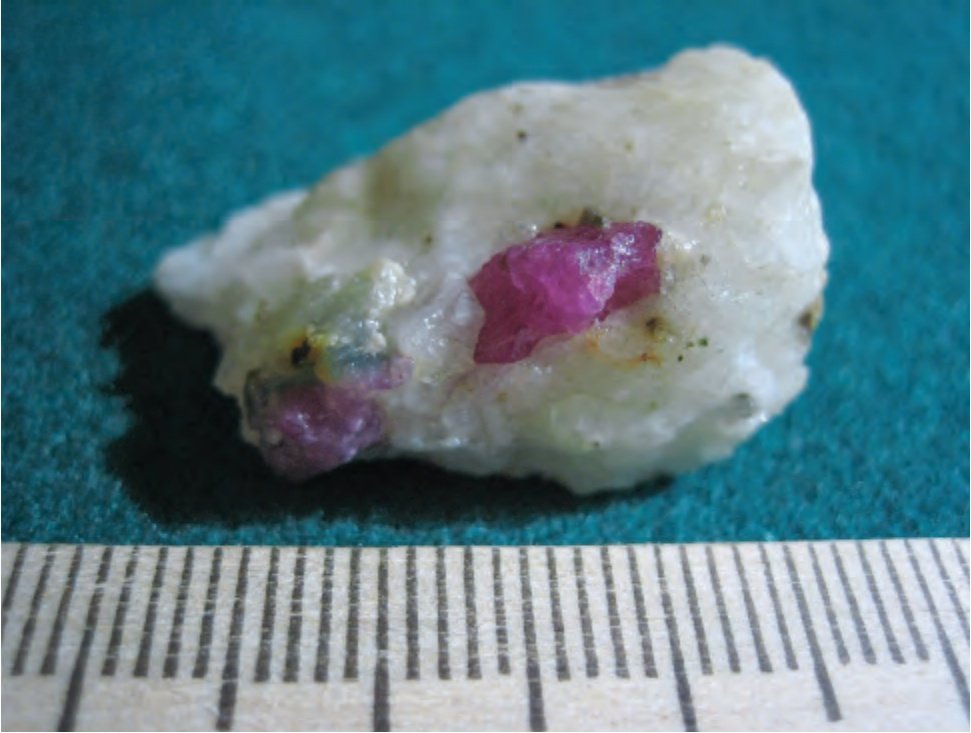
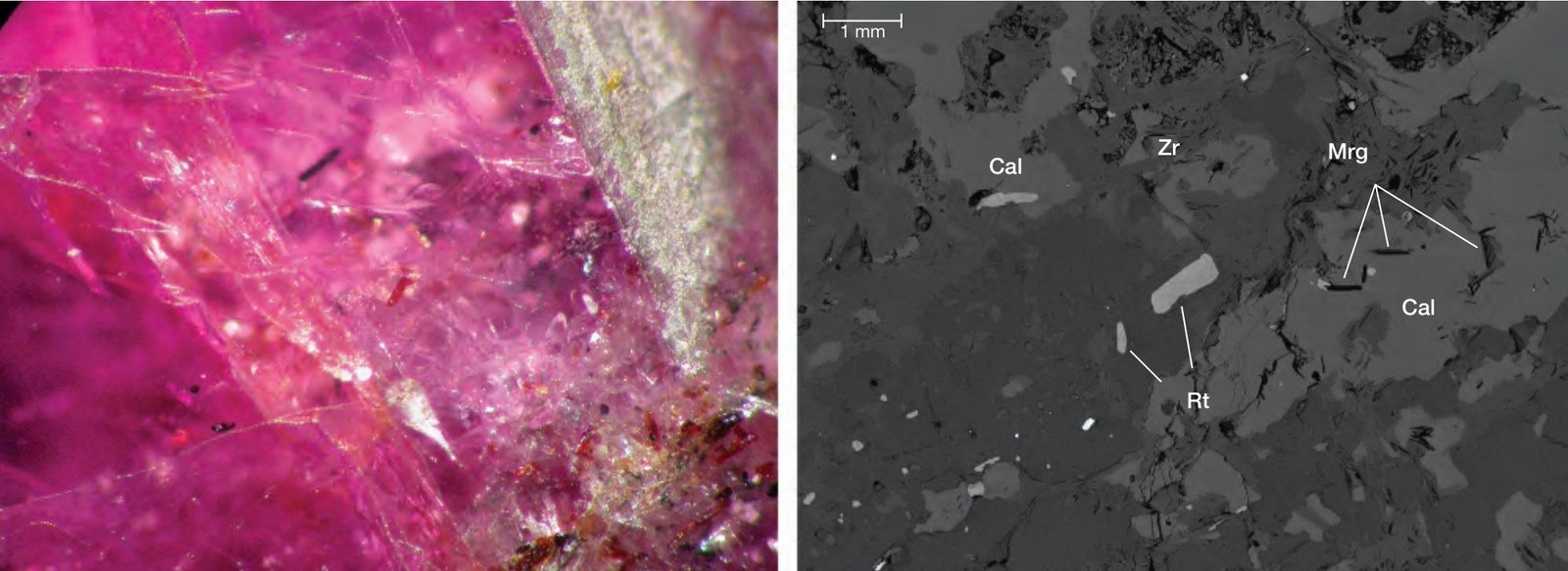
Ruby forms in two fundamentally different geologic settings, and the difference shows up in the stone on your counter.
Marble-hosted ruby forms when limestone is metamorphosed: the marble is poor in iron and, in the right deposits, rich in chromium. The result is low-iron, high-chromium corundum — which means strong red fluorescence under long-wave and short-wave UV, and in the very best stones a visible glow in ordinary daylight. This is the physical basis of the “pigeon’s blood” look, and it is why marble sources dominate the top of the market.
Basalt-hosted ruby is carried to the surface in alkali basalt and recovered from weathering gravels. Basalt is iron-rich, so the corundum incorporates more iron: fluorescence is weak to inert, and the body color tends toward a darker, browner or garnet-like red.
This is the fastest way to organize every source you will ever be asked about:
| Deposit type | Fluorescence | Typical color | Sources |
|---|---|---|---|
| Marble-hosted (metamorphic, low Fe) | Strong red — can glow in daylight | Vivid red, often with a pinkish modifier; “pigeon’s blood” | Mogok & Mong Hsu (Myanmar), Montepuez (Mozambique), Luc Yen (Vietnam), Jegdalek (Afghanistan), Snezhnoe (Tajikistan), Winza (Tanzania) |
| Basalt-hosted (high Fe) | Weak to inert | Darker red, brownish/garnet-like | Pailin (Cambodia), Chanthaburi (Thailand), Muling (China), Australia, Nigeria, Kenya (Mangare) |
| Other/amphibole & ultramafic | Variable — often strong | Red to pinkish-red; some exceptional | Montepuez (amphibole-hosted), Winza, Madagascar (Vatomandry, Andilamena, Didy) |
The discipline that keeps you honest: fluorescence is a clue to origin, never a proof. A UV lamp is a conversation tool on the sales floor, not an identification instrument. Origin determinations are made in a laboratory from inclusion scenes and trace-element chemistry (LA-ICP-MS, LIBS), and even then the report language is careful — “Mozambique,” “Burma (Myanmar),” “Madagascar,” or sometimes only a general geographic attribution. You frame the conversation; the lab makes the call.
Source by source: where ruby comes from
| Source | Type | Character | Market position |
|---|---|---|---|
| Mogok, Myanmar | Marble | The historical benchmark: vivid red with fine silk and strong fluorescence; dolomite/calcite marble host | Top of the market. Restricted access and legal complexity (see below) |
| Mong Hsu, Myanmar | Marble | 1990s boom; dark blue cores in the rough, routinely low-temperature flux-assisted heat treated to dissolve the core | Huge volume of commercial material |
| Montepuez, Mozambique | Amphibole-hosted | Discovered 2009; low iron, often strongly fluorescent; the best material genuinely rivals Mogok | The dominant world ruby source by volume; Gemfields runs formal auctions |
| Madagascar (Vatomandry, Andilamena, Didy/Zahamena) | Metamorphic/alluvial | Variable; rushes from the late 1990s, notably the 2012 Didy ruby rush | Large volume of commercial-to-fine goods, heavily treated |
| Vietnam (Luc Yen, Quy Chau) | Marble | Often pinkish-red, bright; also a notable fancy sapphire source | Respected mid-to-fine niche |
| Winza, Tanzania | Metamorphic | 2007–08 rush; unusually clean, strongly fluorescent red-to-pink | Short-lived supply; now a collector name |
| Jegdalek (Afghanistan), Snezhnoe (Tajikistan) | Marble | Historically important, fine color | Limited modern supply |
| Pailin (Cambodia) / Chanthaburi (Thailand) | Basalt | Higher iron, darker reds | Also the world capital of corundum heat treatment and trading |
| Longido, Tanzania | Ruby-in-zoisite | Opaque red in green zoisite (“anyolite”) | Carving and bead material, not faceting goods |
| Muling, China | Basalt | Dark commercial red | Volume commercial |
| Nepal, Kenya, Malawi, Greenland | Various | Minor/emerging | Limited trade presence |
A few of these deserve a sentence more.
Mogok is the name clients have heard, and it carries real weight: centuries of production, marble-hosted material with the silk-plus-fluorescence combination that defines the classic look. When a client says “Burmese ruby,” they usually mean “the best ruby,” and often they mean the Mogok look rather than the Mogok address.
Montepuez is the modern reality. The 2009 discovery in Cabo Delgado, Mozambique, changed the ruby market more than anything else in a generation: for the first time in decades, fine-quality, strongly fluorescent, low-iron ruby was available in volume. Much of what a client thinks of as “the Burmese look” in a mid-range price bracket is Mozambique material. Saying so is not a downgrade; it is accurate, and accuracy is what survives a second opinion.
Mong Hsu explains a lot of the modern trade: the rough characteristically has a dark blue core, and the routine treatment is low-temperature, flux-assisted heat that dissolves that core and heals fissures with precipitated corundum. That is a legitimate, permanent, industry-standard treatment — and it appears on a lab report as indications of heating with residues. Know that phrase; you will see it constantly on commercial ruby.
[MEDIA: video | C17-M11-V1]
Watch: Sapphire and Ruby Mine in Pailin, Cambodia — GIA (GIA-CS-03), 2:59
Why here: Vincent Pardieu in the field at a secondary basalt-hosted deposit, washing gravel and running a jig. It also makes the point that GIA field gemologists collect reference samples directly from miners before any treatment — the only way to know what “untreated” looks like.
https://www.youtube.com/watch?v=q6CRKlDpEGE
Treatment: heat is standard, glass is a different product
Ruby treatment is fully covered in M09; here is the ruby-specific version you need at the counter.
Standard heat treatment. Heating (roughly 1600–1800 °C for corundum) dissolves rutile silk, improves clarity, and can remove a blue core or reduce a brownish modifier. It is permanent, it does not change care, and it is so standard that the great majority of commercial ruby has been heated. It must still be disclosed — but a heated ruby is genuinely a ruby with the same durability as an unheated one.
Low-temperature flux-assisted heat. Below full melting, borax/silica flux melts into surface-reaching fractures and precipitates synthetic corundum that heals them. This is the standard treatment for Mong Hsu material and much Mozambique and Madagascar ruby. Detectable by flux fingerprints and healed-fissure residue; disclosed as “indications of heating with residues.”
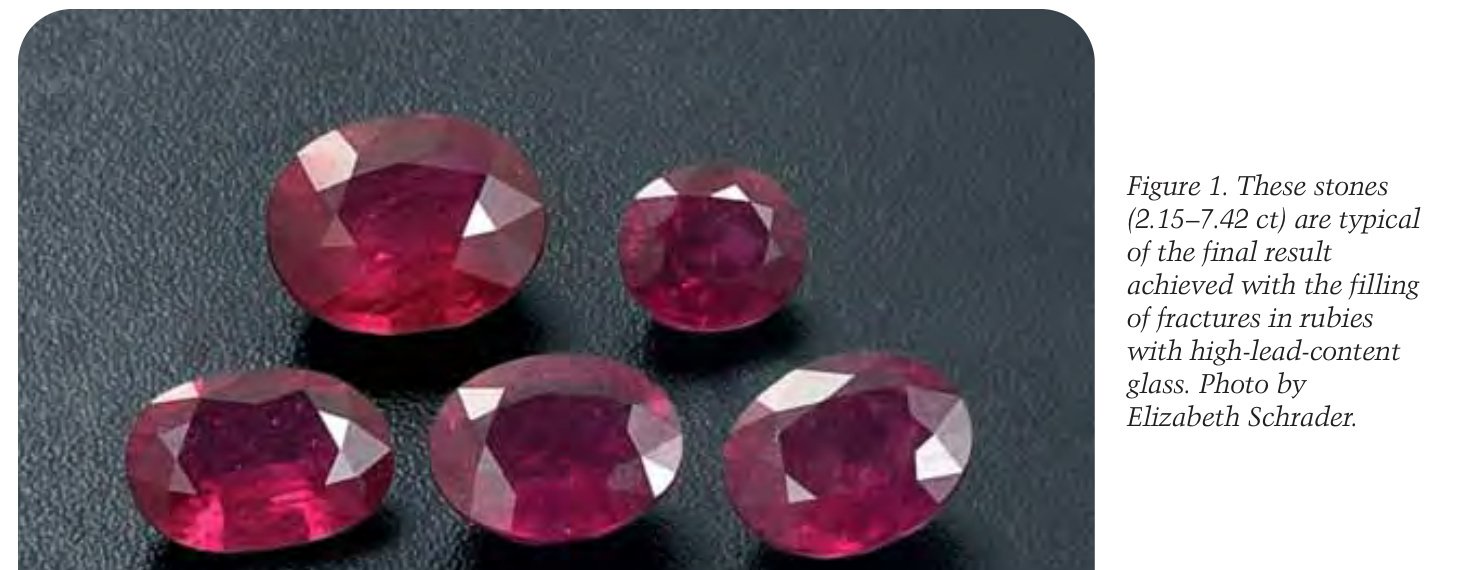
Lead-glass filling is the line. Heavily fractured, low-grade rough is impregnated with a high-lead-content glass whose refractive index is close to corundum’s, making the fractures effectively invisible to the naked eye. The result looks like a transparent ruby and behaves like a composite.
| Detection feature | What you see |
|---|---|
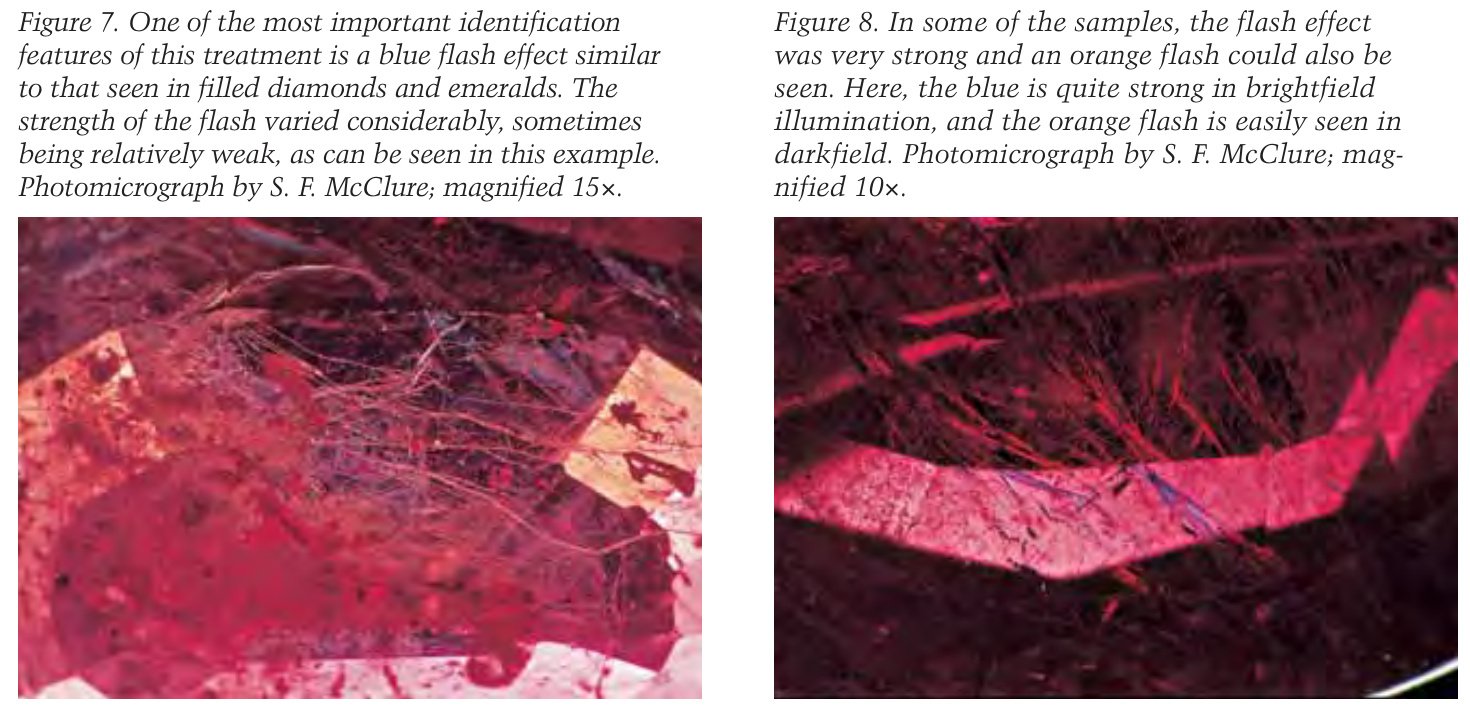
| Flash effect | Bright blue and/or orange flashes along filled fractures and at facet junctions, in reflected light — the single most useful 10× clue |
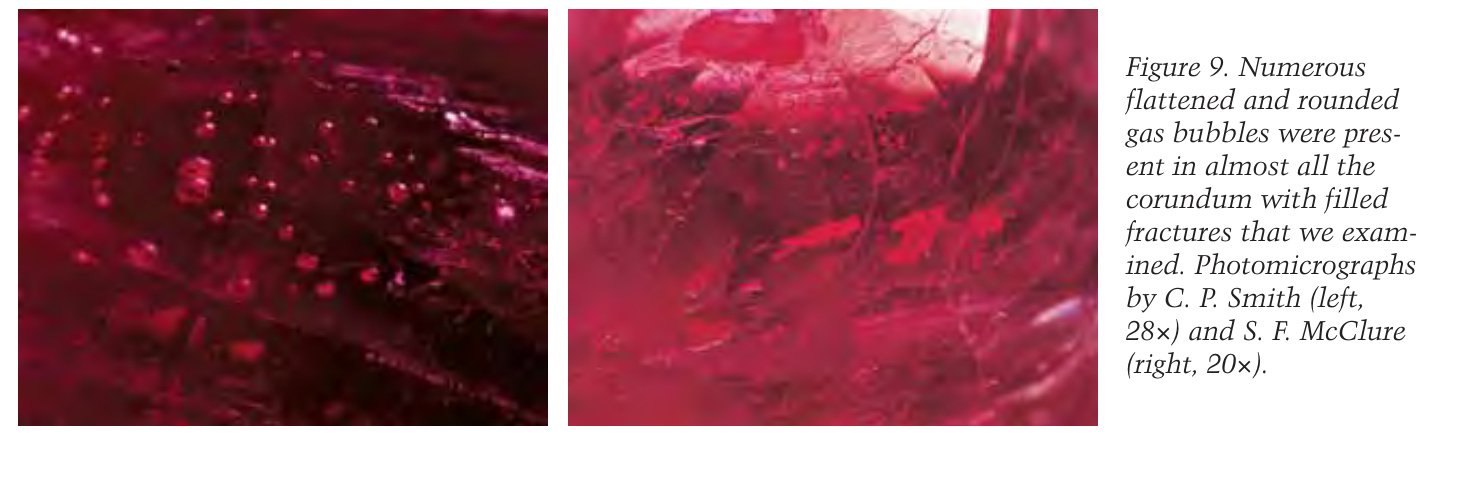
| Large gas bubbles | Rounded bubbles trapped in the glass fill |
| Flattened bubbles | Elongated bubbles at the glass/corundum interface |
| Luster/polish difference | Filled areas take a poorer polish and read slightly dull or “soft” against the corundum |
| Fracture pattern | Extensive, web-like surface-reaching fractures in a stone that otherwise looks unexpectedly clean |
Care rules for a filled ruby — non-negotiable:
- Warm soapy water and a soft cloth only.
- No acids: lemon juice, household cleaners, or commercial jewelry dip will attack the glass.
- No ultrasonic, no steam.
- No torch — the glass softens around 500 °C, so any sizing, retipping or prong work must be done cold, and only by a bench jeweler who has been told the stone is filled.
- Never recut a filled ruby: recutting fractures the fill and generally destroys the stone.
GIA identifies lead-glass-filled ruby as a manufactured composite and reports the fill on the report. Under the FTC Jewelry Guides (Overton 2004) the unqualified word “ruby” implies natural, untreated material; a filled composite must be disclosed before sale. Disclosure is not optional, and it is not waived because the client says she does not care.
[MEDIA: video | C17-M11-V2]
Watch (or re-watch): How to Classify a Lead Glass–Filled Ruby — GIA (GIA-CS-06), 5:27
Why here: GIA names the four detection features — flash effect, large gas bubbles, flattened gas bubbles, and the durability warning — in five minutes. This is the single highest-value video in the course for a sales associate.
https://www.youtube.com/watch?v=evrQv-HNrI0
Synthetics and look-alikes, briefly
Ruby has been synthesized since the early 1900s, and the material is plentiful. From M08, with a ruby lens:
- Verneuil (flame-fusion), from 1902. Curved growth striae and rounded or elongated gas bubbles are the giveaways; also often an unnaturally clean, slightly “neon” red.
- Flux-grown (Chatham, Kashan, Ramaura and others). Flux fingerprints — whitish, veil-like residues — and sometimes metallic platinum crystals from the crucible.
- Hydrothermal (Tairus, and Lechleitner-type synthetic overgrowth on a natural seed). Growth zoning, seed plates, and a visible growth boundary.
Under the FTC these must be called laboratory-grown, lab-created or synthetic ruby — never simply “ruby.” “Created ruby,” “cultured ruby,” and “ruby-like” are all unacceptable substitutes.
Natural look-alikes matter more day to day:
| Look-alike | How to separate it |
|---|---|
| Red spinel | Singly refractive (no doubling), no pleochroism, RI ~1.718, SG ~3.60; historically “Balas ruby” |
| Red garnet (pyrope/almandine) | Singly refractive, RI ~1.74–1.79, often with a slightly darker, “hot” red; no fluorescence |
| Rubellite (red tourmaline) | Strong doubling, RI ~1.62–1.64, SG ~3.06, strongly pleochroic |
| Glass / CZ | Glass is singly refractive with bubbles and swirl; CZ is far too heavy (SG ~5.8) and too dispersive |
Red spinel and the “rubies” that were never ruby
Two of the most famous rubies in history are not rubies.
The Black Prince’s Ruby, set in the Imperial State Crown of the United Kingdom, is a roughly 170 ct irregular cabochon spinel. The Timur Ruby, ~352 ct, also in the British royal collection, is likewise a spinel. Both came from Badakhshan — the source that gave the world “Balas ruby,” the old trade name for red spinel — and both were called ruby for centuries because there was no way to tell the difference before modern gemology.
This comes up on the floor more than you would expect, because it is a great story and clients arrive having read it. Three things to get right:
- Spinel is a distinct species (MgAl₂O₄, cubic, singly refractive), not a ruby substitute. It is now collected and priced in its own right, and fine red spinel is genuinely valuable.
- The historic confusion is a fact about history, not about spinel’s worth. “It’s not a real ruby” is the wrong framing; “it’s a spinel, and here’s why that’s interesting” is the right one.
- GIA now offers origin determination for red spinel — it is one of the species covered by GIA’s origin services, and GIA expanded those services further effective 1 January 2026 (adding opal, peridot and demantoid garnet to ruby, sapphire, emerald, Paraíba-type tourmaline, alexandrite, red spinel, and untreated jadeite/omphacite jade from Myanmar and Guatemala).
Value factors and honest budget tiers
Color dominates, exactly as it does for every colored stone. Then origin, then clarity, then size, then treatment.
- Color (hue, tone, saturation). The best red is a vivid, slightly pinkish-to-pure red of medium-to-medium-dark tone with strong saturation, and — in marble material — the fluorescence that makes it glow. GIA applies defined criteria to the “pigeon’s blood” color term rather than treating it as a marketing word. Stones that are too dark read as garnet; too light read as pink sapphire.
- Origin — but only after quality. A pale, included Mozambique or Burmese ruby is not valuable because of its passport. Origin premiums apply to fine material.
- Clarity, with the ruby exception. Silk is expected and often desirable. What hurts is any inclusion that deadens transparency or threatens durability — and, critically, the extensive surface-reaching fractures that make a stone a candidate for glass filling.
- Size. Supply falls away fast; expect significant price steps past 1 ct, 3 ct and 5 ct in fine quality.
- Treatment. Unheated commands a large premium over heated of comparable quality; filled material trades at a small fraction of either.
Budget framing you can actually say out loud (commercial retail, per carat, directional — check against your own cost sheets):
| Per-carat band | What you are realistically buying |
|---|---|
| Under ~$500 | Small, heavily included, treated commercial; glass-filled composite or synthetic is common at this level. Verify before you promise anything. |
| ~$500–2,000 | Heated commercial ruby, eye-visible inclusions, decent color — the everyday jewelry range |
| ~$2,000–10,000 | Fine heated material, and small unheated stones with good color |
| $10,000+ | Fine unheated material, larger sizes, top colors, documented origin |
| Auction tier | Provenanced, unheated, top-origin stones: six and seven figures per carat |
The honest version of that table is the best answer to the client with the screenshot. Her $900 stone is in the top row; your $14,000 stone is in the bottom two. They are both “ruby.”
Legal and ethical context
Ruby is one of only two gem materials covered by a specific US import statute. The Tom Lantos Block Burmese JADE (Junta’s Anti-Democratic Efforts) Act of 2008 — Pub. L. 110-286, enacted 29 July 2008 — amended the Burmese Freedom and Democracy Act of 2003 to prohibit importation into the United States of jadeite and rubies (including jewelry containing them) mined or extracted from Burma, regardless of where the material was processed. Note the narrowness: the statute covers jadeite and ruby only, not sapphire, spinel or other Burmese gems.
That is the 2008 rule. The picture did not stand still: the broader Burma sanctions program was terminated in 2016, and following the 2021 coup OFAC re-imposed sanctions on Myanmar Gem Enterprise and associated entities. The practical rule for a working associate and buyer: ask your compliance officer before purchasing or importing Burmese-origin material, and never assume an answer you learned years ago is still current. This is a legal question, not a gemological one, and it changes.
On traceability, be equally honest. Origin reports identify country or region — not the mine. Gemfields’ Montepuez ruby auctions and a handful of integrated operations are the exception rather than the rule; the great majority of commercial ruby has no mine-level chain of custody. “This stone is Mozambique per the GIA report; we don’t have mine-level traceability on this parcel” is a good sentence.
On the floor: applying it this week
- Monday (10 minutes): With a UV lamp and your loupe, compare any two rubies in your case. Note which fluoresces strongly and which is inert. Say out loud what that suggests about the host rock — and then say what it does not prove.
- Tuesday (10 minutes): Watch GIA-CS-06 again (5:27). Then find a filled stone in your inventory, if you carry them, and locate the flash effect yourself.
- Wednesday (practice): The next time you present a heated ruby, say the treatment as part of the product description, not as a footnote: “This is a heated Mozambique ruby — heat is standard, permanent, and it’s disclosed on the report.”
- Thursday (10 minutes): Check your care sheets. Do you hand out a separate sheet for filled ruby, or the same generic jewelry-care card you hand out for diamonds? Generic sheets fail filled stones.
- Friday (15 minutes): Run the budget table above against your actual inventory and note where you have gaps. Most stores have a hole between the $2,000 and $10,000 per-carat band.
Objections, mistakes and edge cases
| Situation | The trap | Better move |
|---|---|---|
| “I found the same thing online for $900.” | Dismissing the client’s research, or implying everything online is fake | “That’s a different product that shares the name. Let me show you what changes the price — treatment, origin and whether there’s a report. Here’s the $900 stone’s likely category, and here’s what yours is.” |
| “Is it Burmese? That’s the best, right?” | Confirming origin from memory or from a supplier’s verbal claim | “Origin is on the report, not in the story. Mogok is the historical benchmark, but the best Mozambique material genuinely rivals it — let’s look at the stone, then the report.” |
| Client loves a glass-filled ruby for its size and price | Selling it as a ruby without the disclosure and care talk | Disclose the fill and its care limits explicitly, and steer everyday-wear rings toward solid ruby, pink sapphire, spinel or garnet. Filled ruby belongs in pendants, earrings and occasional-wear rings. |
| A ruby that is “too clean” at a low price | Celebrating it | Reach for the loupe. Look for the flash effect, bubbles, and curved striae. A loupe-clean cheap ruby is usually synthetic or filled. |
| “Unheated — I can tell because it fluoresces.” | Using fluorescence as an origin or treatment test | Fluorescence is a clue about iron content, not evidence about heat treatment. Heat treatment of corundum is detected by inclusion features and, in difficult cases, by a lab. |
| Client wants to size or re-prong a piece with an unknown ruby | Putting a torch near it | Confirm whether it is filled first. Glass fill melts at ~500 °C. Bench work on filled stones must be done cold by a jeweler who knows. |
| “Ruby is 9 on Mohs, so the ultrasonic is fine.” | Equating hardness with toughness | Hardness ≠ durability. Filled and heavily fractured stones cannot take ultrasonic, steam, or acid regardless of the Mohs number. |
| Estate piece with an old report | Treating a decades-old report as current | Treatment detection has advanced a great deal — beryllium diffusion around 2001, lead-glass filling in the mid-2000s. Recommend a fresh report for anything significant. |
| Padparadscha-like or bright orange-red stones | Using trade color terms loosely | Color terms like “pigeon’s blood” have specific lab criteria; Be-diffused material must be labeled as treated, never with an unqualified trade color name. |
Self-check
- What element makes ruby red, and what element quenches its fluorescence?
- What is the practical difference between marble-hosted and basalt-hosted ruby, in color and fluorescence?
- Name the four detection features of lead-glass-filled ruby.
- Why must a filled ruby never be recut or sized with a torch?
- Which modern source dominates world ruby supply by volume, and when was it discovered?
- What does “indications of heating with residues” mean, and which source’s material is it most associated with?
- What are the Black Prince’s Ruby and the Timur Ruby actually made of?
- Why is a loupe-clean, inexpensive ruby a warning sign rather than a bargain?
- Which two gem materials does the Tom Lantos Block Burmese JADE Act cover?
- Put these in order of importance for ruby value: origin, color, treatment, size, clarity.
Go deeper
- ★ McClure S.F. et al. (2006) Identification and Durability of Lead Glass–Filled Rubies. G&G 42:1 — https://www.gia.edu/gems-gemology/spring-2006-identification-lead-glass-filled-rubies-mcclure — the anchor paper; 30 minutes.
- ★ Overton T.W. (2004) Gem Treatment Disclosure and U.S. Law. G&G 40:2 — https://www.gia.edu/gems-gemology/summer-2004-gem-treatment-disclosure-us-law-overton — legal anchor.
- Chapin F. et al. (2015) Mozambique Ruby. GIA Research & News — https://www.gia.edu/gia-news-research — Montepuez discovery and deposit.
- Pardieu V. et al. (2015) Low-Temperature Heat Treatment of Mozambique Ruby. GIA Research & News — https://www.gia.edu/gia-news-research-low-temperature-heat-treatment-mozambique-ruby
- Emmett J.L., Douthit T.R. (1993) Heat Treating the Sapphires of Rock Creek. G&G 29:4 — heat-treatment mechanism.
- GIA Colored Stone Reports — origin services — https://www.gia.edu/colored-stone-reports — current species list and fees (expanded 1 January 2026).
- Video: How to Classify a Lead Glass–Filled Ruby (GIA-CS-06) — 5:27, embedded above.
- Video: Sapphire and Ruby Mine in Pailin, Cambodia (GIA-CS-03) — 2:59, embedded above.