Module 7: Two Buyers, One Ring: Couple Dynamics
More than seventy-five percent of modern couples shop together for an engagement ring before any proposal takes place.
They browse saved boards on phones, visit boutiques on weekend afternoons, and compare diamond shapes over lunch. This shared approach eliminates the terrifying risk of selecting the wrong silhouette, yet it introduces a delicate sales floor challenge: navigating the interpersonal dynamics of two people buying one ring.
When a couple sits at your counter, you enter a private emotional landscape.
You encounter the balance between personal aesthetic preference (what the wearer envisions on their hand every day) and practical investment limits (what the paying partner feels comfortable spending). You meet differing communication styles: intuitive and visual versus analytical and measured. Neither partner wishes to appear unsupportive or demanding in front of the other.
Inexperienced associates stumble by taking sides. They might praise the wearer’s expensive taste while alienating the purchasing partner, or validate budget cuts while ignoring the wearer’s lifelong aesthetic.
Master bridal advisors act as empathetic diplomats. They maintain balance, decode silent body language, and steer joint appointments toward harmonious decisions.
—
—
1. The Consultative Triangle
Every joint appointment involves three active participants: the Wearer, the Purchaser, and the Consultant.
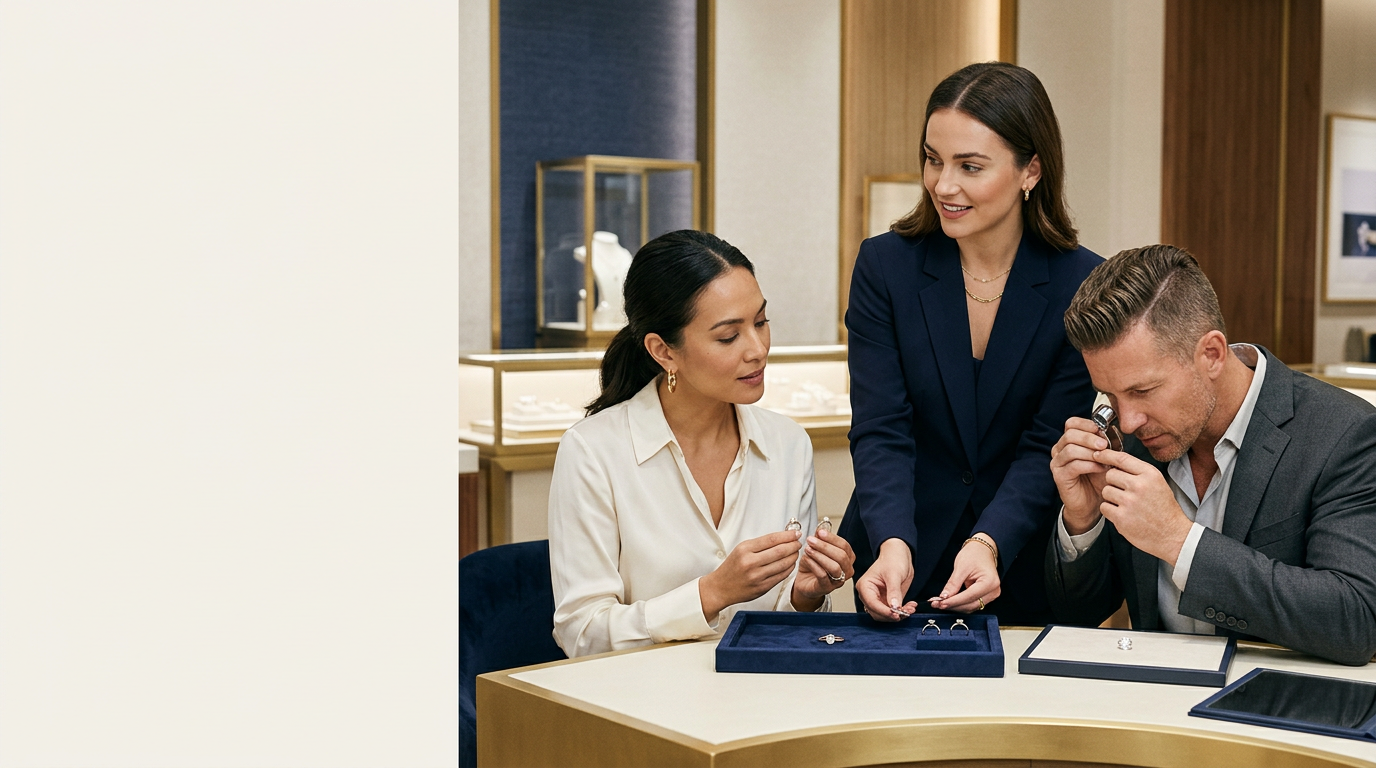
The fatal consultative error is unbalanced engagement. Focusing solely on the wearer treats the paying partner like an automated cash machine. Focusing solely on the checkbook treats the wearer like a passive observer. Both approaches fracture trust.
Elite advisors practice conscious equilibrium:
– Maintain equal eye contact across both partners throughout the conversation.
– Alternate questions between aesthetic sensation (“How does this band feel between your fingers?”) and structural value (“Let me show both of you how this cut symmetry returns fire under natural light”).
– When one partner speaks, observe the other partner’s subtle reactions.
—
—
2. The Four Couple Archetypes
Recognizing a couple’s dynamic within the opening minutes allows you to adapt your approach naturally:
1. The Collaborative Team
High alignment, relaxed banter, and open budget comfort. They enjoy the process together.
Guidance: Use binary comparisons to prevent analysis paralysis. Keep choices simple and decisive.
2. The Visionary and The Pragmatist
One partner dreams of large carat size; the other is visibly stressed by price points.
Guidance: Separate design discovery from final pricing. Explore smart trade-offs in diamond color, clarity, or origin that deliver the desired visual scale within comfortable boundaries.
3. The Hesitant Shopper
One partner was brought along reluctantly and feels out of place in a fine jewelry salon.
Guidance: Disarm tension immediately with warm hospitality, espresso, and conversation unrelated to jewelry.
4. The Thorough Researchers
Arrive with notes, spreadsheets, and technical questions, testing your gemological knowledge.
Guidance: Acknowledge their preparation. Discuss table percentages, pavilion angles, and alloy durability with candor.
—
—
3. Reading Non-Verbal Cues
In emotional appointments, discomfort is rarely stated aloud. It shows up in body language:
– Crossing arms or leaning back when price is mentioned: Signals budget anxiety. Step back from pricing immediately: “Remember, everything we look at right now is simply to identify the aesthetic blueprint she loves. Once we know the design codes, we calibrate the center stone to fit your comfort zone.”
– Quickly returning a ring to the tray with a polite smile: The wearer dislikes the piece but avoids hurting their partner’s feelings because he suggested it. Remove the emotional burden: “A ring can look striking in the case, but feel completely different on the hand. Let us set this one aside and find something that makes your eyes light up.”
– Checking the partner’s face before answering: The wearer worries about asking for something outside their budget. Address the paying partner warmly: “She values your perspective. Which of these two settings do you feel reflects her everyday style?”
—
—
4. Resolving Disagreements: The Binary Elimination Model
When partners disagree on style, cluttering the tray with six rings deepens the impasse.
Clear the presentation pad completely. Place exactly two rings on the velvet:
“If you were walking out the door wearing one of these two rings today, which one feels more like you?”
Remove the rejected ring immediately and return it to the vitrine. Introduce a new challenger beside the winner. Repeat this sequence until one undisputed favorite remains. By reducing decisions to simple pairwise choices, tension dissolves.
—
—
5. The Wishlist Hand-off: Preserving the Surprise
Even when couples co-shop to define the aesthetic, over eighty percent still want the final proposal to be a romantic surprise. The wearer does not want to know the purchase date, the location, or the final invoice total.
Execute the Wishlist Hand-off Protocol:
1. Document the Design: Record the favored mounting model, finger size, metal purity, and diamond shape openly in front of both partners.
2. Present the Style Card: Give the wearer an unpriced lookbook card or digital summary of her favorite design.
3. Establish Confidentiality: Turn to the purchasing partner with a knowing smile: “Now that we have her exact design blueprint safely in our vault, the proposal timing remains your secret.”
4. Schedule the Private Stone Selection: Arrange a private follow-up with the purchasing partner to evaluate loose diamonds and finalize payment terms.
5. Mask CRM Alerts: Ensure automated order-ready texts or receipts are routed exclusively to the purchaser’s private personal channel.
—
6. Daily Floor Summary
Guiding two buyers toward one ring requires emotional maturity and diplomatic skill.
When you validate the wearer’s aesthetic identity while giving the purchaser total financial security, you turn what could be a stressful negotiation into a cherished memory that cements their loyalty for a lifetime.
—
7. Morning Team Briefing
– Keep 50/50 Eye Contact: Distribute attention equally between the wearer and the purchaser throughout the consultation.
– Watch for Physical Hesitations: If a partner crosses their arms when prices are quoted, pivot back to design discovery.
– Use Pairwise Comparisons: Keep only two rings on the pad during style disagreements until a single winner emerges.
– Never Take Sides: Anchor debates in daily lifestyle and existing wardrobe rather than personal opinions.
– Master the Wishlist Hand-off: Curate the design together, but invite the purchaser back alone to protect proposal secrecy.
—
8. Fact-Check Verification
| Metric / Practice | Industry Benchmark | Retail Execution Rule |
| :— | :— | :— |
| Joint Shopping Share | >75% of bridal couples | Design consultations for two equal decision-makers. |
| Desire for Surprise Proposal | >80% expect surprise timing | Protect proposal timing via private follow-up. |
| Pad Comparison Limit | Exactly 2 rings during conflict | Binary choice sets prevent cognitive overload. |
| Confidential CRM Channels | Dedicated private contact check | Mask automated alerts to prevent spoiled proposals. |
| Conversational Balance | 50% Wearer / 50% Purchaser | Prevents feelings of financial or aesthetic exclusion. |
Module Knowledge Assessment
Comprehensive Knowledge Assessment: Module 7
1. What percentage of modern bridal couples participate in joint shopping before the engagement ring proposal?
a) Less than 10%
b) Approximately 25%
c) More than 70% [CORRECT]
d) Exactly 100%
2. What is the fatal error of focusing exclusively on the ring wearer during a joint couple consultation?
a) The wearer will demand too many free gifts.
b) The purchasing partner feels ignored, disrespected, and treated like an ATM, prompting them to veto the purchase and leave. [CORRECT]
c) The jewelry store will run out of champagne.
d) The engagement ring cannot be legally registered.
3. How should a bridal specialist distribute eye contact and conversation during a joint appointment?
a) 90% to the person holding the credit card.
b) 90% to the bride because it is her ring.
c) Approximately 50/50, alternating between aesthetic sensation and gemological value. [CORRECT]
d) Only look at the display cases to avoid awkwardness.
4. What is the recommended strategy when dealing with the “Dreamer & The Accountant” couple archetype?
a) Tell the accountant partner to be more generous.
b) Separate aesthetic exploration from final pricing, and demonstrate smart trade-offs or lab-grown options that deliver the dream look within budget. [CORRECT]
c) Refuse to show any rings over $1,000.
d) Advise them to postpone getting married.
5. What does it typically mean when a purchasing partner leans back, crosses their arms, and stops speaking after a price is quoted?
a) They are ready to pay immediately.
b) They are experiencing severe budget anxiety and feel cornered by sales pressure. [CORRECT]
c) They fell asleep.
d) They want to look at more expensive diamonds.
6. How does the “Elimination Bracket” technique prevent decision paralysis at the sales counter?
a) It removes all rings from the store except the most expensive one.
b) It presents only two rings on the pad at a time, forcing simple binary choices until one clear favorite emerges. [CORRECT]
c) It requires the couple to take a written exam.
d) It limits the appointment to exactly three minutes.
7. When a couple disagrees on metal color (e.g., yellow gold versus platinum), how should the consultant respond?
a) Strongly agree with the bride because she wears it.
b) Anchor the decision objectively by examining the wearer’s daily jewelry wardrobe and skin-tone harmony without taking personal sides. [CORRECT]
c) Flip a coin on the counter.
d) Advise them to buy two rings.
8. What is the core objective of the “Wishlist Hand-off Protocol”?
a) To trick the couple into buying insurance.
b) To openly curate and document the wearer’s dream ring blueprint, while reserving the final stone purchase and budget details for a private solo consultation to preserve proposal surprise. [CORRECT]
c) To post their ring details on social media immediately.
d) To ship the ring to their home without an invoice.
9. Why is it vital to verify and mask communication channels in the CRM after a joint bridal consultation?
a) To prevent automated marketing SMS or order-ready emails from accidentally spoiling the surprise proposal. [CORRECT]
b) Because jewelry stores are not allowed to send text messages.
c) To prevent other sales associates from seeing the commission.
d) Because the couple’s phone numbers change after engagement.
10. If the wearer quickly removes a ring and returns it to the velvet tray with a polite smile, what should the consultant do?
a) Insist that she keep wearing it for another ten minutes.
b) Diplomatically remove the ring: “It’s amazing how rings look different on the hand than in the case; let’s find something that makes your eyes light up.” [CORRECT]
c) Ask the purchaser why he picked such an ugly ring.
d) Immediately lower the price by 50%.