THE FIRST 90 SECONDS: OPENERS THAT START CONVERSATIONS
Elite opening protocols and non-verbal positioning designed to disarm retail defense reflexes and establish consultative authority.
The Four Words That End a Sale Before It Starts
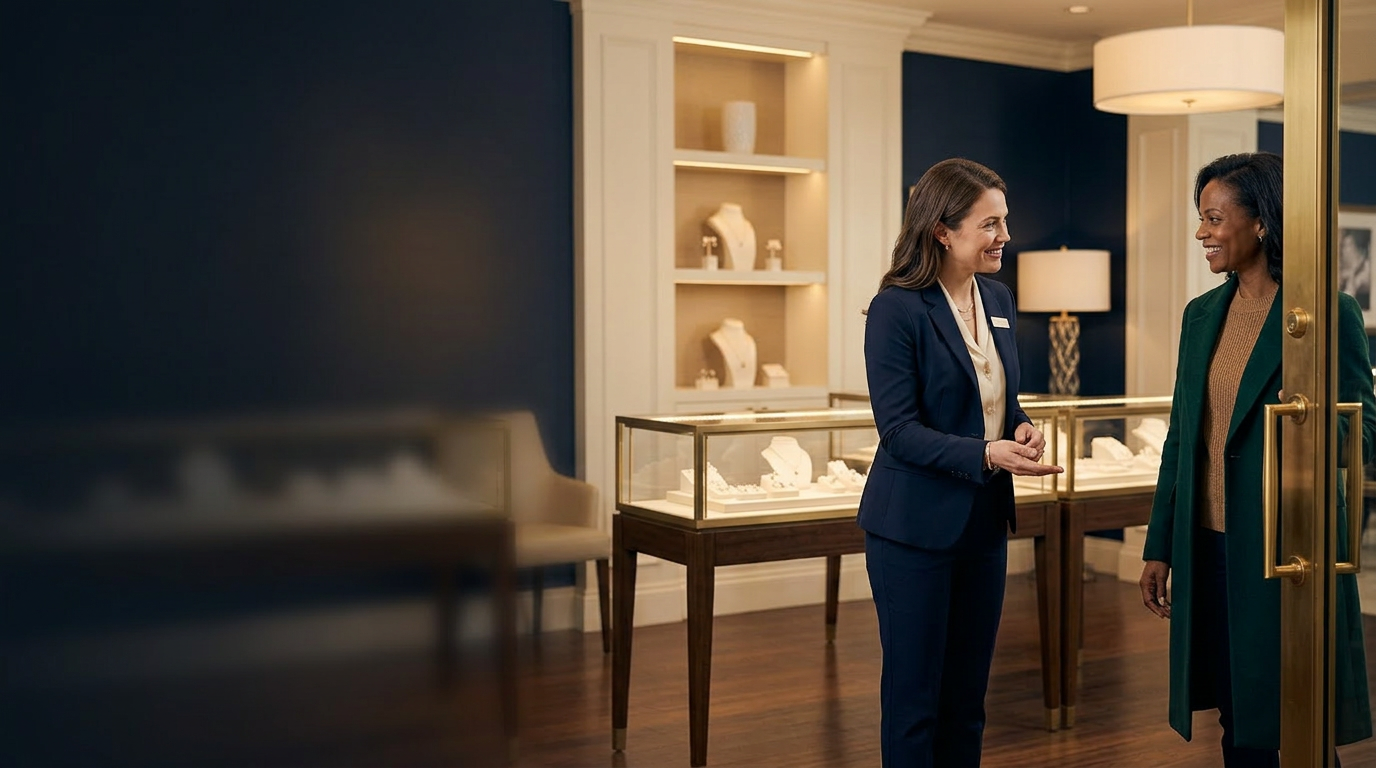
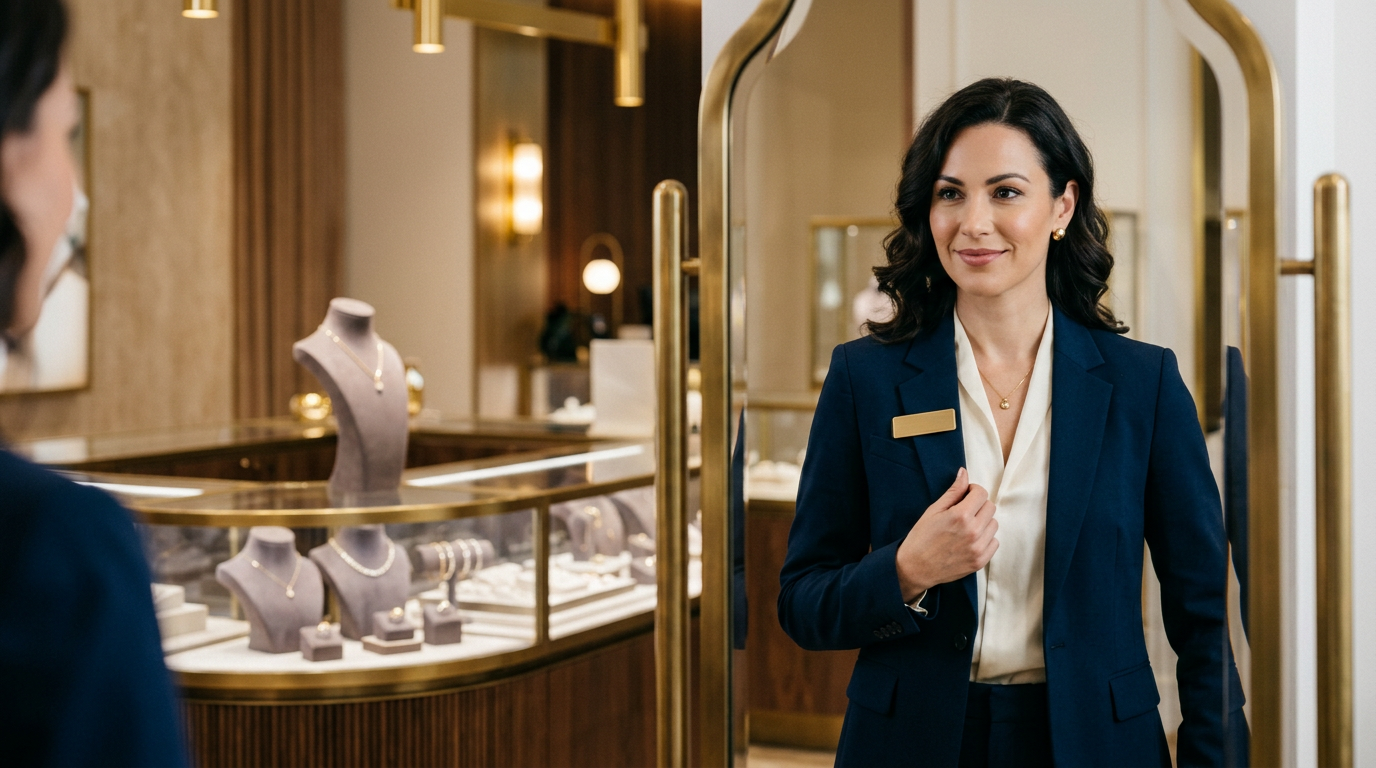
A client steps across your threshold. The brass chime fades. She pauses near the vitrine displaying cushion-cut solitaire engagement rings, eyes scanning the velvet pads, fingers lightly gripping her handbag. You step forward, smile warmly, and deliver the greeting drilled into thousands of retail workers worldwide:
“Can I help you find anything?”
Without looking up, she replies instantly: “No thanks, just looking.”
You nod politely, say “Let me know if you need anything,” and drift back to the point-of-sale terminal. Eleven minutes later, after wandering around the perimeter cases in silence, she walks out the front door. Not a single additional word was exchanged.
Nothing in that exchange was rude or unprofessional. Yet it represents the single most common failure point on the luxury sales floor.
The phrase “Can I help you?” is a closed-ended reflex that triggers an immediate, defensive reflex. Renowned marketing author Seth Godin called it “almost a useless thing to say” in retail environments, and luxury sales trainers have spent decades attempting to eradicate it. It fails because it presents an emotional and cognitive ultimatum: to say “yes” means admitting to a salesperson that you need assistance, inviting immediate sales pressure before you have even acclimated to the room. To say “no” requires zero cognitive effort, protects personal space, and swiftly closes the door on the interaction.
Fine jewelry is rarely bought out of mechanical “need.” It is acquired to mark love, celebrate milestone achievements, signal taste, or safeguard generational sentiment. When you open with a transactional clerk’s greeting, you downgrade an emotionally significant occasion into an errand.
This module provides a tactical alternative: greetings that respect luxury floor psychology, survive the instinctive “just looking” reaction, and convert the critical first ninety seconds into an authentic client relationship.
—
Why the First Ninety Seconds Drive High-Ticket Metrics
Retail jewelers evaluate sales associates on three fundamental performance indicators:
1. Conversion Rate: The percentage of walking store traffic that completes a purchase.
2. Average Ticket Value (ATV): The total dollar amount divided by the number of transactions.
3. Units Per Transaction (UPT): The ability to attach complementary items, care plans, or additional gifts.
Every one of these metrics is determined by whether an associate establishes conversational permission within the first minute and a half. If a client puts up an emotional shield during the initial approach, they remain an anonymous browser. If you dismantle that shield with warmth and observational intelligence, they become a collaborative partner in a discovery process.
The Mouwatt Study: Measurable Impact of Opening Strategy
The difference in wording is not merely aesthetic, it is mathematically measurable. In a retail sales study highlighted by sales trainer Leonard Mouwatt in JCK Magazine (“Approach With Care: Getting Help for ‘May I Help You?'”), greeting retail shoppers with:
“Have you been here before?”
generated an approximate 16 percent increase in gross retail sales compared to opening with “Can I help you?”
The psychological mechanism behind this uplift is twofold:
– For the returning client: It triggers feelings of recognition, status, and community. It acknowledges their history with the house.
– For the first-time visitor: It prompts them to describe their relationship to the store (“No, I’ve driven past for years, but I’m finally looking for an anniversary gift”), immediately revealing purchase intent without feeling interrogated.
INSTORE Magazine, the premier publication for American independent fine jewelers, lists eliminating stale opening questions among its foundational “100 Things Every Jewelry Salesperson Should Know.” Phrases such as “Can I help you find anything?” and “Anything in particular you’re looking for?” are explicitly categorized as conversation killers that surrender control of the floor.
—
The Luxury Decompression Zone: The First Ten Seconds
Before speaking a single syllable, understand the physical and neurological transition a client undergoes when entering a fine jewelry boutique.
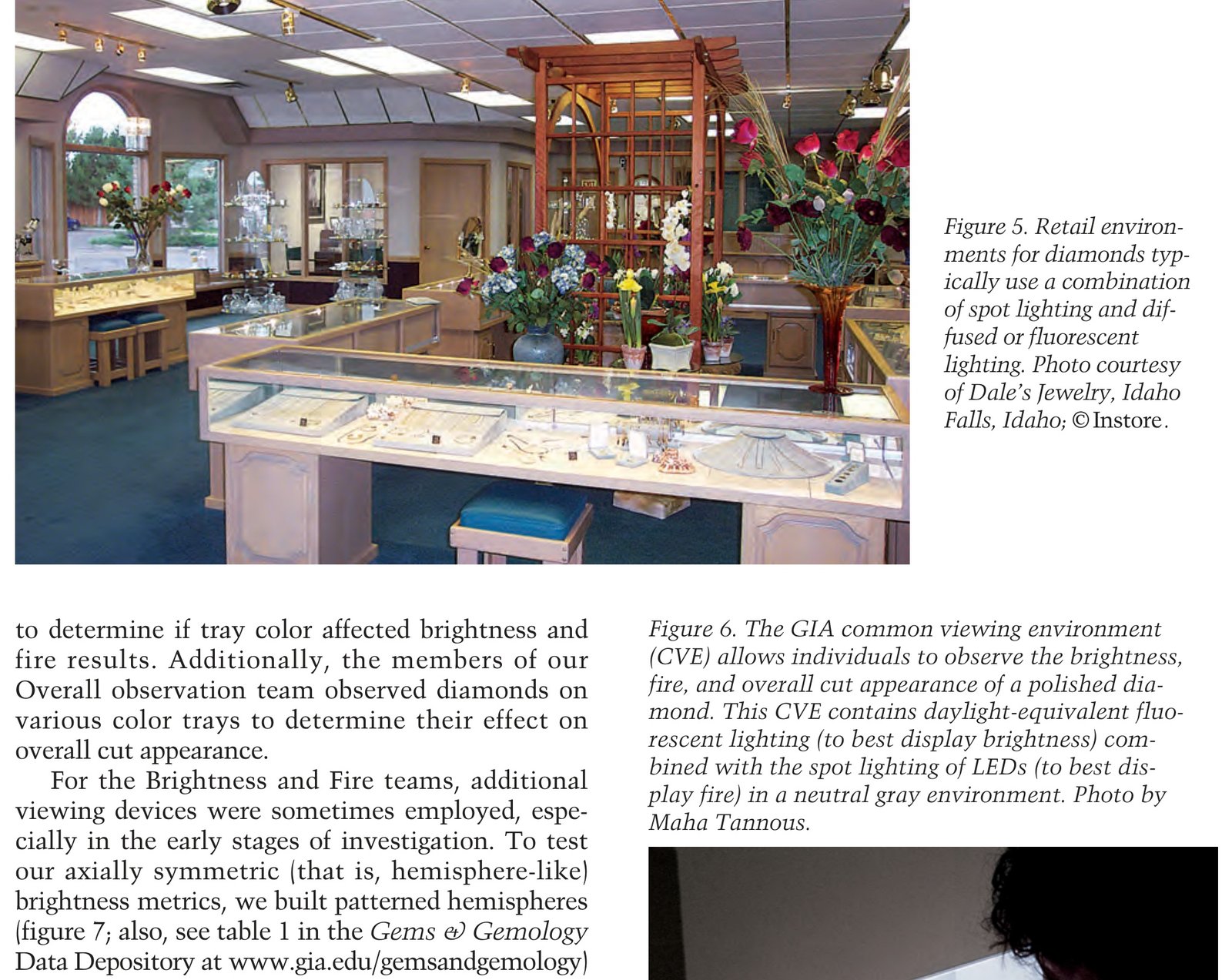
In retail architectural psychology, the area immediately inside the entrance is known as the Decompression Zone (typically the first 10 to 15 feet). When a client enters from a bustling street or an indoor shopping concourse, their sensory system is recalibrating:
– Pupillary adjustment: Shifting from outdoor daylight to intimate 3500K–4000K showcase halogen or high-CRI LED lighting.
– Acoustic adaptation: Moving from traffic noise into ambient showroom music and quiet carpeted acoustics.
– Psychological guard: Fine jewelry stores feature armed guards, buzz-in security doors, and high-value vitrines. A client often feels an innate, subtle intimidation.
If an associate pounces within the first three steps, the client experiences that approach as predatory pressure. They recoil.
The Professional Floor Rhythm
“`
[0–5 Seconds] Visual Welcome: Catch the client’s eye, offer a genuine, unhurried smile, and nod.
[5–15 Seconds] Sensory Decompression: Allow them to cross the threshold, orient their posture, and step toward a display.
[15–30 Seconds] The Angled Approach: Walk forward at a 45-degree angle (never head-on) with open hands.
“`
By acknowledging the client visually the moment they enter, you satisfy basic hospitality and security protocol (confirming to potential bad actors that they have been seen). By withholding verbal approach for ten to twenty seconds, you allow the client to breathe, lower their defenses, and choose a focal point.
—
The 45-Degree Stance and Floor Posture
How you stand communicates far more than what you say.
In traditional retail, associates frequently stand pinned behind a high display counter, creating a physical barrier between themselves and the buyer. Alternatively, inexperienced associates often approach a browser head-on, squaring their shoulders like an interrogator.
The Luxury Protocol
1. Approach from the side: Step up adjacent to the showcase at a 45-degree angle. This aligns your gaze with theirs, positioning you as a fellow observer admiring the jewelry rather than an adversary across a counter.
2. Hands visible and relaxed: Rest hands lightly at waist level or hold a clean micro-fiber gem cloth. Never fold your arms across your chest or plunge hands into suit pockets.
3. Respect physical proxemics: Maintain an arm’s-length distance (approximately 3 to 4 feet). Do not crowd the vitrine glass.
—
Category 1: Statement Openers (The Zero-Friction Move)
One of the most effective techniques taught by elite luxury sales coaches is the Statement Opener.
A statement is powerful because it is impossible to answer with “no.” It bypasses the client’s reflexive defense filter because it does not ask for anything, it simply makes an insightful, complimentary observation.
Statement Openers in Practice
Scenario A: Browsing the Bridal Vitrine
Client is leaning over a case featuring platinum round brilliant solitaires.
Associate (stepping up gently at a 45-degree angle): “There must be a serious celebration on the horizon.”*
Client: “Ha, yeah… we’ve been talking about it for two years. I think it’s finally time.”*
Associate: “Congratulations! That is such an incredible chapter. Tell me, has she given you any hints on shapes, or are you starting with a completely blank canvas?”*
Scenario B: Admiring a Colored Gemstone Piece
Client is studying an intense blue Ceylon sapphire cocktail ring.
Associate: “That royal blue is impossible to ignore. Sapphire cut with that kind of brilliance doesn’t stay in the salon long.”*
Client: “It’s stunning. I rarely see this shade of blue.”*
Associate: “It has remarkable life under this light. I’m Elena, by the way. Please, let me pull the tray so you can see how that stone responds against skin.”*
Notice the psychological progression: the associate makes a tasteful observation, validates the client’s aesthetic instinct, and smoothly introduces themselves by name before transitioning to hands-on exploration.
—
Category 2: Low-Stakes Conversational Openers
If you choose to open with a question, ensure it is open-ended, conversational, and detached from an immediate financial transaction.
The goal of the first ninety seconds is not to extract a budget; it is to establish human rapport and gauge the client’s mood, conversational tempo, and receptivity.
| Strategy | Script Example | Psychological Purpose |
|—|—|—|
| Environmental / Situational | “Welcome in! Did you manage to dodge the afternoon rain out there?” | Breaks the ice with universal small talk; completely neutral and safe. |
| Personal / Unhurried | “Welcome to our salon! What fun plans do you have going on with the rest of your afternoon?” | Invites lifestyle context without sounding nosy. |
| Store Familiarity (Mouwatt Script) | “Good afternoon! Is this your first visit with us, or have you been in before?” | Proven ~16% sales uplift; immediately separates brand devotees from new walk-ins. |
| Curated Curation | “Welcome in! Feel free to explore, we just received three new estate pieces in that rear case this morning that are breathtaking.” | Directs curiosity toward fresh inventory while explicitly giving permission to browse freely. |
Crucial rule: These questions only work when delivered with authentic presence. If recited mechanically like an airport boarding announcement, clients detect the manipulation instantly.
—
Introducing Yourself: The Power of the First Name
Elite client advisors establish identity early. Within the first two sentences of genuine conversation, give your name:
“I’m Marcus, by the way. Welcome to our salon.”
Why does this matter so fundamentally?
1. Dismantles Anonymity: An anonymous retail clerk is easy to dismiss; a named host demands social consideration and mutual respect.
2. Paves the Path for Long-Term Clienteling: As detailed in Course C3, lifetime luxury jewelry value is built on repeat personal clientele. A customer cannot ask for you on their next visit if they never learned your name.
3. Prompts the Reciprocal Name Exchange: When you offer your name with warmth and zero pressure, over 80 percent of clients will instinctively respond with their own: “Nice to meet you, Marcus. I’m David.” Once you have the client’s name, you can personalize the entire rest of the appointment.
—
The Phrase to Ban Forever: “How Are You Today?”
Alongside “Can I help you?”, there is another reflexive phrase that luxury sales associates must eliminate from their vocabulary:
❌ “Hi, how are you today?”
Why is this phrase harmful?
– It is meaningless autopilot: It is uttered millions of times a day at gas stations, drive-thrus, and supermarket checkout aisles. It signals zero genuine interest.
– It generates a dead-end answer: 99% of people respond with an automatic “Good, how are you?” or “Fine.” It adds zero momentum to the conversation.
– It feels like hollow sales cheer: In high-end luxury, calm authenticity and quiet professionalism always outperform manufactured corporate enthusiasm.
Replace “How are you today?” with a specific observation about the day, the weather, their arrival, or a warm, sincere “Welcome in.”
—

Mastering the “I’m Just Looking” Brush-Off
Regardless of how gracefully you execute your initial approach, you will inevitably encounter the standard retail reflex:
Client: “Thanks, I’m just looking.”
Most novice associates interpret this as a rejection. They say “Okay, let me know if you need anything,” and retreat behind the counter. That is a fatal error.
“I’m just looking” is not an ejection; it is a defense reflex. The client is simply establishing boundaries and confirming that they are not about to be subjected to high-pressure closing tactics.
The 3-Step “Just Looking” Recovery Framework
“`
[Step 1: Validate] Agree with them completely. Remove all conversational resistance.
[Step 2: Liberate] Explicitly encourage them to browse and examine the collection.
[Step 3: Pivot Open-Ended] Ask a light, intriguing question that requires a narrative answer.
“`
The Verbatim Scripts
Script A (The INSTORE Classic):
Associate: “That’s wonderful! That’s exactly what these showcases are for. Please, take all the time you like. What caught your eye first when you walked in today?”
Script B (The Curiosity Bridge):
Associate: “Of course, take your time! We have hundreds of one-of-a-kind designs out today. Are you looking for inspiration for a special milestone, or just indulging a love for beautiful jewelry?”
Script C (The Casual Hand-Off):
Associate: “Absolutely, enjoy the cases! My name is Sarah. I’ll be right here polishing these platinum pieces. If you’d like to try anything on your hand to see how it feels, just wave me over.”
Notice what happens in Script C: you honor their independence, establish your identity, anchor your presence nearby with productive work, and plant the suggestion of trying a piece on. You remain supportive and approachable without hovering over their shoulder.
—
The Complimentary Cleaning Ritual: A High-Value Bridge
In the fine jewelry industry, an associate holds an extraordinary conversational advantage that electronics or apparel salespeople do not have: clients frequently walk through the door already wearing the product category.
If a client is wearing fine jewelry, especially a diamond engagement ring, a wedding band, or a gemstone pendant, offering a complimentary inspection and professional cleaning is the ultimate relationship accelerator.
The Tactical Mechanics
1. Notice with sincere admiration: Observe what they are wearing. Do not comment on tarnish or dirt; praise the design or setting.
2. Offer the service as hospitality:
> “That emerald-cut solitaire on your hand is absolutely gorgeous. Would you like me to drop that into our ultrasonic and give it a fresh steam while you browse? It takes about three minutes, and it will sparkle like the day it was mounted.”
3. The Psychological Payoff:
– Removes the physical barrier: The client entrusts you with their most cherished personal possession. This creates an immediate bond of trust.
– Extends showroom dwell time: While the ring is in the back room or under the steamer, the client remains comfortably in your store for an extra five to ten minutes without feeling rushed.
– Natural loupe inspection: When you return the ring, you present it on a clean velvet pad with tweezers and hand them a 10x loupe. You can point out the pristine condition of their prongs or gently note if a prong requires tightening, establishing your technical authority as a trusted gemological advisor.
Ethical caveat: This must be delivered as genuine hospitality, not as a predatory pretext to manufacture repair invoices or trap the client into a forced presentation.
—
The Script Trap: Why Rehearsed Autopilot Fails
Shane Decker, one of the most respected sales performance coaches in the global jewelry trade, frequently cautions associates against relying on a single favorite line:
“If you use the same opening line all the time, it becomes an unconscious habit. You stop listening, you stop observing, and your clients can smell the routine ten feet away.”
Luxury consumers possess finely tuned antennae for scripted insincerity. When an associate treats every visitor like a generic entry in a sales script, the relationship is dead on arrival.
To develop professional mastery, build an adaptable repertoire of openers based on four contextual cues:
“`
+– Client Demographics & Composition (Solo, Couple, Parent/Child)
+– Physical Body Language (Rushed, Contemplative, Hesitant)
CONTEXTUAL OBSERVATIONS –+– Showcase Destination (Bridal, Fashion, Colored Gems, Swiss Watches)
+– External Variables (Rainy afternoon, Friday evening, Lunch hour)
“`
By calibrating your opener to the specific person in front of you, you project the hallmark of true luxury: bespoke attentiveness.
—
Summary Matrix: Opener Playbook
| Client Behavior | Common Mistake (Avoid) | Professional Opener (Recommended) | Next Conversational Move |
|—|—|—|—|
| Paces quickly straight to the bridal case | “Can I help you find an engagement ring?” | “There must be an exciting proposal in the works.” | Ask about her personal aesthetic and lifestyle. |
| Wanders slowly along fashion cases | “Looking for anything special today?” | “Welcome in! Take all the time you’d like. What caught your eye first?” | Highlight a newly arrived one-of-a-kind piece. |
| Accompanied by a friend or partner | Talking only to the person closest to the case | Acknowledge both: “Welcome in! What brings you two downtown this afternoon?” | Involve both in the narrative and discovery. |
| Arms crossed, defensive posture | Approaching immediately head-on | Give 20 seconds decompression. Approach at 45°: “Welcome to our salon. Feel free to browse, I’m David if you’d like to see anything on.” | Step back to a nearby case to give breathing room. |
| Wearing worn or dull diamond jewelry | Ignoring their existing jewelry | “That halo setting is stunning. Let me give that a quick ultrasonic bath while you look around.” | Inspect prongs under loupe; present on velvet pad. |
| States firmly: “I’m just looking” | “Okay, let me know if you need help.” | “I love that! Take your time. What brought you in today, exploring for gifts or treating yourself?” | Transition smoothly to open-ended lifestyle discovery. |
—
7-Day Floor Implementation Plan
To turn these principles into permanent counter habits, complete this sequential weekly drill:
Day 1 (The Habit Purge): Ban “Can I help you?” and “How are you today?”* from your speech entirely. Keep a tally sheet at your station. Every time you catch yourself about to say either, pause, smile, and reset.
* Day 2 (Mastering the Decompression Window): Count to fifteen mentally when a client enters before taking your first step. Practice acknowledging them with eye contact and a warm smile at the door without speaking until they reach a case.
* Day 3 (The 45-Degree Stance): Focus on your physical geometry. Approach every client from the side at an angle. Observe how much more relaxed their shoulders appear compared to a frontal approach.
Day 4 (The Statement Opener Drill): Deliver at least five statement-based openers (“There must be a celebration coming up” or “That sapphire has unbelievable saturation”*) to real clients. Record how many lead directly into a multi-sentence dialogue.
* Day 5 (The “Just Looking” Recovery): When a client says they are just looking, execute the Validate-Liberate-Pivot sequence without hesitating or retreating.
* Day 6 (The Cleaning Hospitality Ritual): Offer complimentary jewelry cleaning to at least three clients wearing rings or pendants. Time how much natural dwell time this creates in your showroom.
* Day 7 (Weekly Review & Self-Audit): Review your conversion rate and customer feedback with your sales manager or mentor. Identify which two openers felt most authentic in your personal voice.
—
Objections, Mistakes and Floor Edge Cases
Edge Case 1: The Client Who Refuses to Speak
* The Situation: You deliver a warm, low-pressure opener, and the client gives a curt head nod or says nothing at all.
* The Mistake: Repeating the line louder, asking another question, or hovering awkwardly.
The Professional Move: Smile, say “Enjoy browsing,”* and step five feet away to organize a case or polish a tray. Remain within sightlines with open, available body language. Often, an introverted client needs three minutes of silence before initiating conversation on their own terms.
Edge Case 2: Simultaneous Walk-Ins
* The Situation: Two separate parties enter the showroom within ten seconds of each other, and you are the only associate currently on the floor.
* The Mistake: Giving 100% of your focus to Party A while completely ignoring Party B.
The Professional Move: Give Party A a warm welcome: “Welcome in, I’ll be with you in just a moment.” Turn immediately to Party B, make eye contact, smile, and say: “Welcome in! Please make yourselves comfortable, I’ll be right with you both.”* Verifying that both parties have been seen maintains security and prevents walk-outs.
Edge Case 3: The Client Who Directly Asks for a Discount in the First 30 Seconds
The Situation: A client walks up to a showcase, points at an item, and asks: “What’s your bottom-dollar cash price on this?”*
* The Mistake: Quoting a discount immediately or acting defensive.
The Professional Move: Smile calmly, unlock the case, and transition to value: “We take extraordinary care with our pricing, but before we talk numbers, let’s make sure this is actually the piece you love. Let’s get it in your hands.” (Explored in depth in Module 5: Price Objections Without Discounting*).
—
Module Self-Check
Test your command of the first ninety seconds before moving to Module 2:
1. Why does the question “Can I help you?” trigger a defensive reflex in over 70% of retail consumers?
2. What specific sales uplift was documented by Leonard Mouwatt in JCK Magazine when associates asked “Have you been here before?” instead of standard clerk greetings?
3. What is the Decompression Zone, and why is approaching a client within the first five feet of the door counter-productive?
4. What physical angle should an associate adopt when stepping up to a showcase alongside a client, and why does this reduce conversational friction?
5. Formulate two original examples of Statement Openers that cannot be answered with the word “no.”
6. Why should you introduce yourself by your first name within the first exchange of an interaction?
7. Explain the three steps of the Validate-Liberate-Pivot framework used to handle “I’m just looking.”
8. Why does offering a complimentary ring cleaning generate substantial dwell time and psychological trust?
9. Why does sales trainer Shane Decker warn against relying on a single, standardized greeting script?
10. What is the appropriate protocol when two distinct clients walk through the doors at the exact same moment?
—
Milestone Achieved
You Have Mastered the First 90 Seconds!
You now command the 45-degree welcoming stance, zero-friction statement openers, and the complimentary cleaning bridge. Put these into practice on your next floor shift.
Authoritative References & Further Reading
– Leonard Mouwatt / JCK Magazine: “Approach With Care: Getting Help for ‘May I Help You?'” (February 2016). Primary source for greeting psychology, the 16% sales uplift data, and luxury floor etiquette.
– INSTORE Magazine: “100 Things Every Jewelry Salesperson Should Know.” Foundational guidance on eliminating closed-ended questions and navigating the “just looking” objection.
– Shane Decker: “This I Know: Sales Floor Discipline & Client Habits.” Key concepts on avoiding automated scripts and cultivating authentic presence.
– Seth Godin: Research and lectures on retail consumer psychology and permission-based marketing.
– National Retail Federation (NRF) / Luxury Institute: Customer journey and showroom dwell-time benchmarks for fine jewelry and hard luxury retail.
—
Media Credits & External Links
– [Approach With Care: Getting Help for ‘May I Help You?’: JCK Magazine](https://www.jckonline.com/magazine-article/approach-with-care-getting-help-for-may-i-help-you/)
– [100 Things Every Jewelry Salesperson Should Know: INSTORE Magazine](https://instoremag.com/100-things-every-jewelry-salesperson-should-know/)
– [Shane Decker: This I Know: INSTORE Magazine](https://instoremag.com/shane-decker-this-i-know/)
– [The Jewelers Playbook: Video Training on Luxury Floor Technique](https://www.youtube.com/@TheJewelersPlaybook)