Buying Signals and When to Stop Talking

The Fatal Floor Error: Talking Past the Close
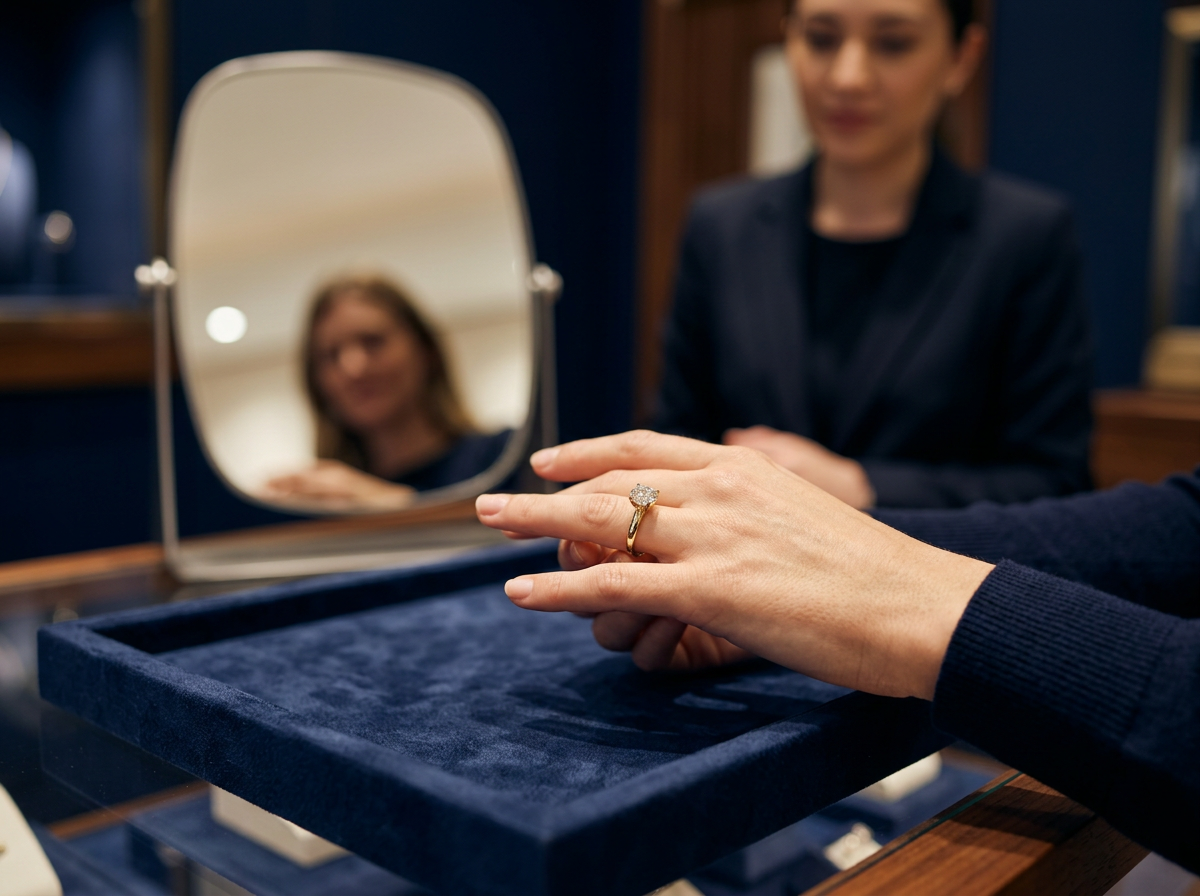
A couple is seated at the private bridal counter. The fiancée has just slipped a 1.80-carat oval diamond solitaire onto her finger. She turns her hand slowly under the focused halogen spot. Her breathing deepens. She looks into the mirror, smiles softly, and whispers to her partner:
“Oh, honey… it’s perfect. It fits like it was made for me.”
The partner looks at her with clear affection, reaches out to touch the platinum band, and looks up at the sales associate with relaxed shoulders. The sale has been won. The emotional decision is complete. All that remains is to confirm the ring size, invite them to celebrate, and begin the paperwork.
Instead, the sales associate, fueled by nervous adrenaline and eager to prove his gemological expertise, leans forward and announces:
“And keep in mind, that diamond has a medium blue fluorescence under long-wave ultraviolet light! A lot of people online will tell you that fluorescence is a bad thing, but in an I-color stone like this, it actually can make the diamond appear up to one color grade whiter in natural daylight, although in rare cases with very strong fluorescence it can cause an oily or hazy look, but this one definitely isn’t hazy at all!”
The fiancée freezes. Her smile vanishes. She slowly slides the ring off her finger and sets it on the velvet pad.
“Wait… what did you say about an oily look? Does this stone have a defect?”
The partner crosses his arms and leans back. “You know what? Let’s not rush. We should think about this and do some more research.”
Twenty minutes later, they leave the boutique empty-handed.
This is the catastrophic tragedy known across the luxury trade as Talking Past the Close.
Nervous, untrained associates suffer from horror vacui, the fear of empty conversational space. They believe that if there is silence on the sales floor, they are failing. In reality, relentless talking is a sign of profound insecurity. When a client is ready to buy, additional sales chatter does not add value; it introduces friction, manufactures doubts, and destroys certainty.
Selling fine jewelry is not an act of verbal persuasion. It is the art of knowing when to stop talking and allow the client to buy.
—
The Psychology of the Buying Signal
A Buying Signal is an unconscious verbal or physical cue indicating that a client has crossed the psychological threshold from evaluation to ownership.
In high-ticket luxury, customers rarely blurt out: “I am ready to make a purchase right now.” That feels too vulnerable. Instead, their subconscious mind leaks their buying intent through micro-expressions, posture shifts, logistical questions, and possessive linguistic changes.
“`
EVALUATION MINDSET OWNERSHIP MINDSET
“Is this a good diamond?” —–> “How long would sizing take?”
Client is analyzing specs. Client is mentally wearing it home.
Distance, scrutiny, arms tense. Relaxed breath, mirror gaze, stroke of the metal.
“`
Your job on the sales floor is to act as an attentive observer. The instant you spot a buying signal, your presentation is over. You immediately pivot from educator to facilitator.
—
The 18 Diagnostic Buying Signals of Hard Luxury

To ensure you never miss the moment of decision, monitor these 18 observable cues across three distinct categories:
—
Category A: Physical & Non-Verbal Signals (The Body Language of Ownership)
1. The Prolonged Mirror Gaze: The client stops looking down at their hand and stares into the wall or counter mirror for more than three continuous seconds, admiring their overall reflection.
2. The Ambient Light Walk: The client turns away from the intense showcase spotlights and moves their hand into ambient room light to see how the stone performs in real life.
3. The Sensual Stroke: The client strokes the shank, bezel, or diamond with the thumb of the same hand. This tactile stroking indicates deep emotional bonding.
4. The Shoulder Drop: A visible physical exhalation. The tension drains from the client’s shoulders and neck; their body language becomes loose and relaxed.
5. The Protective Clench: When you reach toward the velvet pad to demonstrate another piece, the client instinctively curls their fingers inward or pulls their hand back to prevent you from taking it.
6. Pupillary Dilation: In response to genuine aesthetic pleasure, the client’s pupils noticeably dilate (the “sparkle in their eye”).
7. The Intimate Lean: Both partners lean in toward each other over the counter, closing physical distance and excluding the rest of the showroom.
—
Category B: Verbal & Logistical Signals (The Practical Mindset)
8. The Timeline Inquiry: “If we decided on this today, how long would it take to size it to her finger?”
9. The Durability / Daily Care Question: “Can I wear this in the shower, or do I need to take it off at the gym?”
10. The Presentation Packaging Question: “Does this come in that signature wooden box with the ribbon?”
11. The Companion Validation Query: “Honey, what do you think? Doesn’t this look unbelievable on my hand?”
12. The Maintenance / Warranty Inquiry: “What kind of warranty or service plan comes with your rings?”
13. The Payment Logistics Question: “Do you take split payments between two cards?” or “Do you offer twelve-month financing?”
—
Category C: Linguistic Signals (The Possessive Pronoun Shift)
The most definitive verbal marker in luxury sales is the Possessive Pronoun Shift.
When clients begin evaluating an item, they use distant, objective articles:
– “What does that ring cost?”
– “Is the diamond an F color?”
– “How wide is this band?”
The moment they mentally adopt the piece, their language shifts to first-person possessive pronouns:
– “Would my wedding band sit flush against it?”
– “Will our jeweler be able to engrave the date inside?”
– “How will this look with my tennis bracelet?”
| Objective Evaluation (Keep Presenting) | Possessive Ownership (Stop Talking & Close) |
|—|—|
| “What is the clarity on that diamond?” | “Will anyone be able to see that inclusion when I’m wearing it?” |
| “Is platinum heavier than white gold?” | “I love how substantial this feels on my finger.” |
| “Do people wear these every day?” | “I could wear this every single day with everything in my closet.” |
—
The Sacred Silence Discipline
The single most difficult skill for a retail salesperson to master is silence.
When you ask a closing question or present a breathtaking piece, a psychological tension fills the air. Amateurs rush to break this tension with more words, discounts, or specifications. Master client advisors welcome this tension, because they understand that silence is where the client makes up their mind.
“`
[ THE PRESENTATION APEX ] –> Associate delivers the core emotional value statement.
▼
[ THE PHYSICAL RETREAT ] –> Associate steps back 18 inches, hands relaxed at waist.
▼
[ THE 5-SECOND PAUSE ] –> Absolute silence. Do not speak until the client speaks.
“`
The Rules of Strategic Silence
1. The Mirror Silence Rule: When a client looks in the mirror with a piece on, do not speak. Let them absorb their reflection. Any words you utter during this moment shatter their personal reverie.
2. The Price Drop Rule: When you quote the price of a high-ticket item, state the number clearly and stop speaking.
– Amateur: “That piece is $14,500… but we can look at financing, or I can talk to my manager about a discount, or we have a smaller one for $9,000…” (Projects weakness, desperation, and lack of confidence in value).
– Master: “That piece is fourteen thousand five hundred.” (Silence. Calm, unblinking eye contact with a gentle smile).
3. The “First to Speak” Law: After asking a closing question or stating an investment level, the person who speaks first determines the direction of the transaction. If you speak first, you surrender conversational power. If the client speaks first, they reveal their real thoughts.
—
The Physical Retreat: Giving the Client Space to Buy
When high-ticket clients feel crowded, their fight-or-flight instincts activate.
If you are leaning across the counter, hovering over their shoulder, or staring intensely at their hands, they feel like prey. They will manufacture an excuse (“We need to grab lunch and think about it”) simply to escape the physical pressure.
The 2-Foot Step-Back Protocol
The moment you observe a major buying signal:
1. Step back two feet from the consultation counter.
2. Lower your hands to waist level or rest them lightly on a presentation cloth.
3. Avert direct eye contact temporarily by glancing down at your paperwork or giving the couple visual privacy.
This subtle physical retreat communicates: “You are under no pressure. You have complete control of this room.” Paradoxically, by stepping back physically, you pull the client toward the purchase emotionally.
—
How to Acknowledge a Buying Signal Without Pressure
When a buying signal occurs, do not shout “Great! Let’s ring it up!”
Instead, use a Graceful Transition Bridge that honors their cue and smoothly moves toward logistics:
—
Scenario A: The Client Asks a Care Question
Client: “Can I wear this sapphire ring in the pool or while exercising?”
>
The Wrong Move: Launching into a twenty-minute lecture on Mohs hardness and chlorine chemical erosion.
>
The Master Bridge: “Corundum is an extraordinarily durable gemstone, second only to diamond, so it handles everyday life beautifully, though we always recommend slipping it off before swimming or weights to protect the prongs. It sounds like you are already imagining wearing this as your signature everyday piece. Shall we check your exact ring size so our master jeweler can prepare it for you?”
—
Scenario B: The Client Strokes the Metal in the Mirror
Client: (Stares into the mirror, strokes the platinum band, sighs happily)
>
The Wrong Move: “And did you know platinum was used by the ancient pre-Columbian Indians?”
>
The Master Bridge: (Pause for 4 seconds of silence. Step forward gently.) “It looks like it was created specifically for you. It belongs on your hand. Why don’t we finalize the documentation and wrap this in our presentation box today?”
—
Scenario C: The Partner Looks for Approval
Client (to partner): “Honey, what do you think? Do you love it?”
>
Partner: “If you love it, I love it. It’s stunning.”
>
The Master Bridge: “That is all the validation anyone could ever ask for. Let’s make this official. Follow me over to the salon desk and I will prepare your certificate and valuation.”
—
Summary Matrix: The Buying Signal Playbook
| Observed Signal | Signal Classification | Fatal Associate Mistake | Master Floor Transition Bridge |
|—|—|—|—|
| “How long does sizing take?” | Verbal / Logistical | Quoting a 2-week delay with apologies | “Our master jeweler can have this custom-sized to perfection by Thursday afternoon. Let’s take your ring measurement right now.” |
| “Can I shower with this?” | Verbal / Practical | Technical lecture on chemical erosion | “It is engineered for everyday life. Sounds like you never want to take it off! Let’s get your sizing recorded.” |
| Prolonged Mirror Gaze (>5 sec) | Non-Verbal / Emotional | Interrupting with more 4Cs specifications | Silence for 5 seconds. Then: “It commands the room on you. Let’s make it yours.” |
| “Would my band sit flush?” | Linguistic / Possessive | Pointing at the showcase case | “Let’s see! Pull your wedding band out and let’s pair them side-by-side on your hand.” |
| Pupillary Dilation / Smile | Physiological / Visceral | Ignoring the reaction; showing stone #4 | Stop showing new pieces immediately. Anchor on this favorite: “Your eyes completely lit up when you put this on.” |
| Couple Leans In Whispering | Social / Alignment | Hovering over them and listening | Step back 3 paces. Give them 30 seconds of privacy, then return with clean documentation. |
—
Floor Edge Cases in Signal Reading
Edge Case 1: The False Positive (The Flirtatious Browser)
– The Situation: A client exhibits high enthusiasm, tries on six pieces, smiles constantly, and makes possessive comments, but is simply enjoying playing dress-up with zero intent to buy.
– The Solution: Test reality with a low-friction logistical question. “If we find the piece you adore today, are you looking to take it home this afternoon, or are we compiling your official wishlist for the holidays?” If they are browsing, they will immediately state: “Oh, I’m just dreaming today!” You have saved forty-five minutes of misdirected closing effort while maintaining a wonderful brand impression.
Edge Case 2: The Poker Face Client
– The Situation: A client shows zero facial expressions, gives one-word answers (“Fine,” “Okay”), and keeps arms folded, yet remains in the salon for twenty minutes.
– The Solution: Do not mistake quietness for disinterest. Introverts process high-ticket decisions internally. Avoid bubbly enthusiasm. Match their quiet demeanor, present with understated elegance, and ask diagnostic questions: “On a scale of one to ten, how close is this to the aesthetic you envisioned?”
Edge Case 3: The Contradictory Buying Signal
– The Situation: The client says “This is way too expensive” while simultaneously refusing to take the ring off their finger and continuing to look at it in the mirror.
– The Solution: Believe their body, not their words. Their words are a logical defense; their body is expressing pure emotional ownership. Do not drop the price immediately. Validate the emotion: “It is a substantial investment, but look at how completely it transforms your hand. Let’s look at how we can make this comfortable through our interest-free private account.”
—
7-Day Floor Implementation Plan
– Day 1 (The Silence Tally): Keep a mental count of every time you interrupt a client’s contemplation. Commit to giving 3 full seconds of silence after every client response.
– Day 2 (Spotting the Pronoun Shift): Listen actively for the words “my,” “our,” and “we” during every presentation. The moment you hear one, stop presenting new features.
– Day 3 (The Mirror Step-Back): When a client steps to the mirror, take two full steps back and fold your hands. Measure how much longer they admire the piece when you do not hover.
– Day 4 (The Price-Drop Freeze): Practice quoting high-ticket prices without adding a single word after the number. Hold comfortable eye contact and smile.
– Day 5 (Testing the False Positive): Use the “Take home today vs. wishlist” bridge on an overly enthusiastic browser to verify genuine intent.
– Day 6 (The Companion Pivot): When an accompanying partner says “It looks great on you,” turn immediately to closing logistics rather than presenting another ring.
– Day 7 (Weekly Close Audit): Analyze any lost sales from the week with your manager. Did you talk past the close on any presentation? Identify the exact signal you missed.
—
Module Self-Check
Test your mastery of buying signals and silence discipline before progressing to Module 5:
1. What is the definition of “Talking Past the Close,” and what psychological consequence does it trigger in a customer?
2. Why is relentless sales chatter considered a sign of salesperson insecurity rather than professionalism?
3. What is the Possessive Pronoun Shift, and why is it one of the most reliable buying signals in luxury retail?
4. List three distinct non-verbal physical buying signals that indicate a client has mentally accepted ownership of a piece.
5. Explain the 5-Second Silence Rule when a client is admiring jewelry in the counter mirror.
6. What is the correct way to quote a high-ticket price, and what fatal mistake must an associate avoid after stating the number?
7. Explain the purpose of the Two-Foot Step-Back Protocol upon spotting a major buying signal.
8. How should an associate respond when a client asks: “Can I wear this in the shower?”
9. How can an associate distinguish between a genuine high-intent buyer and an enthusiastic “flirtatious browser”?
10. If a client verbally objects to the price but refuses to take the ring off their hand, which signal should the associate believe?
—
Authoritative References & Further Reading
– Shane Decker: Buying Signals on the Diamond Counter: How to Stop Selling and Start Writing.
– INSTORE Magazine: The Power of the Pause: Why the Best Salespeople Know When to Shut Up.
– Allan & Barbara Pease: The Definitive Book of Body Language: Non-Verbal Cues in High-Stakes Negotiations.
– Harvard Program on Negotiation (PON): The Strategic Value of Silence in Value Creation and Closing.
– JCK Magazine: Reading the Luxury Customer: Micro-Expressions and Buying Intent.
—
Media Credits & External Links
– [INSTORE Magazine: Floor Sales & Buying Signals](https://instoremag.com/)
– [JCK Online: The High-Ticket Closing Playbook](https://www.jckonline.com/)
– [The Jewelers Playbook: Video Masterclass on Reading Buying Signals](https://www.youtube.com/@TheJewelersPlaybook)